



 Ашық рұқсат
 Рұқсат берілді
 Рұқсат ақылы немесе тек жазылушылар үшін
Том CLIV, № 3 (2025)

ARTICLES
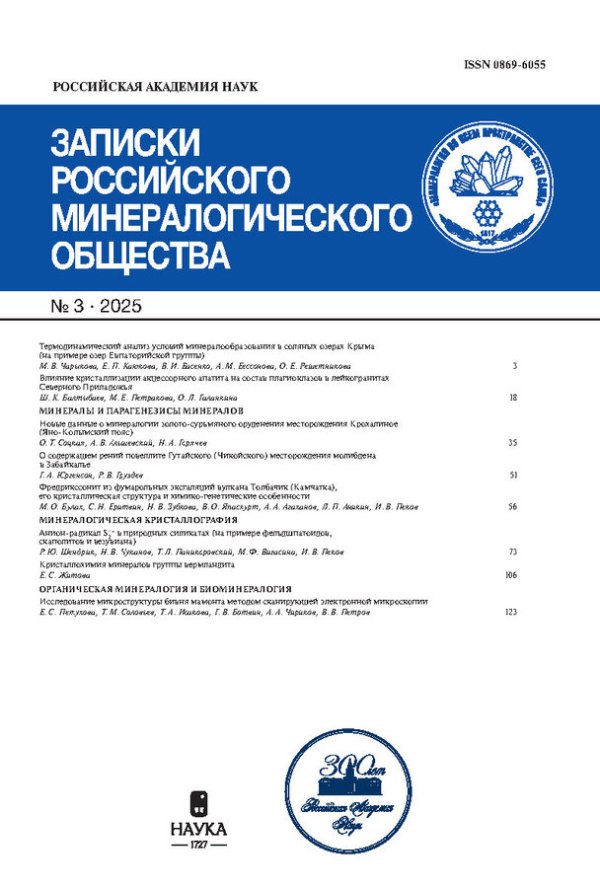
Thermodynamic Analysis of Mineral Formation Conditions in Crimean Salt Lakes (Using the Example of the lakes of the Yevpatoria Group)
Аннотация
Data on the chemical composition of surface and pore brines of 10 salt lakes of the Crimean Peninsula belonging to the Yevpatoria group are presented. Using the method of thermodynamic modeling, saturation indices for calcium and magnesium carbonates, gypsum, and halite were calculated and their dependence on the total salinity of brines was established. According to the modeling results and taking into account the chemical composition of brines, calcite and gypsum deposition is most likely in the least salty lakes (Bogaily, Moynaskoye, and Oburgskoye ones), and calcite, aragonite, dolomite, magnesite, gypsum, and halite deposition is possible in the saltiest lakes (Sasyk-Sivash, Airohi, Galgasskoye, and Terekii ones). Lakes Sakskoye, Aji-Baychi, and Konradskoye are characterized by an intermediate position in terms of brine salinity and a set of minerals, the deposition of which is possible from surface and pore brines.
 3-17
3-17


Effect of Crystallization of Accessory Apatite on Composition of Plagioclase in Leucogranites of the Northern Ladoga Region
Аннотация
Leucogranites are characterized by low Ca content and, as a consequence, the presence of only essentially sodium plagioclase, usually not higher than andesine composition. Using a number of intrusions of two-feldspar leucogranites in the Northern Ladoga region as an example, it was shown that the different compositions of plagioclase in them can be explained not by the initially different contents of the main oxides in magmas, or by special P–T conditions of crystallization, but by variations in the amount of crystallized apatite, which determined the different degree of fractionation of Ca from the melt. These observations are confirmed by thermodynamic modeling, which showed the emerging "deficit" of Ca in the magma and a decrease in the content of the anorthite molecule in plagioclase during joint crystallization with apatite or after it. It is shown that the crystallization of apatite from low-calcium magmas, even in accessory quantities (1—3%), can lead to a change in the composition of plagioclase in the rock by 10—30 mol. % of An.
18-34
МИНЕРАЛЫ И ПАРАГЕНЕЗИСЫ МИНЕРАЛОВ
New Data on the Mineralogy of Gold-Antimony Mineralization of the Yano-Kolyma Belt on the Example of the Krokhalinoye Deposit
Аннотация
The article presents the results of studies of the mineralogy of the ores of the poorly studied gold-antimony Krokhalinoye deposit (dyke type), located on the southeastern flank of the Yana-Kolyma orogenic belt. Sulfide mineralization is represented mainly by stibnite, arsenopyrite and pyrite, less often jamesonite and berthierite are noted; of the gold minerals, high-fineness native gold, aurostibite, electrum and "mustard" gold (auroantimonate) are present. The native gold of the deposit is the highest-fineness of all known deposits of the Central Kolyma region.
35-50
On the Rhenium-Containing Powellite of the Gutayskoe (Chikovskoe) Molybdenum Deposit in Transbaikalia (Russia)
Аннотация
The article contains brief information on the Gutayskoe (Chikovskoe) deposit, the first molybdenum deposit in Russia, the mineral composition of its ores, and new data on powellite containing 0.9 wt % Re from this deposit. The paper presents electron microscopic images and the chemical composition of powellite. Presumably, Mo6+ in powellite can be replaced by Re7+, i.e. rhenium in it can occur in the form of perrenate anion (ReO4)-.
51-55
Fredrikssonite from Fumarolic Exhalations of the Tolbachik Volcano (Kamchatka, Russia), its Crystal Structure and Chemical-Genetic Features
Аннотация
Fredrikssonite, a Mn3+-dominant oxoborate of the ludwigite group, has been found in exhalations of the Arsenatnaya fumarole at the Second scoria cone of the Northern Breakthrough of the Great Tolbachik Fissure Eruption, Tolbachik volcano, Kamchatka, Russia. Earlier this mineral was known only in Mn-enriched skarnoids of the Filipstad ore district in Sweden. In the Arsenatnaya fumarole, Fredrikssonite occurs as reddish-rufous long-prismatic and acicular crystals up to 0.05 mm long in sublimate incrustations formed at temperatures not lower than 550 °C, in association with anhydrite, minerals of the berzelite-schäferite series, svabite, tilasite, calciojohillerite, magnesioferrite, hematite, Mn³⁺-containing ludwigite, rhabdoborite-group borates, diopside, forsterite, and powellite. Tolbachik fredrikssonite is represented by the Fe3+-richest variety known today, almost free of Fe2+ and Mn2+. Its chemical composition (wt.%): 40.96 MgO, 0.28 CuO, 26.57 Mn2O3, 13.03 Fe2O3, 17.78 B2O3, 1.41 As2O5, total 100.63; the empirical formula calculated based on 5 O atoms per formula unit is: (Mg1.97Cu0.01)∑1.98(Mn3+0.65Fe3+0.33)∑0.99[B0.99As0.02O3]O2. The parameters of the orthorhombic (space group Pbam) unit cell are: a = 9.2078(12), b = 12.4458(13), c = 2.9812(3) Å, V = 341.64(7) Å3. The crystal structure of fredrikssonite from the Arsenatnaya fumarole is solved on a single crystal (R = 6.95%); it is isostructural to other members of the ludwigite group. The formation conditions of Mn3+-rich oxoborates of this group are discussed.
56-72
Mineralogical Crystallography
Radical Anion S2•– in Natural Silicates (on the Example of Feldspathoids, Scapolites and Vesuvianite)
Аннотация
The previously published data on S2•–-containing minerals of the sodalite, cancrinite and scapolite groups are summarized, and new data on the S2•– radical anion in haüyne with a commensurate modulated structure and in vesuvianite are presented. It is shown that the S2•– radical anion is quite widespread as an impurity in these minerals, affecting their colour as yellow chromophore, as well as such physical properties as luminescence, ESR, Raman and optical electronic spectra in the visible, near IR and UV regions. It is concluded that the S2•– radical anion plays an important role in the geochemistry of sulfur and can be considered as an informative geochemical marker.
73-105
Crystal Chemistry of Wermlandite-Group Minerals
Аннотация
Crystal chemical features of wermlandite group minerals are discussed that are assigned to motukoreaite and wermlandite structure types. By comparing the geometric parameters of subcells and the topology of metal-hydroxyl layers for minerals with different anions, it is shown that the metal-hydroxyl layer exhibits no adaptability to the charge and/or geometry of the interlayer anion. The crystal structures of the wermlandite group minerals, like those of other layered double hydroxides, consist of "rigid" metal-hydroxyl layers that transfer the charge (valence forces) to the negatively charged (anion-water or anion-cation-water) layers through a system of hydrogen bonds in which the oxygen of the metal-hydroxyl layer is a donor, and the acceptors are anions, water molecules, and, as in the case of the wermlandite group minerals, cationic complexes A(H2O)6 located between the metal-hydroxyl layers. Unlike most layered double hydroxides, the interlayer distance in the wermlandite group minerals and their synthetic analogues shows neither a linear dependence on the charge nor a linear relationship with the size of the interlayer cation A (although this has been postulated previously). This is because the interlayer distance in this case is determined mainly by (1) the layer charge, i. e. the height of the gap between the two types of layers, and (2) the height of the anion-cation-water layers, namely the height of the sulfate tetrahedra located at two levels of z coordinates and linked to other structural blocks by hydrogen bonds. The superposition of these parameters leads to a nonlinear character of d00n on the layer charge, nor on radii of A cation. A linear correlation is observed between the divalent cation radius (r) and the subcell parameter a' (range 3.05—3.35 Å), according to the equation a' = 0.9614r + 2.2328 (R2 = 0.99), which can be used to diagnose layered double hydroxides with M3+ = Al. The interlayer distances of the wermlandite group minerals and their synthetic analogues are in the range 10.9—11.4 Å. Karchevskyite, which does not correspond to the other members of the group in crystallographic characteristics, requires revision research.
106-122
Organic mineralogy and biomineralogy
Study of Microstructure of the Mammoth Tusk by Scanning Electron Microscopy
Аннотация
This work presents the results of a study of the microstructure of mammoth tusk (MT) samples Mammuthus Primigenius using scanning electron microscopy. Dependence of the tusk tissue strength on the characteristics of the crack formation and mineralization was determined. It was found that MT tissues are characterized by the presence of microcracks, the number of which increases with a decrease in the quality of the substantial. It is shown that the anisotropy of the tusk properties, due to the specific framework mineral-organic structure, decreases with an increase in the number of microcracks. It was revealed that the dentin of the tusks is characterized by an uneven distribution of calcium and magnesium ions, indicating the occurrence of mineralization processes accompanied by the transformation and saturation of tissues with magnesium-containing minerals, which was confirmed by the results of X-ray phase analysis, which showed the presence of newberyite (Mg(PO3OH) · 3H2O) in the sample. The nature of foreign inclusions can also indicate the environment in which the tusk was found before its discovery, or the introduction of mineral particles into the body of the tusk during the life of the animal.
123-136