





 Acesso aberto
 Acesso está concedido
 Acesso é pago ou somente para assinantes
Volume CLIV, Nº 4 (2025)
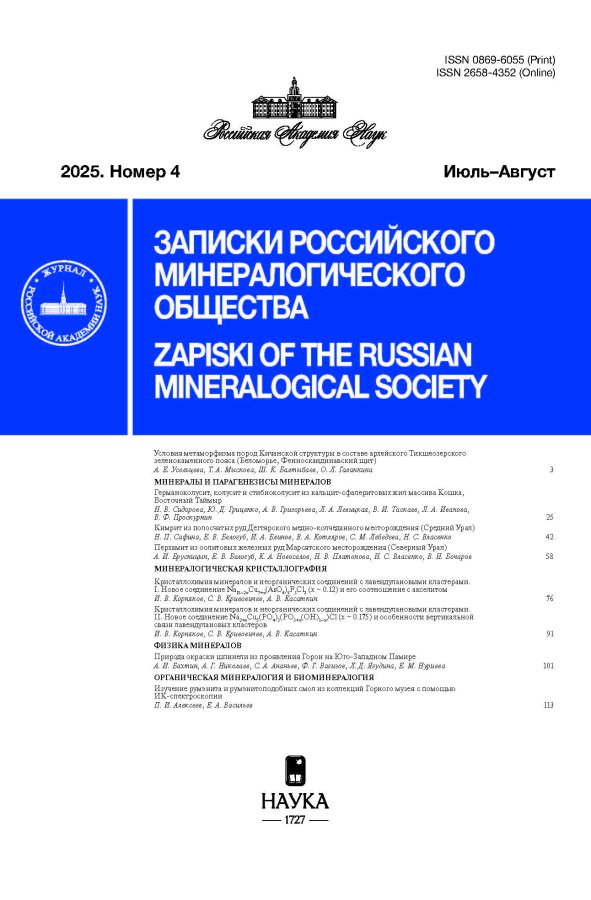
- Ano: 2025
- Artigos: 8
- URL: https://journals.eco-vector.com/0869-6055/issue/view/14420
Edição completa
Acesso aberto
Acesso está concedido
Acesso é pago ou somente para assinantes

ARTICLES
Conditions of Metamorphism of Rocks of the Kichan Structure in the Archean Tiksheozero Greenstone Belt (Belomorian Region, Fennoscandinavian Shield)
Resumo
Metamorphic rocks of the Kichan structure of the Tiksheozero greenstone belt were formed after differentiated volcanic series and represented by gneisses, schists, and amphibolites. Conditions of metamorphism correspond to the high-pressure part of the epidote-amphibolite and amphibolite facies. The Gibbs energy minimization method has shown that mineral assemblages of metabasites (plagioclase + biotite + hornblende + garnet) occupy low- and medium-temperature regions in the P–T diagram (550–720 °C, 3–10 kbar). Metamorphic conditions for assemblages of kyanite-garnet-biotite and garnet + two-mica gneisses correspond to temperature 600–730 °C and pressure 6–8 kbar, which is consistent with petrographic observations. When using multiple mineral equilibria, the best intersections of reaction lines correspond to 640–650 °C, 7.8–8.0 kbar with decreasing to 620–630 °C, 6.2–6.5 kbar if Ti-containing phases and H2O are taken into account. For metabasic mineral assemblages, the calculated water activity is close to 0.6, while for gneisses it reaches 0.9–1.0. According to predecessors, mineral assemblages and texture of the studied rocks were formed during the Proterozoic (1.80–1.76 Ga) stage of metamorphism of Archean volcanics synchronous with the late stages of the formation of the Svecofennian and Lapland-Kola orogens. Supracrustal series of volcanics were presumably formed in marginal-oceanic settings in the transition zone between the Karelian Craton and the Belomorian mobile belt.
Zapiski RMO (Proceedings of the Russian Mineralogical Society). 2025;CLIV(4):3-24
 3-24
3-24


МИНЕРАЛЫ И ПАРАГЕНЕЗИСЫ МИНЕРАЛОВ
Germanocolusite, Colusite and Stibiocolusite from Calcite-Sphalerite Veins of the Koshka Carbonatite Massif, Eastern Taimyr
Resumo
For the first time on the Taimyr Peninsula, germanium mineralization, including its own mineral phases — minerals of the germanite group, namely germanocolusite, colusite and stibiocolusite, has been found and described. These minerals were discovered in calcite-sphalerite veins of the Koshka carbonatite massif, which belongs to the Middle-Late Triassic volcano-plutonic carbonate belt of the Taimyr Peninsula. In this members of the germanite group variations in the composition in the ratios of Ge, As, Sb and Sn are wide. Members of the colusite–germanocolusite isomorphous series are common whereas stibiocolusite is rare. These minerals form zonal crystals 5–50 µm in size in association with complex zonal sphalerite, chalcopyrite, pyrite, and less common galena. Colusite crystals exhibit both zoning with enrichment of the marginal parts by Sb and Sn, and oscillatory zoning, with rhytmic varying of the contents of many species-defining components. Germanocolusite contains up to 11 wt. % Ge (5.1 apfu Ge); colusite – up to 11.5 wt. % As (5.99 apfu As); stibiocolusite – up to 6.9 wt. % Sb (1.92 apfu Sb); the Sn content does not exceed 4.1 wt. % (1.19 apfu Sn). Reflectance spectra and unit-cell parameter of these minerals were also determined.
Zapiski RMO (Proceedings of the Russian Mineralogical Society). 2025;CLIV(4):25-41
25-41
Cymrite from Banded Ores of the Degtyarskoe Massive Sulfide Deposits (Central Ural)
Resumo
Microinclusions of cymrite was found in banded chalcopyrite-sphalerite-pyrite ores of the Degtyarskoe massive sulfide deposit (Central Urals). The most interesting feature of cymrite is its enrichment in gallium (Ga2O3 up to 2.02 wt. %). Cymrite forms platy aggregates up to 80 μm long and up to 20 μm wide and, less frequently, single platy inclusions up to 40 μm long and 5—7 μm wide in sphalerite. The mineral is intergrown with barite, mica, and chlorite. The chemical composition was determined using electron microscopy and microprobe (the water content was calculated by stoichiometry, wt. %): SiO2 24.29—32.37, Al2O3 23.51—26.15, BaO 33.80—39.66, K2O up to 0.50, Ga2O3 0.30—2.02, FeO up to 1.69, ZnO up to 3.06, H2O 4.04—4.78, total = 98.83—101.96 and maps of the distribution of elements were constructed, which show the monocrystalline nature of the mineral. The empirical formula of the Ga-richest areas in of one grain is (Ba0.92K0.02)0.94(Al1.83Zn0.15Ga0.09Fe0.04)2.10Si1.99O8·H2O. The presence of the mineral is also confirmed by Raman spectroscopy. The Raman spectra with bands at 3499, 1078, 986, 954, 795, 675, 449, 392, 349, 295 and 166 cm−1 are similar to those of the reference spectrum of cymrite from the Rruff.info database № R080032.
Zapiski RMO (Proceedings of the Russian Mineralogical Society). 2025;CLIV(4):42-57
42-57
Perhamite from Oolite Iron Ores of the Marsyaty Deposit (Northern Urals)
Resumo
Perhamite — an hydrous calcium and aluminum silicate-phosphate with a Si : P = 3 : 4 ratio — was found in the oolitic iron ores of the Marsyaty deposit at the Northern Urals, Russia. The studied ores are divided into oxide (quartz-chamosite-goethite) and carbonate (kaolinite-quartz-siderite) ones. Perhamite occurs in carbonate ores in association with siderite. Perhamite is represented by spherulite aggregates of lamellar grains 20—30 μm across. In hand samples, perhamite has a yellow-brown color, in thin sections it is colorless, transparent, n ≈ 1.56, birefringence is very low. The identification of the mineral is confirmed by XRD. The chemical composition of perhamite is characterized by variations in the contents of Si, P, Al, Ca and Sr. In the case where the phosphorus content is minimal and silicon is maximal, the cationic part of the mineral formula has the form (Ca2.2Sr0.6Ba0.1)Σ=2.9(Al7.3Fe0.4)Σ=7.7(Si3.1P3.9)Σ=7.00 or, more simply, (Ca2.0Sr1.0)Σ=3.0Al7.7(Si3.0P4.0)Σ=7.0. Minerals with higher phosphorus and lower silicon contents correspond to the perhamite–goyazite polysomatic series. The polysomatic series perhamite–iangreyite is also possible. The formation of perhamite occurred at the stage of early diagenesis of ferruginous deposits and is associated with the process of replacing initially sedimentogenic goethite oolites by siderite.
Zapiski RMO (Proceedings of the Russian Mineralogical Society). 2025;CLIV(4):58-75
58-75
Mineralogical Crystallography
Crystal Chemistry of Minerals and Inorganic Compounds with Lavendulan Clusters. I. New Compound Na15–2xCu7+x(AsO4)8F3Cl2 (x ~ 0.12) and Its Relation to Axelite
Resumo
The new compound Na15–2xCu7+x(AsO4)8F3Cl2 (x ~ 0.12) was obtained by chemical transport reactions. The crystal structure at 100 K (tetragonal, P4bm, a = 14.58917(16), c = 8.30072(14) Å, V = 1766.76(5) Å3, Z = 2) was solved by direct methods and refined to R1 = 0.025. The crystal structure is based upon copper-arsenate layers formed by combining lavendulan clusters based on Cu1 and Cu2 atoms through Cu3O4FCl octahedra. The crystal structure exhibits sharp axial asymmetry. The Na15–2xCu7+x(AsO4)8F3Cl2 (x ~ 0.12) compound is closely related to axelite Na14Cu7AsO4)8F2Cl2. Nonstoichiometry of composition is caused by isomorphism according to the scheme 2Na+ → Cu2+ + ☐.
Zapiski RMO (Proceedings of the Russian Mineralogical Society). 2025;CLIV(4):76-90
76-90
Crystal Chemistry of Minerals and Inorganic Compounds with Lavendulan Clusters. II. New Compound Na2+xCu5(PO4)3(PO3+x(OH)1-x)Cl (x ~ 0.175) and Features of the Vertical Linkage of Lavendulan Clusters
Resumo
The new compound Na2+xCu5(PO4)3(PO3+x(OH)1-x)Cl (x ~ 0.175) is obtained by chemical transport reactions. The crystal structure at 100 K (orthorhombic, Cmce, a = 13.6341(2), b = 13.8802(2), c = 15.5183(3) Å, V = 2936.74(8) Å3, Z = 8) was solved by direct methods and refined to R1 = 0.022. The compound Na2+xCu5(PO4)3(PO3+x(OH)1-x)Cl (x ~ 0.175) is a representative of a new structure type of inorganic compounds. Lavendulan clusters of the composition [Cu5(PO4)8Cl] in its structure are combined into layers parallel to the (001) plane. The layers unite with each other by means of an edge-mirror linkage, resulting in the formation of a dense heteropolyhedral framework with voids occupied by Na+ cations. The new linkage type is the first example of edge-mirror linkage of lavendulan clusters, as opposed to the vertex-mirror and translational linkage types.
Zapiski RMO (Proceedings of the Russian Mineralogical Society). 2025;CLIV(4):91-100
91-100
ФИЗИКА МИНЕРАЛОВ
The Nature of Spinel Coloring from the Goron Deposit in the Southwestern Pamirs
Resumo
This paper presents results of a study of the color of natural spinel from the Goron deposit. Mössbauer spectroscopy, optical absorption and luminescence spectroscopy were used to identify crystal chemical features of Goron spinel. The distribution of main chromophore centers in studied spinel samples was studied and the nature of color of spinel has been revealed. The main color centers are chromium, iron, and manganese ions which are located in tetrahedral and octahedral coordination polyhedra. Additionally, it was established that the main color is affected by exchange interactions of pairs of Fe3+IV–Fe3+VI ions that interact through a common oxygen ligand. As a result, a complex set of optically active centers was obtained which created a unique color (including the alexandrite effect) in spinel.
Zapiski RMO (Proceedings of the Russian Mineralogical Society). 2025;CLIV(4):101-112
101-112
Organic mineralogy and biomineralogy
Study of Rumanite and Rumanite-Like Resins from the Collections of the Mining Museum with IR Spectroscopy
Resumo
Samples of viscous fossil resins: rumanite, rumanite-like resins and succinite from the collections of the Mining Museum were investigated using Fourier-transform infrared spectroscopy (FTIR). In this paper, the characteristics of the IR spectra of fossil resins from the Carpathian region (Romania, Moldova), Sakhalin Island (Starodub locality, Russia), Kaliningrad region (Yantarny settlement, Russia) and Transcaucasian amber (Gorchu locality, Azerbaijan) are compared. It was established that resinites of the Starodub deposit belong to two types of viscous fossil resins. The more common type of resin has identical IR spectra with rumanite-like resins from Transcaucasia. Classical rumanite of the Carpathian region differ significantly from them in the IR spectra: the absence of absorption bands at 1325, 1180, 1095, 855, 814 cm-1, a wide band in the range between 1030 and 975 cm-1. The IR spectrum of classical rumanite is closest to the IR spectrum of succinite, from which it differs by the absence of a clearly expressed Baltic shoulder with a maximum at 1160 cm-1 and absorption bands associated with exocyclic groups (3078, 1642 and 888 cm-1). All studied types of resinites are characterized by the signs of viscous resins: the maxima for single and double C-O bonds in carboxyl groups are at 1160 and 1725 cm-1. For rumanite-like resins, we have established a significant variability in the intensity of individual IR absorption bands between different samples from the same location and within the same sample.
Zapiski RMO (Proceedings of the Russian Mineralogical Society). 2025;CLIV(4):113-124
113-124