




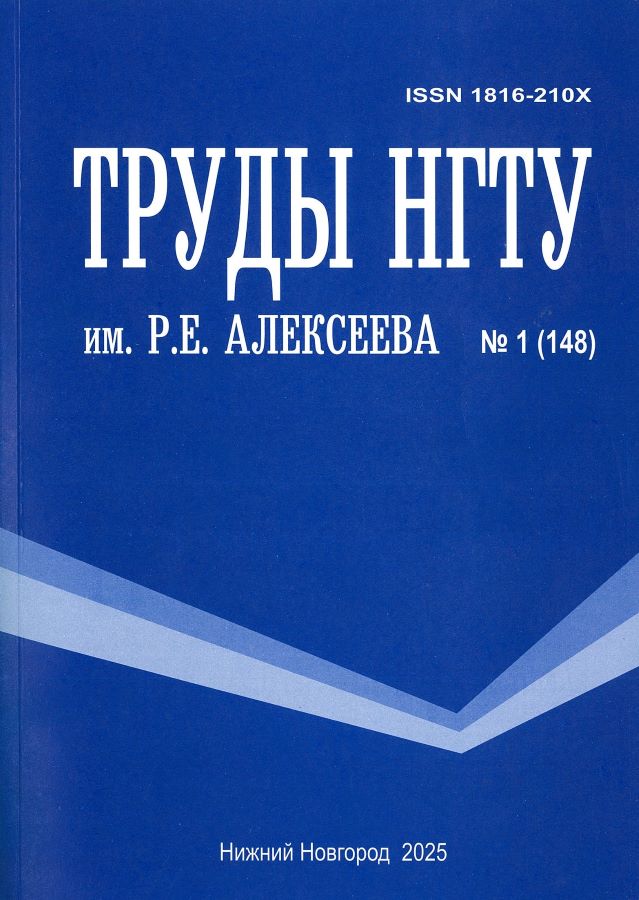
Trudy NGTU im. R.E. Alekseeva
A peer-reviewed scientific and technical journal.
Editor-in-Chief:
- Andrey A. Kurkin, Professor of the Russian Academy of Sciences, specialist in the field of research of marine natural disasters and nonlinear sea waves
Publisher & Founder
- Nizhny Novgorod State Technical University named after R.E. Alekseev
Indexation
- Russian Science Citation Index
- Google Scholar
- Ulrich's Periodicals Directory
- Dimensions
About journal
Trudy NGTU im. R.E. Alekseeva is a peer-reviewed scientific and technical journal consisting of three headings reflecting the results of applied and fundamental research. The priority thematic areas are: computer science and management, system analysis, electric power, nuclear energy, mechanical engineering, transport. The main content consists of scientific articles, scientific reviews, reviews and reviews. The relevance of the journal is determined by the need to form a comprehensive communication space for the management of scientific and technical information, trends in integration into the Russian and world scientific space.
The journal is recommended by the Higher Attestation Commission for publishing the results of dissertation research in the following specialties:
- Computer science and information processes;
- Ground transportation and technological facilities and complexes;
- Nuclear power plants, fuel cycle, radiation safety;
- System analysis, information management and processing, statistics.
Current Issue
No 1 (2025)
- Year: 2025
- Published: 30.01.2025
- Articles: 10
- URL: https://journals.eco-vector.com/1816-210X/issue/view/13089
Full Issue

COMPUTER SCIENCE, MANAGEMENT AND SYSTEM ANALYSIS
Development and implementation of software tools for regression testing of algorithms in solving production planning problems
Abstract
The article presents a developed software for solving the problems of production resources distribution in the automation of the manufacturing high-tech products for enterprises of the mechanical engineering division of the State Corporation Rosatom. An NP-hard production planning problem is considered. Heuristic procedures with different work scenarios depending on the specifics of the problem are used to solve it. The decision algorithms implemented in the SMART-resource software are based on the author's frontal algorithms. It is possible to use various scenarios to solve the problem due to the information obtained taking into account the implemented feedbacks. A mathematical model of the problem of production resources distribution is presented, within the framework of which the task of production resources distribution according to the criterion of minimizing deviations from the specified directive deadlines for the production of planned products is set. Its NP-hardness is shown. Algorithms for its solution are given. A software tool has been developed and implemented that allows regression testing and tuning of internal parameters of frontal algorithms with feedback for target tasks when solving NP-hard production planning problems using the SMART-resource production planning system.
 7-14
7-14


Dynamic model and method of detecting a single-phase voltage dip based on autocorrelation function and neural network autoencoder
Abstract
The paper deals with the problem of detecting the moment of power quality violation in the alternating current electric network. A new ACF-AE method of power quality control is proposed. This method uses the autocorrelation function of the voltage signal and a neural network autoencoder that recognizes anomalies. The effectiveness of various power quality control methods is compared with the proposed one. The experimental results show that the proposed method can accurately detect the start and end points of a single-phase dip in the voltage signal containing noise and harmonics. Compared with the traditional threshold method based on the root mean square value, the proposed method has better accuracy and reliability.
15-25
Image morphological analysis methods for detecting defects in coatings
Abstract
The article discusses image morphological analysis methods for detecting defects in coatings. The application of morphological operations such as erosion, dilation, closing and gradient effectively highlights object boundaries in images. An approach to automated coating image analysis is proposed. This approach allows determining the defect coordinates, area, perimeter, and eccentricity. The results demonstrate the high efficiency of morphological processing methods in enhancing the accuracy and completeness of surface structure analysis. A table documenting defect characteristics has been developed, serving as a foundation for further classification and quality assessment of coatings. The proposed methods improve defect detection accuracy and have potential applications in industrial and scientific research.
26-36
Practical uses of method of phase velocity conditional extremum in analysis of vehicle movement in traffic flow
Abstract
The paper generalizes and supplements the method of conditional extremum of phase velocity previously proposed by the author. The concept of qualitative and quantitative change in the law of change of state of a dynamic system is introduced and a methodological basis for using this method is formed. This made it possible to develop an original approach to the problem of studying the movement of a vehicle in a traffic flow. The results can be used in developing recommendations for safe vehicle control, synthesizing control algorithms for moving objects, developing simulators, optimizing the vehicle propulsion and steering systems and so on.
37-49
NUCLEAR POWER AND ATOMIC POWER ENGINEERING
Testing of multi-loop circuit in natural circulation mode of lead-bismuth coolant
Abstract
The article presents the results of test bench with a liquid metal coolant with four circulation circuits connected in the upper chamber: one heat source in the form of a seven-rod fuel assembly simulator and four heat exchangers removing heat from each circuit. Data on the mode of natural circulation of lead-bismuth melt in two- and four-loop circulation systems, as well as data on changes in the natural circulation mode when the heat transfer in one of the circulation loops is disrupted are obtained.
50-58
MECHANICAL ENGINEERING AND TRANSPORT: THEORY, TECHNOLOGY, PRODUCTION
Analysis of risks of loss of vehicle stability during oscillatory process of impact on steering control
Abstract
The paper analyzes the loss of stability for front- and rear-wheel drive vehicles. Linear models are created and frequency response are studied. The conditions for the occurrence of resonances for each of the two systems are formulated. It has been proven that there is no risk of loss of stability for a rear-wheel drive vehicle, and a condition has been formulated under which loss of stability is possible for a front-wheel drive vehicle.
59-65
Hydrostatic transmission control algorithms development using real-time imitational model
Abstract
The paper presents control algorithms for a hydrostatic transmission of a special transport vehicle using simulation modeling. The methodology is presented and the stages of algorithm development are described: concept formation, debugging, testing as part of the physical controller software, testing of vehicle systems, which may involve a simulation model of the external environment. The presented development was successfully implemented into the control system of the prototype. Comparison of the results of modeling and a natural experiment shows that the accuracy of the simulation model is sufficient for the purposes under consideration and the presented approach can be used in design.
66-78
The influence of the control law on oscillatory processes in an electromechanical drive
Abstract
The influence of the S-shaped law of torque assignment in the control of an electromechanical power transmission on the dynamic load of a mechanical transmission and on the energy efficiency of movement is studied. The S-shaped law of torque assignment showed the possibility of excluding the excitation of vibrations when changing the driving mode and the direction of application of the load in the mechanical transmission of the power transmission. A high value of the regenerative torque when releasing the pedal and moving in braking mode reduces the efficiency of movement, increasing the specific energy consumption. The application of the S-shaped law of torque assignment is possible for the implementation of motion control algorithms and software implementation.
79-86
Study of factors determining the choice of type and load capacity of logging loading and transport vehicles
Abstract
The article is devoted to the study of analytical dependencies of factors determining the type and load capacity of loading and transport vehicles. The hourly productivity and cost of skidding of these vehicles are considered, as well as the relationships between factors such as speed, downtime, skidding distance and load capacity utilization. The presented graphs and technical data confirm the analysis. It is concluded that the average technical speed of loading and transport vehicles depends on their type, load capacity and service life, and that different types of vehicles have different speeds depending on their load capacity. Analytical expressions are given for calculating the average technical speed for various types of loading and transport vehicles. Based on the analysis and calculations, the possibility of introducing improvements to increase the efficiency and productivity of loading and transport vehicles is considered. In the future, this may include optimizing load capacity, reducing downtime or increasing speed, depending on specific requirements and constraints. This study provides valuable information to improve the efficiency and productivity of loading and transport vehicles. They enable design and research professionals to optimize productivity and make informed decisions about the design of logging loading and transport vehicles.
87-103
Method for determining the stiffness of arbitrary-shaped anti-roll bar
Abstract
The article studies methods for stiffness calculation of wheeled vehicle suspension systems spring elements. The KAMAZ Innovation Center has developed a new method for antiroll-bar stiffness calculation is developed, taking into account its geometric shape. This method allows to achieve a high accuracy of calculation with an error within 5 %. The design scheme of the antiroll-bar is presented. The comparative assessment is made on the basis of the results of a series of anti-roll bar models calculations using a numerical method in a finite element analysis program.
The proposed method allows to clarify the calculations of vehicle dynamics by obtaining the stiffness value of the transverse stability stabilizer close to the real one for correct determination of the roll angle of the wheeled vehicle's sprung mass, which is an important criterion of vehicle motion safety.
104-110

Регистрационный номер и дата принятия решения о регистрации СМИ: серия ПИ № ФС 77 - 56417 от 11 декабря 2013.