


 Open Access
 Access granted
 Subscription or Fee Access
No 7 (2025)

EXECUTIVE OPINION
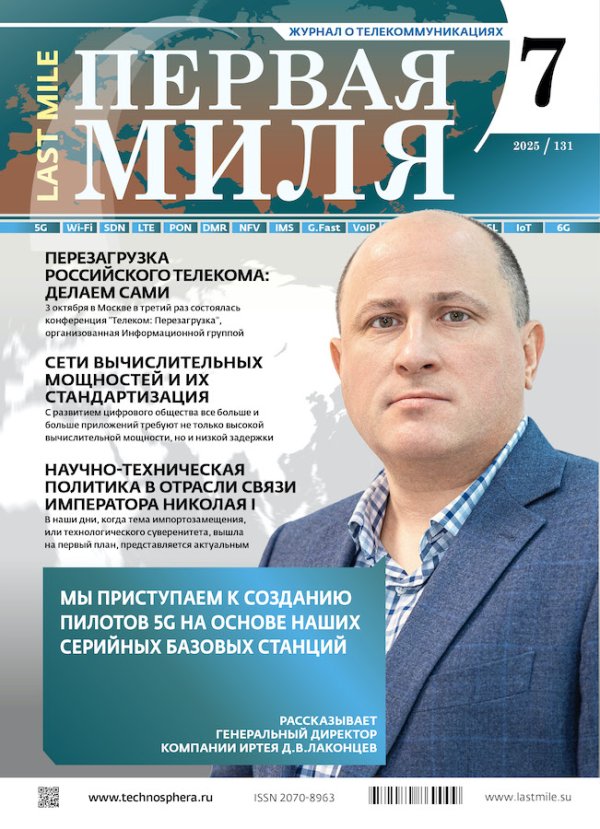
We are starting to produce 5G pilots based on our mass-produced base stations
Abstract
К.т.н., профессор Сколковского института науки и технологий Дмитрий Владимирович Лаконцев возглавляет компанию ИРТЕЯ, разработчика и производителя российских базовых станций (БС) четвертого и пятого поколений. С конца 2024 года первая серийная партия из 214 БС находится в коммерческой эксплуатации в сети ПАО "МТС" в целом ряде регионов нашей страны. В 2025-м ИРТЕЯ поставит оператору еще 1000 единиц оборудования. ПЕРВАЯ МИЛЯ попросила Д.В. Лаконцева рассказать о создании первой российской базовой станции 5G и о ближайших планах компании.
 8-13
8-13


ВЫСТАВКИ И КОНФЕРЕНЦИИ
Restarting Russian telecom: do it ourselves
Abstract
On October 3 in Moscow, the conference "Telecom: Restart" was held for the third time, organized by the ComNews Information Group. The report discusses a number of the leading Russian manufacturers of telecommunications equipment and software featured in the program, whose solutions make it possible to abandon products from foreign vendors.
18-22
"Microelectronics 2025": focus on technological sovereignty
Abstract
From September 22 to 26, 2025, at the Scientific and Technological University "Sirius" (Federal Territory "Sirius"), the 11th Russian forum "Microelectronics" took place, gathering over 3,500 participants from the Russian Federation, Belarus, Kazakhstan, and China. Traditionally, at this interdisciplinary event, considerable attention was given to telecommunications: both to electronic component base for equipment production and to the communication technology itself.
24-28
CABLES AND PASSIVE EQUIPMENT
Spine-leaf architecture and VSFF connectors of the optical subsystem in structured cabling systems
Abstract
The necessity of tightening requirements for the maximum attenuation created by standard fiber optic connectors in the data center cabling system is justified. The expediency of introducing VSFF group connectors in this area is demonstrated, and an assessment of the maximum attenuation they introduce is performed. The need to expand the component composition of the cabling system by introducing adapter cassettes designed for installation in standard cassette and slot shelves is noted.
30-35
36-36
On the “pulling out” of optic fibers from the sleeve in a cable with a central module
Abstract
A comparative analysis of the designs of aerial optical cables is conducted. It is shown that self-supporting designs with strength elements made of high-molecular-weight threads have undeniable advantages in terms of design and operational characteristics compared to cables with a central module. It is concluded that the main reason for the "pulling out" of optic fibers from the optical sleeve into the module is the effect of gravity in a suspended single-module cable. It has been shown that a properly implemented amount of excess fiber length in a single-module cable and presence of the necessary technological reserve of cable at the splice closure will help to avoid the “pulling” of optical fibers. Practical recommendations are given for protecting against the “pulling” of optical fibers from the splice closure into the module during the technical operation of communication lines.
38-43
WIRELESS COMMUNICATION
Digital radio communication system INTRANK MC
Abstract
In 2023, the "LEO TELECOM" company launched its own brand of equipment, INTRANK, adding to its status as a classic system integrator the additional status of "manufacturer." In this paper, another family of products under this brand is presented: the INTRANK MC digital radio communication system.
44-45
46-47
EXPERT OPINION
The "Microelectronics" Forum – an event not to be missed
Abstract
Группа компаний "Т8" второй год подряд выступила инновационным партнером XI Российского форума "Микроэлектроника 2025", состоявшегося на Федеральной территории "Сириус" в конце сентября, а также организовала в его рамках круглый стол, посвященный прикладной фотонике, собравший большую аудиторию. Руководитель ГК "Т8" д.т.н. В.Н. Трещиков поделился с корреспондентом "ПЕРВОЙ МИЛИ" впечатлениями об очередном участии в масштабном мероприятии.
48-50
СЕТЕВАЯ ИНФРАСТРУКТУРА
Computing power networks and their standardization
Abstract
Development of the digital economy has led to manufacturing the huge data sets, processing the relies on powerful computing resources and broadband network connections. Convergence of computing and networking has become an important trend. Against this background, a new network paradigm called the Computing Power Network (CPN) has been proposed, which integrates the scheduling capabilities of computing resources in a single network. This paradigm aims to integrate distributed computing nodes, coordinate computing resources, network resources and user requirements, and achieve integrated scheduling of computing and network resources. This paper analyzes the architectural principles of the CPN design and operation and provides an overview of international standards.
52-58
WIRED COMMUNICATION
Evolution of transport fiber optic transmission systems Part 1. Standardization and main directions of FOTS technology development
Abstract
This series of papers examines the of transport fiber optic transmission systems (FOTS) evolution including standardization and the main directions of FOTS technology development (Part 1); features of transport FOTS generations (Part 2); advantages of fifth-generation fiber-optic transport networks (part 3).
60-69
120 channels in optical networks
Abstract
The advantages of dense wavelength-division multiplexing (DWDM) systems operating in the extended Super C spectral range are discussed. An intelligent telecommunications platform N3COM of the new generation DWN7500, capable of operating with the extended spectrum, is presented.
70-71
CHAPTERS OF HISTORY
Science and technology policy in the communications sector of Emperor Nicholas I
Abstract
The paper is prepared based on the materials from the exhibition of the Central Museum of Communications named after A.S. Popov, "Alexander I: Communication Before and After." It highlights the historical aspects of the emergence of Russian science and technology policy in the communications sector – one of the main topics of the exhibition. It is noted that Emperor Nicholas I (the successor of Alexander I) paid special attention to fast means of communication, which made Russia the birthplace of the electrical telegraph. However, such a brilliant beginning in the context of domestic developments did not receive further development.
72-78