






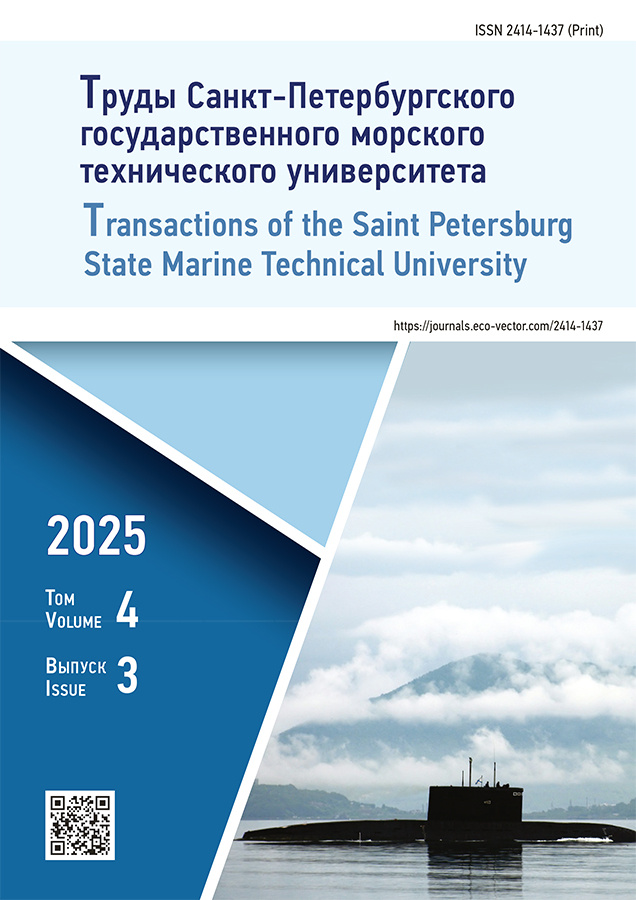
Transactions of the St. Petersburg State Marine Technical University
Quarterly peer-review scholarly journal, publish since 2017.
Editor-in-Chief
- Denis I. Kuznetsov, Dr. Sciences (engineering)
Associate Professorб Vice-Rector of Research
Saint-Petersburg State Marine Technical University
Publisher and Founder
- Saint-Petersburg State Marine Technical University
WEB: https://www.smtu.ru
About
"Transactions of the St. Petersburg State Marine Technical University" Journal is published by the St. Petersburg State Marine Technical University (SPbSMTU) since 1938 (until 1991 under the title "Papers of LKI").
The Journal is addressed to a wide range of scientists and specialists, as well as to the heads of research and design organizations, industry, educational institutions, the Naval Armed Forces, and also to teachers, graduate students, undergraduate students and cadets of higher educational institutions.
The main content of the peer-reviewed scientific publication are scientific articles.
Publication language
- Russian
- English
Main subjects
- information measuring and control systems
- electrical complexes and systems
- engineering technology
- ship theory and construction mechanics
- ship design and construction
- shipbuilding technology, ship repair and organization of shipbuilding production
- marine power plants and their elements (main and auxiliary)
Sections
- Information systems
- Energy and electrical engineering
- Mechanical engineering
Indexing
- Russian Science Citation Index
- Crossref
- Google Scholar
- Dimensions
- Lens
- OpenAlex
- Scilite
- Semantic scholar
The journal use 'Diamond Open Access' publication model.
Current Issue
Vol 4, No 3 (2025)
- Year: 2025
- Published: 23.09.2025
- Articles: 15
- URL: https://journals.eco-vector.com/2414-1437/issue/view/12944
Full Issue

Mechanical engineering
Special Aspects of Using Partial Response Method in Studying Vibration of Quasi-One-Dimensional Finite Element Models
Abstract
BACKGROUND: Today, the finite element method (and software packages based on it, mainly foreign) is substantially the only computational method that actually allows solving parametrization problems of static deformation and vibration of complex structures. They often require much effort to prepare the inputs, advanced computing equipment, and funds to purchase the corresponding software packages. The development of an approach allowing to occasionally reduce the requirements and to relatively easily develop domestic computational software based on it seems quite relevant.
AIM: To develop approaches that allow for less labor-intensive and faster parametrization of static deformation and associated flexural, longitudinal, and torsional steady-state oscillations (vibrations) of structures, allowing modeling by systems of quasi-one-dimensional finite element models.
METHODS: The basic investigation method used in the study is a modification of the partial response method with some significant advantages in solving problems of steady-state forced vibration or static deformation of structures that allow modeling using quasi-one-dimensional finite element models. The proposed method — the discrete modification of the partial response method — consists in the recording of partial responses and recurrent partial parameters of algebraic equations to calculate the matrix entries. In this case, the conventional solution of the boundary value problem is replaced by the solution of a series of conjugation problems for pairs of partial systems, where each has its own boundary data. The number of pairs under consideration corresponds to the number of sections, for which the researcher wants to parametrize the studied process (amplitudes of linear and angular displacements, internal forces, and end reactions). The scope of problems to be solved is significantly expanded by using the method proposed by the authors to correct and/or modify the inertia and rigidity of elements of a quasi-one-dimensional finite element model and the external load acting on it. This approach allows us to build quasi-one-dimensional models for solving both one-dimensional and multidimensional problems and problems requiring to consider the additional factors that complicate the vibration pattern.
RESULTS: The paper presents several applications of the discrete modification of the partial response method in combination with the correction and modification of the parameters of quasi-one-dimensional finite element models.
CONCLUSION: The study allows us to conclude that the aim has been achieved, which is confirmed by the development of a discrete modification of the partial response method, allowing to calculate deformation parameters and steady-state vibrations for a certain class of structures.
 277-290


The Effect of Pulse Parameters on Intensity of Removal of Organic Layers from Carbon Steel and Other Materials During Pyrolysis Using Nanosecond Industrial Lasers
Abstract
BACKGROUND: The article investigates pulsed laser cleaning (LC) technologies relevant for contemporary metalworking industries.
AIM: To obtain new data for describing (at a semi-quantitative level) the relationship between LC output parameters and a set of adjustable operating parameters of these processes by experimental research of removing organic layers from metal samples using an up to 200 W pulsed laser, parametric analysis, and similar experimental data obtained earlier in similar studies with nanosecond lasers.
METHODS: A series of experiments on LC of steel samples from paint films and a layer of rubber-containing contaminants (generated in tire production) was carried out with varying laser parameters and determining the LC performance, energy consumption, and some parameters affecting the destruction of the organic layer.
RESULTS: An analysis of the results in combination with data from similar LC operations showed the complex multifactorial relationship between the input and the output operating parameters. In addition, it demonstrated that one of the most clearly (and directly proportional) parameters affecting the intensity of metal cleaning are the pulse duration tp and the duty cycle DC. In optimal conditions, the LC energy consumption is close to 13 MJ/(dm3 layer) in the LC option of elastomer-containing layer. In this LC option, the surface of St3 samples does not have noticeable erosion and its microhardness is approximately ≤ 180 HV, which is close to this parameter of the initial steel.
CONCLUSION: In further R&D, it will be advisable to select LC parameters based on the layer removal mechanism, which, according to preliminary estimates, in low energy consumption conditions comes with combination of energy-intensive thermal ablation (pyrolysis) and the coating exfoliation due to higher thermoelastic stresses in it.
291-301
Effect of Shape of Intake Valve with Different Number of Spiral Guides (Blades) When Changing Temperature in the Cylinder of Small-Sized Marine Engine Ch8.5/11
Abstract
BACKGROUND: A review of the literature shows that the study of temperature distribution and the effect of pressure is an important basis for the design of the most wear-resistant and durable valves and significantly affects the choice of materials. Studying the temperature distribution inside valves at the pressure exerted on them during engine operation is experimentally a very time-consuming and demanding task. It is required to perform such calculations with software allowing to consider certain loads based the crankshaft rotation angle of the test sample.
AIM: The object of the study was a valve of a factory-built small-sized marine engine and the same valves with a modified design and added spiral guides (screens, blades) to study the effect of temperature exerted on them depending on the crankshaft rotation. All studied valves had the homogeneous structural material.
METHODS: To conduct the study, we used the finite element method implemented in the Ansys software, where a non-stationary thermomechanical calculation of valves with different designs made of homogeneous material was performed using the small-sized marine engine Ch8.5-11 valve with the subsequent analysis of the results, their study, and comparison.
For the convenience of the solution, the study was divided into two parts. In this part, the influence of temperature during the operation of the small-sized marine engine Ch8.5/11 is studied; the future study will involve the transfer of the studied temperature fields to the pressure in the small-sized marine engine cylinder tested by the valves.
RESULTS: At this stage, the finite element method was used to build and visualize the temperature fields of valves with different designs, to calculate the heat flux density, and to analyze the value of the spiral guides installed on the valves in relation to the temperature. As the calculation was non-stationary, we selected the highest test temperature stresses exerted on the valves during operation for the small-sized marine engine study.
CONCLUSION: The simulation allowed to collect data on the temperature distribution inside valve trays of the studied 40X steel valves, which can be viewed at any time of the studied interval. The study of the heat flux in valves of different designs revealed that the heat flux increased in the valve with 3 blades (283.12 W/mm2) and the heat flux in the design with 6 blades was 281.49 W/mm2.
303-316
Investigation of Strength of Polymer Matrix under the Influence of Temperature Time Factor
Abstract
BACKGROUND: The widespread use of polymer composite materials (PCM) in the shipbuilding industry necessitated the study of the physical and mechanical properties of PCM, including under the influence of temperature time factor, which are important and timely. This is further supported by the need to improve the technology of using polymers in the form of thin antifriction coatings in critical machines.
AIM: To investigate the strength of polymer matrix under the influence of temperature time factor by preparation of materials and samples for experiments; study of changes in the polymer matrix at different composite sintering temperatures; study of the synthesis (growth) of polymer strength; building mathematical models of polymer strength growth at different temperatures from 200 to 350 °C; study of the polymer strength loss (destruction).
METHODS: PA-6/66-3 polyamide, which has been in high demand lately, was selected for the study. Both theoretical research methods and empirical ones were used, including high-tech experiments using digital technologies and processing using CAE software.
RESULTS: It was found that the sintering temperature of a polymer determined the strength growth rate and the dependence of the strength growth rate on temperature was linear. Dependence graphs of the tensile strength and the sintering time at various temperatures are shown and experimental curves are approximated. It was revealed that the polymer thermal degradation proceeded up to the specified tensile strength and had a pronounced inflection point.
CONCLUSION: The study shows that the law of strength growth (synthesis) can be represented as a linear dependence on the sintering temperature of the samples. We can conclude that the coefficients in the equation of the direct rate of strength growth depend significantly on the melting point. The study allows us to make recommendations on improving the manufacturing technology of dispersed polyamide products.
317-325
Methods of Numerical Modeling of High-Velocity Ice Resistance: a Review
Abstract
The rapid development of shipping in the Arctic region has increased the demand for special ice-class vessels, leading to the search for new and improved methods for modeling ship movement in ice conditions. Developing a mathematical model of ship-ice interaction is a complex task due to the challenges in simulating ice properties and there is no single universally accepted approach to ice modeling. However, numerous methods are available that can solve specific problems with sufficient accuracy. Despite their effectiveness, known numerical modeling methods for ship-ice interaction have significant limitations related to high computational costs and limited accuracy, highlighting the need for further improvement. The search for optimal combinations of different numerical methods and improving computational efficiency has become a key research area to improve the safety and cost efficiency of Arctic shipping. To conduct a comprehensive analysis of and systematize existing numerical modeling methods for ship-ice interaction and identify promising areas for their improvement to improve the efficiency of Arctic shipping. The review includes a comparative analysis of the advantages and disadvantages of each method (DEM, FEM, CEM, SPH, PD, and LBM) and an assessment of their applicability for solving specific ship-ice interaction modeling problems. The following aspects of method application were examined: computational efficiency, simulation accuracy, and optimal applications. The authors systematized the main numerical modeling methods for ship-ice interaction; identified common characteristics of all studied methods; determined key areas for improving existing approaches; developed recommendations for determining ice resistance, and made a list of software packages to implement modeling methods. The study highlights the need for further research in optimizing computational processes and improving the accuracy of ship-ice interaction modeling. This review provides recommendations for selecting a method to model ship movement in ice. However, all existing methods have their limitations, necessitating further development, including the development of combined approaches and the improvement of computational processes.
327-340
Investigation of Atmospheric Corrosion Inhibitors’ Activity Against Mold Fungi
Abstract
BACKGROUND: There is a need to develop effective methods for protecting marine equipment from biochemical corrosion. In addition, pathogenic fungi produce metabolites and enzymes that destroy metal structures. For successful use, such materials must meet the following key requirements: reliable corrosion protection; availability of raw materials for production; user-friendly processes; compatibility with various preservative bases (oil, fuel, and water); the ability to suppress the development of mold fungi; low toxicity and no pungent odor; the ability to control the concentration in the solution; safe disposal methods of used solutions, and affordable cost.
AIM: To evaluate the antifungal efficacy of inhibitory compounds used to protect metal structures.
METHODS: The study used contact and volatile corrosion inhibitors common in ship repair practice. The study involves the disk diffusion test, which allows to clearly see the fungistatic effect.
RESULTS: Experimental studies have shown that volatile inhibitors surpass contact ones. In the premises, an objective hierarchy of inhibitors has been built based on their applicability, biochemical corrosion efficacy, and toxic load.
CONCLUSION: The studies show the need for further improvement of methods for protecting ship equipment from biochemical corrosion with an emphasis on the use of volatile inhibitors as a more effective means of protection.
341-346
Welding, related processes and technologies
Theoretical Description of Powder Delivery to Direct Laser Deposition Area
Abstract
BACKGROUND: The parameters of powder flow delivered to the direct laser deposition area affect the interaction of the powder, laser, and melt pool, directly determining the bead shape and the quality of the deposited material. Controlling the spatial distribution of powder flow in the processing area is key for improving the process performance and repeatability.
AIM: To develop a semi-analytic approach to find powder particle trajectories in the problem of direct laser deposition using a discrete jet nozzle.
METHODS: The carrier gas flowfield in an unobstructed half-space filled with a protective gas is approximated by an analytical solution of the Euler equation. Powder trajectories are determined by numerical integration of the equation of motion based on the Stokes’ law.
RESULTS: Powder trajectories are determined by the distribution of the carrier gas velocity at the tube outlet by applying the exact solution of the Euler equation for specific parameters of powder particles and carrier gas used in additive manufacturing.
CONCLUSION: The paper presents an elementary semi-analytic model of powder delivery in the problem of direct laser deposition allowing to obtain the spatial distribution of powder particles in the processing area.
347-354
Effect of Gas Flow on Samples Produced by Selective Laser Melting
Abstract
BACKGROUND: Selective laser melting (SLM) is a technology for manufacturing metal parts by melting particles of metal powder compositions using laser radiation. SLM provides excellent mechanical properties of manufactured parts and large discretion of design. The paper studies the effect of laser power on the spattering of molten powder. The study analyzed the causes, appearance, and composition of spatter and methods to prevent it.
The SLM is performed in shielding inert gas; thus, it has been shown that the gas flow is a decisive factor as it removes condensate and prevents oxidation of the material during melting. The solidified spatter has an average size of approximately 162 µm, which is significantly larger than the initial powder size of 32 µm.
AIM: To analyze the spatter of stainless steel powder during processing and the effect of gas flow on sample quality, especially its porosity.
RESULTS: The study showed that gas flow rate significantly affects the uniformity of the properties of manufactured products. The properties of the manufactured parts varied based on the location of the samples on the platform. The quality of the manufactured parts was higher when placed in areas with high gas flow rate and lower when placed in areas with low gas flow rate.
CONCLUSION: The study may be used to predict and test the quality of parts manufactured using the SLM.
355-364
Development of Punching Technology for Combustion Liners with Thermal Control Coatings
Abstract
BACKGROUND: The efficiency of a contemporary gas turbine engines can be improved by increasing the operating temperature inside the engine, resulting in extreme thermal stress on materials. The temperature of combustion products inside aircraft engines can reach temperatures exceeding the melting points of the alloys used, limiting their applications. To protect working parts, thermal control coatings and cooling systems with punch holes are used. Laser perforation is a promising method that provides high precision and cost-effectiveness of hole punching processes for combustion liners with thermal control coatings. The development and improvement of such technologies is relevant for the aerospace industry and general mechanical engineering, where a balance between quality, performance, and cost is required.
AIM: To develop an efficient laser perforation solution for combustion liners with thermal control coating, providing an optimal combination of precision, surface quality, and performance. The paper analyzes and compares existing punching methods to support the choice of the best possible technology.
METHODS: The paper provides a technical analysis of existing perforation solutions for aerospace and general industrial applications. Punching options for combustion liners are considered based on data from open sources. The experimental part included the use of a serial five-axis laser processing machine SLP520 with a fiber laser.
RESULTS: Analysis showed that laser perforation outperforms alternative methods in terms of accuracy and processing speed. Optimal laser radiation parameters ensure the lowest thermal effect on the thermal control coating and high repeatability. Experiments showed that a long-focus lens ensures fixed diameter and shape of the holes and a boron nitride protective paste helps prevent splashes around the holes.
CONCLUSION: Laser perforation is an effective punching solution for cooling holes in combustion liners with thermal control coating. The proposed technology provides high precision, quality, and repeatability, making it preferable for aerospace applications. Further research may be aimed at studying the effect of protective paste on the thickness of the modified layer.
365-373
Design Methods Used to Minimize Residual Stresses in Direct Laser Deposition
Abstract
BACKGROUND: In the additive manufacturing of hardening alloy products, they are often destroyed. This is caused by an unfavourable combination of metallurgic factors and high processing stresses. When manufacturing large-sized industrial structures by direct laser deposition, it is impossible to ensure a favorable phase structure and mechanical properties of the deposited metal due to the low interpass temperature and high cooling rate. In this case, to prevent structural damage, it is required to reduce stress and deformation.
AIM: To empirically analyze the efficiency of local deposit geometry and local chemical composition modification to reduce residual stresses and deposition deformations simulating the manufacturing of large-sized structures by direct laser deposition.
METHODS: We analyze wall-type deposits made of Ti-6Al-4V alloy with two types of fillets (flat and concave) on the ends. We also describe a wall-type deposit without fillets with a gradient transition from a soft layer of pure titanium to a significantly stronger Ti-6Al-4V layer. To determine stresses and deformations in deposits, a numerical direct laser deposition model was developed. Interlinked problems of heat conduction in a non-stationary formulation and the quasi-static problem of thermally-induced plasticity were solved by the finite element method.
RESULTS: The flat fillets added to the ends of the deposit has little effect on the magnitude of residual stresses and accumulated plastic deformations. Concave fillets significantly reduce plastic deformation, ensuring the manufacturing of defect-free deposits. The most effective approach was to add a less durable but more plastic interlayer between the rigid substrate and the deposit made of a stronger alloy. In this case, the highest level of accumulated plastic deformations is achieved at the ends of the deposit in the soft interlayer region and depends little on the interlayer length. The stronger part of the Ti-6Al-4V deposit has no effective plastic deformation.
CONCLUSION: It was demonstrated that numerical modeling using local deposit geometry and chemical composition modifications allow to significantly reduce residual stresses and plastic deformations in deposits manufactured by direct laser deposition.
375-384
Removal of Thermal Barrier Coating by Laser Cleaning
Abstract
BACKGROUND: Various types of coatings are used for corrosion and wear protection of structural materials and thermal insulation. Coatings that are used in high-temperature conditions, e.g. aircraft and industrial gas turbine engines, have the most complex structure. They are used to isolate the turbine components from the hot gas flow, increasing the durability and energy efficiency of engines [1]. Thermal barrier coatings have three main requirements, including low thermal conductivity, stability at high temperatures, and high durability, and they are fairly difficult to remove.
AIM: To solve the problem of removing thermal barrier coating from moving blades of gas turbine engines subjected to intensive wear in tough operating conditions. Laser cleaning technology is proposed as the most effective cleaning method. It is an advanced technology that allows finding solutions to reduce production costs and increase the performance and quality of processes [2]. The paper discusses the importance of preserving the basic blade material during thermal barrier coating removal for its subsequent use (new coating). The aim is to remove the thermal barrier coating without damaging the basic metal and to determine the optimal conditions for such works.
METHODS: To achieve the aim, the blade made of CS70-VI alloy was cut into several parts along the length of the airfoil; one part was selected as a check test piece that was not cleaned. The remaining test pieces were tested during laboratory experiments aimed at studying the influence of input laser cleaning parameters on the removal of the thermal barrier coating. All samples were then subjected to metallographic tests to determine the material structure, microhardness, and thickness of the thermal barrier coating.
RESULTS: The paper presents metallographic analysis of microhardness and thickness of thermal barrier coating after testing confirming the effectiveness of laser cleaning to ensure the durability and reliability of moving blades for gas turbine engines.
CONCLUSION: The study involved a literature review of papers related to laser cleaning. Next, we selected the variation ranges of the main processing parameters and conducted a series of experiments followed by the metallographic analysis of test pieces. Metallographic analysis allowed to determine the conditions ensuring complete removal of the thermal barrier coating and the relationship between the thickness of the thermal barrier coating and the radiation power.
385-392
Energy and electrical engineering
Mathematical Models and Circuits of Test Impulse Noise Generators for Electromagnetic Compatibility Calculations
Abstract
BACKGROUND: Marine electronic and electrical equipment may not be supplied to ships unless it meets the impulse noise immunity requirements. Tests of equipment designed without due regard of such requirements record its failures. It is important to be able to predict the effects of noise at the equipment design stage.
AIM: To provide mathematical models and circuit simulations of test impulse noise generators to verify the impulse noise immunity of circuits during their development.
METHODS: The study is based on the electromagnetic compatibility standards of the Russian Maritime Register of Shipping and IEC 61000-4 standards of the International Electrotechnical Commission. The study uses mathematical descriptions of pulse waveforms and electrical engineering software used to simulate circuits.
RESULTS: The study provides formulas describing standard impulse noise, detailed diagrams of test generators used in simulation software, examples of models, and errors of simulated noise parameters.
CONCLUSION: The proposed models and simulations allow predicting the effect of noise at the equipment design stage prior to noise immunity tests and reduce the time and cost of equipment modification.
393-400
Identification of Anomalies in Analysis of Hydroacoustic Measurements of Unsteady Processes
Abstract
BACKGROUND: When processing hydroacoustic measurements, it is very important to identify and reject the so-called abnormal results as even one result can lead to false inference. The distinctive features of hydroacoustic measurements are, on the one hand, the high cost of errors in case of low accuracy and on the other hand, the difficulty of achieving the required accuracy due to the complexity and variability of the propagation medium and the background effect. The need to know the fine spatial and temporal structure of the measured hydroacoustic unsteady processes imposes additional strict requirements to the measurement methods and tools and their accuracy. The paper discusses and analyzes the issues related to the detection of anomalies in the analysis of hydroacoustic measurements of random non-stationary processes using the method of multiplication of estimates.
AIM: To develop an algorithm for detecting abnormal measurements for stationary and non-stationary processes based on the method of multiplication of estimates.
METHODS: To find the optimal parameter values of the proposed algorithms, we studied the relationship between the probability of correct detection and the probability of a false alarm and the number of multiplied estimates of the initial implementation and the number of covers per implementation length. It has been shown that in conditions of limited a priori data, this method allows to effectively determine the anomalous hydroacoustic measurements both for stationary and non-stationary processes.
RESULTS: Using simulation modeling, we built models of measurements represented by a non-stationary random sequence. The studies have shown the high efficiency of detecting abnormal measurements of the proposed algorithm based on the method of multiplication of estimates. The high performance of the proposed algorithm in conditions of limited a priori data allows for its use in automated primary data processing systems.
401-406
Computer Simulation of Effects of Electrostatic Discharge in Frequency Domain
Abstract
BACKGROUND: There’s a need to develop computer modeling tools that allow assessing the effect of electromagnetic interference on equipment units at the design stage.
AIM: To determine the possibility of using frequency domain computational methods to simulate transient processes, when an electrostatic discharge affects equipment units.
METHODS: The paper proposes to use surface integral equations in the frequency domain to model standardized effects of electrostatic discharges on equipment units. For this, the fast Fourier transform is applied to the standardized discharge current and the effect of a lumped harmonic current source for a frequency sequence is modeled using frequency domain methods. The effect-to-interference conversion factor is determined for each frequency. The time dependences of the voltages and currents induced by electrostatic discharge are determined by the inverse fast Fourier transform applied to the product of the discharge current spectrum and the corresponding conversion factor.
RESULTS: The results obtained by the proposed frequency domain methods match the results of time domain methods with a reasonable degree of accuracy for practical calculations. In this case, the effect of each frequency component is analyzed independently, allowing for a high degree of parallelization of calculations; whereas calculations using time domain methods require completed calculations for previous time points. Requirements to the size of mesh elements are determined by the wavelength at the maximum frequency used.
CONCLUSION: The paper demonstrates the fundamental possibility of using frequency domain methods to model pulsed electromagnetic effects, including the effect of electrostatic discharge. Frequency dependences of the conversion factors and the spectral density of interference provide additional information on the relationship between interference levels and the geometry of equipment units and possible ways to reduce them.
407-412
Hydrogen Storage and Supply System for Fuel Cell Stack
Abstract
BACKGROUND: This paper discusses the relevant issues of using hydrogen energy for marine vehicles, including hydrogen storage and feeding to a solid polymer electrolyte fuel cell stack. Currently, the most proven hydrogen storage systems are titanium and composite cylinders. They compete with intermetallic devices. Each storage system has its own advantages and disadvantages. Contemporary composite cylinders can accommodate gas pressure of up to 400 atmospheres. Reducing hydrogen from 400 atmospheres to several units or tens of bars is a solvable problem. However, it should be considered that changing the gas pressure significantly decreases the fuel temperature at the inlet of the fuel cell stack. Cold dry hydrogen reduces the performance of the electrochemical generator. To increase the performance, it must be heated and humidified.
METHODS: The method used is a hydrogen recirculation system consisting of a jet device, a heat exchanger, a microprocessor-based fuel recirculation control system, sensors, and pipelines. The purpose of the hydrogen recirculation system is to maintain the water balance in the battery and recirculate unused hydrogen in the reaction. The modified electropneumatic converter ITV with feedback is used to maintain constant pressure in the pressure line of the fuel cell battery.
RESULTS: We build a system that maintains constant hydrogen pressure at the inlet of the fuel cell battery and allows for more efficient use of fuel.
CONCLUSION: The hydrogen recirculation system allows to increase in the efficiency of the plant and the modified electropneumatic converter ITV allows maintaining a constant fuel pressure upstream of the fuel cell stack.
413-420

Регистрационный номер и дата принятия решения о регистрации СМИ: ПИ № ФС 77 - 70733 от 15.08.2017.