


Nanoindustry
Scinentific peer-reviewed technical journal.
Editor-in-Chief
- Vyacheslav V. Svetukhin, Doctor of Physical and Mathematical Sciences, Corresponding Member of the Russian Academy of Sciences, Professor, Director of the Scientific and Production Complex "Technological Center".
Publisher
- Associate Printing-and-Publication Center "Technosphera"
Indexing
- Russian Science Citation Index
- RSCI
- CrossRef
- Google Scholar
- Ulrich's Periodicals Directory
- WorldCat
Frequency
- 8 issues per year
About journal
The main topic course is synthesis and investigation of nanosized structures, equipment and methods; technical challenges of nanomateriels and nanostructures application in various industries, medicine, agriculture; nanoindustry mutual problems (attraction of investments, innovations marketing, standardization, intellectual property protection, nanotechnology products safety and environment protection).
Major journal columns
- Competent Opinion
- Exhibitions, Conferences, Seminars
- Expert Estimation
- Infrastructure
- Nanomaterials
- Nanotechnologies
- Control and Measurement
- Laboratory/Production News Reporting
- For the Scientist and Technologist
- Success Story/Attractive Projects
- Standardization/Education
- An idea emerged!
- Patenting problems
Current Issue
 Open Access
 Access granted
 Subscription or Fee Access
Vol 18, No 6 (2025)
- Year: 2025
- Articles: 7
- URL: https://journals.eco-vector.com/1993-8578/issue/view/14061
- DOI: https://doi.org/10.22184/1993-8578.2025.18.6

Nanotechnologies
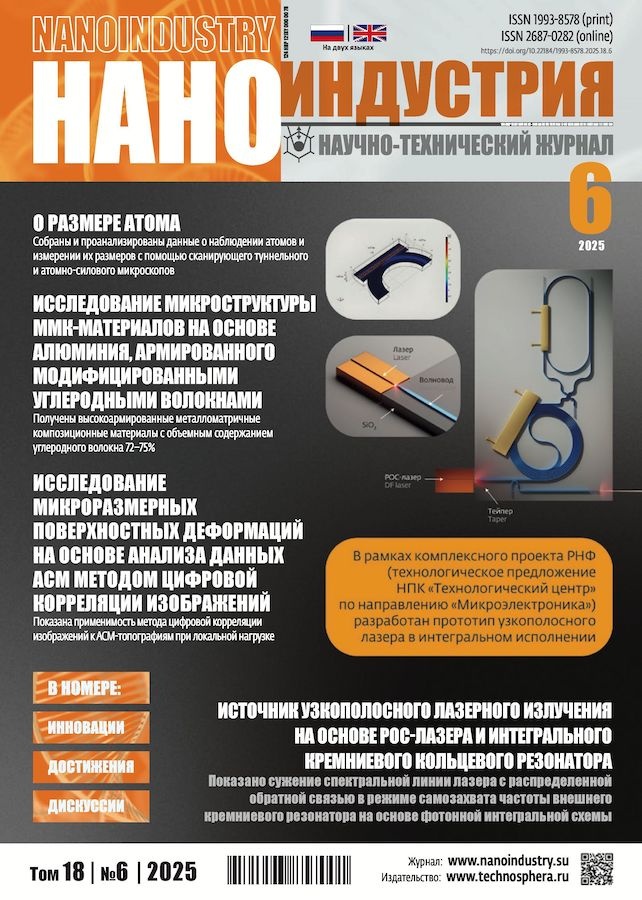
Study of micro-scale surface deformations based on atomic force microscopy data analysis using the digital image correlation method
Abstract
The applicability of the digital image correlation (DIC) method to atomic force microscopy (AFM) topographies under local loading is demonstrated. Technically pure Grade 4 titanium after equal-channel angular pressing according to the Conform scheme was investigated. Local deformation was formed by a microspherical diamond indenter (R = 2.5 μm). AFM scanning of the pre-/post-indentation region was performed with registration using a square scratch pattern (~1 µm). Pre-processing included artifact suppression and field equalization. Subpixel DIC over local windows provided recovery of the radial and tangential components of the displacement field. Continuous maps were obtained, capturing the propagation of disturbances beyond the contact zone and the features of local plastic deformation. The results confirm the technical feasibility and informativeness of DIC for quantitative mapping of displacements during nanoindentation of ultrafine-grained titanium.
 326-334


Coronavirus morphology study using atomic force microscopy
Abstract
Atomic force microscopy allows high-resolution visualization of enveloped viruses, which include viruses of the Coronaviridae family, to study the nature of their adsorption on various surfaces, to measure the mechanical properties of viruses, to assess the effect of changes in the environment and temperature on morphology. Using force curves, it is possible to calculate the Young’s modulus of a viral particle, to assess the nature of the interaction between the envelope protein and the cellular receptor, and even to measure the strength of this interaction. All these capabilities not only allow us to characterize viruses, but also help prevent the spread of pathogens in the human population and choose the optimal treatment strategy.
336-344
About dimension of the atom
Abstract
In modern metrology, the size of an atom is determined statistically as half the interatomic distance in a crystal lattice, rather than through direct measurement of an isolated atom. Scanning tunneling microscopy (STM) and atomic force microscopy (AFM) are key tools for directly observing and measuring the geometry of individual atoms weakly bound to a substrate. The image obtained in STM is the spatial distribution of the electron density of the outer shell of the atom. Although STM is traditionally considered a more detailed method, AFM with modified probes can in some cases provide greater resolution and the ability to chemically identify atoms. In this article, we have collected data on the observation of atoms and their size measurements using scanning tunneling and atomic force microscopy.
346-354
Equipment for Nanoindustry
Narrow linewidth laser source based on dfb laser and integrated silicon ring resonator
Abstract
We demonstrated the narrowing of the distributed feedback laser linewidth from 210 kHz to 150 Hz via self-injection locking with a photonic integrated circuit-based external Si resonator. This opens the prospects for compact narrow lasers for pure microwave signal generation.
356-365
366-369
Nanomaterials
Research on the microstructure of metal matrix composite materials based on aluminum reinforced with modified carbon fibers
Abstract
The work presents the results of a study on determination of metallic coatings thickness on carbon fibers and microstructure of metal-matrix composite materials based on aluminum reinforced with modified carbon fibers. Protective coatings made of metals such as nickel and copper served as modifiers for the carbon fibers. These coatings allowed for impregnation of the carbon fiber with molten aluminum using a liquid-phase method, resulting in highly reinforced metal-matrix composite materials with a volumetric content of carbon fiber of 72–75%.
370-378
Modeling of metallic island nanostructures physical characteristics
Abstract
The results of physical modeling of the functional characteristics of sensors of fields and environment based on islet nanostructures, depending on their size, are presented. The advantages of using cobalt and nickel for sensors of weak magnetic fields and aluminum with a surface layer of aluminum oxide for a gas sensor are shown. The results of the dependences of the physical parameters of the magnetic field and tunneling conductivity in the islet layers of cobalt and aluminum, respectively, on the distances between the islet nanostructures are presented.
380-390