



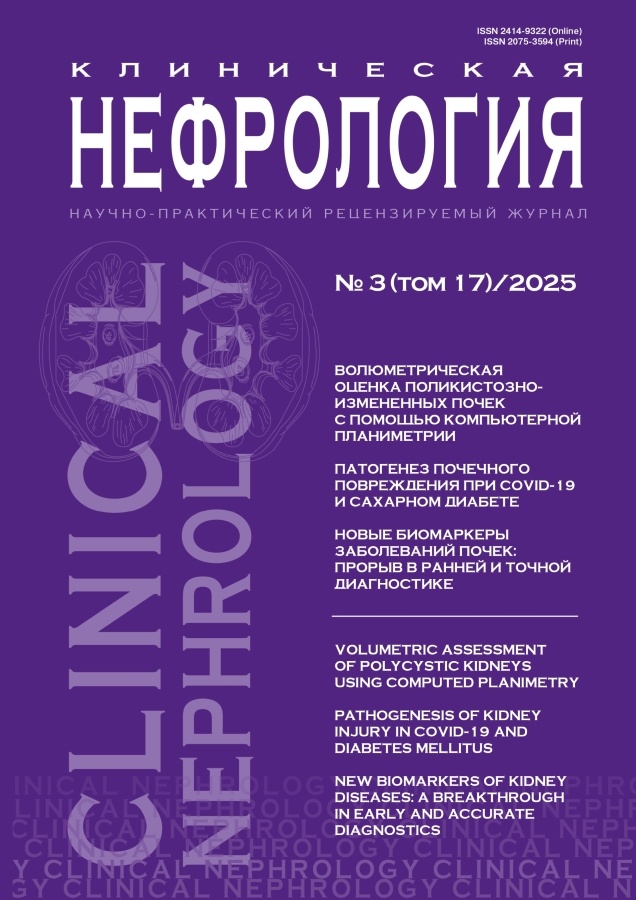
Clinical nephrology
Peer-review scientific medical journal
Editor-in-chief
-
professor Oleg N. Kotenko, MD, Dr. Sci. (Medicine), Chief Specialist in Nephrology of the Moscow Department of Health, Head of the Moscow City Scientific and Practical Center for Nephrology and Pathology of Transplanted Kidney of the City Clinical Hospital No. 52 of the Moscow Department of Health
Publisher
-
LLC “Bionika Media”
Founder
-
Bionika Media Innovations LLC
WEB official
About the journal
The journal supported by:
- Metropolitan Association of Nephrologists
- Scientific Society of Nephrologists of Russia
- Russian Medical Society for Arterial Hypertension
- Creative Association of Pediatric Nephrologists
THE JOURNAL IS THE OFFICIAL BULLETIN OF THE SPECIALIZED COMMISSION OF THE EXPERT COUNCIL OF THE MINISTRY OF HEALTH OF THE RUSSIAN FEDERATION.
Current Issue
 Open Access
 Access granted
 Subscription or Fee Access
Vol 17, No 3 (2025)
- Year: 2025
- Published: 10.10.2025
- Articles: 12
- URL: https://journals.eco-vector.com/2075-3594/issue/view/14074

Original Articles
Adiponectin as an important link in the pathogenesis of protein-energy malnutrition in patients receiving treatment with programmed hemodialysis: yes or no?
Abstract
Objective. Evaluation of the relationship between the blood serum adiponectin level and protein-energy malnutrition (PEM) indices in patients receiving programmed hemodialysis (HD).
Material and methods. A total of 645 patients receiving programmed HD treatment were examined, including 300 men and 345 women aged 56.8±12.8 years. All patients received programmed HD treatment for 8.4±5.3 years. Nutritional status was assessed to diagnose PEM using the method proposed by ISRNM (International Society of Renal Nutrition and Metabolism). Serum adiponectin levels were determined by a method based on a three-stage "sandwich" version of solid-phase enzyme-linked immunosorbent assay using mono- and polyclonal antibodies to adiponectin using the commercial Adiponectin ELISA kit (Mediagnost, Germany), in accordance with the manufacturer's instructions. Reference values for adiponectin were: for women: 3.58–9.66 ng/ml, for men: 2–5.6 ng/ml.
Results. The mean values of adiponectin levels in patients without signs of PEM were 8.4±3.0 ng/ml, and in patients with PEM – 12.1±2.6 ng/ml (p<0.0001). The results of nonparametric correlation analysis revealed negative statistically significant relationships between the serum adiponectin level and the level of the main indicators of nutritional status: total serum protein (Rs = - 0.472; p < 0.0001), serum albumin (Rs = - 0.764; p < 0.0001), serum prealbumin (Rs = - 0.428, p < 0.0001), serum transferrin (Rs = - 0.577; p < 0.0001), blood lymphocytes (Rs = - 0.518; p < 0.0001), arm muscle circumference - AMC (Rs = - 0.618; p < 0.0001), skeletal muscle mass index, according to bioimpedance analysis (Rs = - 0.636; p < 0.0001)) and positive statistically significant relationships between the serum adiponectin level and the percentage of body fat according to bioimpedancemetry (Rs=0.152; p<0.0001).
Conclusion. The obtained data convincingly demonstrated a close relationship between elevated serum adiponectin levels and PEM in patients receiving treatment with programmed HD.
 6-12
6-12


Efficiency of dyslipidemia therapy using Inclisiran in a series of clinical observations of kidney transplant patients
Abstract
Relevance. Dyslipidemia is a risk factor for cardiovascular diseases leading to death in the late period after kidney transplantation.
Objective. Evaluation of the efficacy and safety of combination therapy for dyslipidemia with inclisiran in a group of patients with a transplanted kidney.
Material and methods. A single-center observational uncontrolled cohort study of the efficacy and safety of lipid-lowering therapy (LLT) using inclisiran in a group of patients with dyslipidemia after kidney transplantation was conducted. Data on 10 patients are presented: 8 (80%) women, mean age 39.8±10.5 years. At stage I, basic LLT was prescribed, at stage II, inclisiran was added to the treatment on days 1, 90, and 270. Follow-up period at stage I was 102 days, at stage II – 301 days. Efficacy and safety were assessed at 7 control points. Therapy efficacy was assessed by reducing low-density lipoprotein (LDL) levels, achieving blood LDL level ≤1.4 mmol/L, and the duration of maintaining the achieved effect (days). Blood levels of lipoprotein (a) – Lp(a), triglycerides (TG), and high-density lipoprotein (HDL) were also studied. Safety was assessed based on complaints, general examination and injection site data, alanine aminotransferase (ALT), aspartate aminotransferase (AST), glomerular filtration rate (GFR), blood immunosuppressant drug concentrations, daily proteinuria, and renal ultrasound results.
Results. A decrease in LDL levels by an average of >50% was revealed 30 days after each injection in 6 (60%) patients, and from 8.6 to 46% - in 4 (40%). The dynamics of HDL and TG levels were multidirectional. In 3 patients with elevated Lp(a) levels, a decrease in its level by 5.1–7.4% was revealed. At stage I, basic LLT therapy was ineffective. At stage II, LDL levels ≤1.4 mmol/l were achieved by 2 (20%) patients at points 2 and 3, 5 (50%) patients – at point 4, 3 (30%) – at point 5, 1 (10%) patient – at point 6, and 2 (20%) patients at point 7. A total of 7 patients achieved LDL levels ≤1.4 mmol/l with a median of 47 [IQR: 3; 90] (1; 112) days. LDL levels ≤1.8 mmol/l were achieved in 8 patients with a median of 98.5 [IQR: 61; 236.7] (42; 255) days. In 5 (50%) patients, a decrease in GFR by an average of “minus” 13.6±13.9% (-36.4; -0.1%) was detected. In the remaining 5 (50%) patients, the mean GFR value increased by 15.1±17.3% (1.7%; 42.6%). In all 10 patients, the level of daily proteinuria decreased by an average of 50.4±16.9% (25.6%; 76.9%).
Conclusion. The efficacy of the basic LLT (n=8) in reducing the LDL level compared to the baseline was on average 23.5±10.5% (1.9%; 39.6%) [95% CI 8.9–26.3%], the efficacy of the drug inclisiran was 48.9±20.4% (8.6%; 70.9%) [95% CI 34.3–63.5%]. The efficacy of all applied LLT in all patients was on average 59.9±22.5% (8%; 81.1%) [95% CI 43.8–76.0%]. The median of days with the LDL level ≤1.4 mmol/L in 7 patients was 47 [IQR: 3; 90] (1; 112) days, which amounted to a median share of 15.6% [IQR: 1%; 29.9%] (0.3%; 37.2%) of the total follow-up period (301 days). No side effects indicating poor tolerability of the drug were detected during the use of inclisiran.
13-35
Short-chain fatty acids as predictors of renal function decline in patients with sarcopenia and CHF
Abstract
Objective. Evaluation of the relationship between the blood short-chain fatty acid (SCFA) levels and renal function in patients with sarcopenia and chronic heart failure (CHF).
Material and methods. The study included patients with CHF and sarcopenia who were treated at City Clinical Hospital No. 4 of the Moscow Healthcare Department (2019–2021). Sarcopenia was assessed using bioimpedance analysis, dynamometry, and the SPPB test, renal function was assessed using creatinine levels and the calculated glomerular filtration rate (SCF CKD-EPI), and plasma SCFA levels (C3–C6, including branched acids) were determined by HPLC-MS/MS. Statistical analysis was performed using the R 4.4.2 programming language in the RStudio environment (version 2024.12.0.467).
Results. The study included 74 patients with CHF and sarcopenia (mean age 68.3±5.7 years), who were characterized by high comorbidity: arterial hypertension was observed in 81٪ of patients, coronary artery disease - in 67٪, type 2 diabetes mellitus - in 36٪. Patients were characterized by reduced muscle strength, reduced skeletal muscle mass and limited physical performance. All examined patients showed an increase in SCFA levels compared to reference values. According to the univariate logistic regression data, significant predictors of a decrease in GFR <60 ml/min/1,73 m2 were isovaleric acid (50th percentile, OR=8,93; p<0.001), isobutyric acid (50th percentile, OR=6,69; p<0,001), 2-methylbutyric acid (50th percentile, OR=6,69; p<0,001) and caproic acid (25th percentile, OR=4,11; p=0,0072; 50th percentile, OR=4,60; p=0,0032). Caproic acid was of particular importance: an increase in its level by 25٪ was accompanied by a decrease in GFR by -2,26 ml/min/1,73 m2.
Conclusion. The study showed that in patients with sarcopenia and CHF, increased blood SCFA concentrations, in particular caproic, isovaleric, isobutyric and 2-methylbutyric, are associated with a significant decrease in GFR.
36-43
Use of tocilizumab in treatment of chronic active antibody mediated kidney transplant rejection
Abstract
Objective: to evaluate the safety and efficacy of tocilizumab in the treatment of chronic active antibody-mediated kidney transplant rejection.
Material and methods: A prospective study of tocilizumab use in the treatment of morphologically verified chronic active antibody-mediated transplant rejection was conducted in 15 kidney recipients.
Results and conclusion: in recipients who lost their graft function during the observation period, a high chronicity index was found according to morphological examination of the graft. After administration of tocilizumab, a decrease in the level of microvascular inflammation was observed.
44-50
Relationship between nutritional insufficiency and progression of acute kidney injury in children with signs of multiple organ failure
Abstract
Background. Acute kidney injury (AKI) remains one of the most common and severe forms of organ dysfunction in children in intensive care units. According to current data, the incidence of AKI in critically ill children reaches 30 to 50% and increases significantly in the presence of sepsis, systemic inflammatory response, multiple organ failure, and massive infusion therapy. Clinical and laboratory signs of AKI include a decrease in the rate of diuresis, an increase in creatinine levels, and disturbances in electrolyte and acid-base balances.
Objective. Assessment of the relationship between the nutritional deficiency and the progression of AKI in children in critical condition.
Material and methods. The study included 56 children with AKI, who were stratified into groups by the degree of protein-energy malnutrition. Anthropometric and laboratory parameters were assessed, including albumin and prealbumin levels, diuresis rate, and duration of renal dysfunction.
Results. A significant relationship between the severity of nutritional deficiency and the prolongation of the AKI period was established. Patients with severe protein-energy malnutrition had a significant decrease in protein markers, a longer course of oliguria, and an increased incidence of complications.
Conclusion. Nutritional deficiency has an adverse effect on the course of AKI in children. Protein metabolism markers can be used to assess prognosis and select treatment tactics in intensive care.
51-55
Mechanisms of regulation of compensatory platelet response in nephrolithiasis-associated hematuria in women with the follicular phase of the cycle
Abstract
Objective. Evaluation of the severity of hematuria, the blood estradiol (Es) and progesterone (Pr) levels, the functional activity of platelet receptors and determination of the features of regulation of the platelet component of hemostasis in women with the follicular phase (FF) of the cycle.
Material and methods. The study included 59 women of reproductive age with nephrolithiasis, in whom hematuria was detected during examination. The blood Es and Pr levels were studied on the UniCel DxI 800 analyzer. The activity of purine P2Y- and PX1-receptors, TR-receptor, α2-adrenoreceptor, GPVI-receptor, PAF-receptor and adenosine A2A-receptor was analyzed. Receptor agonists were used in concentrations of EC50 and EC10. Platelet aggregation was assessed by the turbidimetric method on the ChronoLog analyzer. Statistical analysis was performed using the MedCalc package.
Results. In the examined contingent of women, the Es level was in the range of 164,3±5,0 pg/ml, and Pr – 0,44±0,04 ng/ml. The analysis of the platelet receptor apparatus revealed hyperreactivity of the PAF receptor and P2X1 receptor, normoreactivity of the purine P2Y receptors, A2A receptor and TR receptor, hyporeactivity of the GPVI receptor and α2-adrenoreceptor. The revealed dependence of hematuria on the Es level was associated with negative modulation of the signaling of the P2Y receptors, α2-adrenoreceptor and TR receptor. The compensatory platelet response was achieved due to the synergism of the P2Y receptors, P2X1 receptor and PAF receptor. The maximum effect of aggregation in vitro was reproduced during the interaction of purine P2Y receptors and P2X1 receptor, which was associated with an increase in the intracellular Ca2+ level of as a result of co-activation of signaling through Gq and Gi proteins and the opening of the ATP-dependent cation channel.
Conclusion. Understanding the mechanisms of modulation of compensatory platelet response in women with follicular phase of the cycle is necessary for the development of a strategy for personalized diagnostics and treatment of complications of nephrolithiasis.
56-61
Nephrourology
Volumetric assessment of polycystic kidneys using computerized planimetry: analysis of accuracy and clinical significance
Abstract
Background. Autosomal dominant polycystic kidney disease (ADPKD) is a hereditary disorder characterized by the progressive growth of multiple cysts in both kidneys. An increase in total kidney volume (TKV), reflecting the growth of both cysts and (to a lesser extent) noncystic parenchyma, is a key biomarker of disease progression. Accurate assessment of TKV is critical for: 1. Early prediction of the rate of decline in renal function. 2. Patient selection for clinical trials of new drugs. 3. Assessing the effectiveness of specific therapy aimed at slowing cyst growth (e.g., tolvaptan). 4. Assessing the effectiveness of transarterial embolization as part of pretransplant preparation in patients undergoing nephrectomy. Magnetic resonance imaging (MRI) is often used to measure TKV, but computed tomography (CT) remains a widely available and frequently performed imaging modality in patients with ARPKD (e.g., for evaluation of hematuria, urolithiasis, or suspected tumor). Manual planimetry on CT images has historically been considered the “gold standard” for measuring the volume of complex structures, such as polycystic kidneys. However, this method is time-consuming and labor-intensive.
Objective. Evaluation of the accuracy, reproducibility, and clinical utility of computerized planimetry for measuring TKV in ARPKD.
Materials and methods. This prospective study included 20 patients with ARPKD and ESRD (40 kidneys) who underwent multislice computed tomography of the kidneys and retroperitoneal organs. The volume of each kidney was measured using manual planimetry on a workstation (a Toshiba Aquilion Prime 160-slice volumetric CT system (Japan) and an Agfa digital system). Measurements were performed by two independent radiologists to assess interoperator agreement. To assess intraoperator agreement, one radiologist performed measurements twice, 2 weeks apart. The volumes obtained by planimetry were compared with those calculated using the ellipsoid formula (Length × Width × Thickness × π/6).
Results. The mean kidney volume by planimetry was 5208.9 ± 452 ml (range: 1065–17926 ml). Ellipsoid-based volume estimates systematically underestimated true volume (mean difference 7.14%, p < 0.001), especially in patients with severe cystic kidney deformation. Inter- and intra-observer agreement (ICC = 0.987) and inter-observer agreement (ICC = 0.994) were exceptionally high.
Conclusion. Computerized planimetry is a highly accurate and reproducible method for estimating the volume of polycystic kidneys, significantly outperforming ellipsoid-based estimates. This method provides an objective and reliable quantitative measure of total renal parenchyma and cyst volume, which is important for monitoring ARPKD progression, assessing response to therapy (e.g., tolvaptan), and predicting renal function, as well as for evaluating the efficacy of transarterial embolization to assess volume reduction in polycystic kidneys.
62-66
Clinical case
Acute kidney and liver damage in chronic alcohol intoxication
Abstract
Background. Alcoholism is a serious medical, social and economic problem of the 21st century. Regular alcohol consumption in a dose of 60-80 g/day or at least three times a week or a single consumption of ≥300 ml of vodka increases the risk of developing structural and functional changes in the kidneys, liver, pancreas, central nervous system and heart. Acute kidney injury (AKI) is a widespread polyetiological syndrome characterized by a sharp decrease in renal filtration (hypercreatininemia, decreased glomerular filtration rate, decreased diuresis). In alcohol intoxication, liver damage of varying severity is often detected, and the presence of AKI worsens the prognosis of the disease. However, with timely diagnosis and adequate therapy, AKI is reversible in most cases.
Description of the clinical case. The article considers a case of liver damage complicated by AKI in an elderly patient with obesity who had been abusing alcohol for a long time. According to the clinical and laboratory examination conducted at the time of hospitalization and during treatment, the following changes in peripheral blood parameters were noted: leukocytes (24,6×10⁹/l → 7,5×10⁹/l), platelets (603×10⁹/l → 446×10⁹/l), C-reactive protein (240,7 mg/l → 95,7 mg/l), γ-glutamyl transpeptidase (372 U/L → 175 U/L), alanine aminotransferase (49,1 U/l → 27,3 U/l), D-dimer (2,54 → 3,21), creatinine (146 μmol/l → 90 μmol/l), glomerular filtration rate (43 ml/min → 80 ml/min). In addition, the patient had elevated fibrinogen, ferritin, thyroid-stimulating hormone, cystatin C, and rheumatoid factor levels. According to FibroScan, grade F2 liver fibrosis was diagnosed. Instrumental examination revealed atherosclerotic lesions of the carotid and femoral arteries, left ventricle diastolic dysfunction, left atrium dilation, as well as non-erosive gastroesophageal reflux disease and erosive lesions of the gastric mucosa. The article also discusses the mechanisms of kidney and liver damage in chronic alcohol intoxication.
67-75
Literature Reviews
Clinical and epidemiological data on catheter-associated bloodstream infections among patients undergoing hemodialysis treatment
Abstract
This literature review analyzes data on the prevalence of catheter-associated bloodstream infection (CABI) in patients receiving renal replacement therapy by hemodialysis. Key epidemiological indicators, including the incidence of CABI, the spectrum of main pathogens and risk factors are considered in detail. Current data on complex preventive measures, including the use of antimicrobial solutions for closing the catheter, antiseptic barrier caps, are presented. The effectiveness of transparent adhesive dressings with chlorhexidine gluconate, local antiseptic and antibacterial ointments is discussed. The importance of early detection of infection and timely administration of empirical antimicrobial therapy is emphasized.
76-80
Pathogenesis of kidney injury in COVID-19 and diabetes mellitus: a review of current concepts
Abstract
Acute kidney injury (AKI) is a common complication in patients with COVID-19, as confirmed by numerous studies. The prevalence of AKI in COVID-19 varies widely (0,5–80,3%) depending on the severity of the disease. AKI in COVID-19 can be caused by both direct viral effects on the kidneys and an excessive inflammatory response of the body (cytokine storm), as well as hypoxemia and coagulopathy. Direct kidney damage by SARS-CoV-2 via ACE2 receptors in the renal epithelium can lead to tubular and glomerular damage, increasing inflammation and impairing renal function. Also, in patients with diabetes mellitus (DM), these processes can be further aggravated by diabetic nephropathy, which makes the kidneys more vulnerable to damage in COVID-19. Despite this, the classical diagnostic method based on creatinine levels does not have high specificity for the early detection of AKI, since even with a 50% decrease in kidney function, creatinine levels can remain within the normal range. This can lead to late diagnosis of AKI, reduced treatment effectiveness and increased mortality rates. Therefore, further studies to assess the diagnostic accuracy and prognostic value of new markers for the early detection of AKI in patients with COVID-19 are required. This review covers key aspects such as the prevalence and clinical and morphological forms of kidney injury in COVID-19, pathogenetic mechanisms of kidney injury in COVID-19, pathogenetic mechanisms of kidney injury in diabetes mellitus and modern markers for the diagnosis of acute kidney injury in patients with diabetes mellitus and COVID-19. For this review, 25 sources from the PubMed, Google Scholar and CyberLeninka databases were used.
81-84
Лекция
New biomarkers of kidney diseases: a breakthrough in early and accurate diagnostics
Abstract
Kidney diseases pose a significant threat to public health worldwide, with early detection, timely intervention, and accurate monitoring being critical to prevent progression to end-stage kidney disease and improve patient outcomes. However, traditional markers of kidney disease, such as serum creatinine, blood urea nitrogen, and estimated glomerular filtration rate, have limitations in sensitivity and specificity in detecting early renal dysfunction. In recent years, rapid advances in molecular biology, proteomics, and metabolomics have led to the discovery of a number of new biomarkers that are gradually finding application in clinical practice. This mini-review discusses some of the emerging biomarkers of kidney disease, including cystatin C (Cys-C), neutrophil gelatinase-associated lipocalin (NGAL), and kidney injury molecule-1 (KIM-1), which have become valuable tools for the early detection of renal failure, paving the way for improved clinical management and quality of patient care. Despite the enormous potential of these markers, issues such as standardization, cost-effectiveness, and large-scale validation still need to be addressed before they can be widely used. Future research should be aimed at optimizing detection methods, establishing clinical decision thresholds, and assessing the value of these markers in personalized medicine, thereby paving new avenues for accurate diagnosis and treatment of kidney diseases.
85-89
Организация нефрологической службы
ISPD Position Statement on Assisted Peritoneal Dialysis
90-100