





Priroda
Popular science journal of the Russian Academy of Sciences.
Editor-in-Chief
- Aleksey V. Lopatin, Academician of the Russian Academy of Sciences, Doctor of Biological Sciences (Borisyak Palaeontological Institute of RAS (Moscow))
Publisher
- Publishing House "Science"
Indexing
- RSCI
- CrossRef
- Google Scholar
Frequency of release
- 12 issues per year
About journal
Published since 1912. The journal is peer-reviewed and included in the List of Higher Attestation Commissions for publishing works of applicants for academic degrees.
Priroda is a kind of constantly updated encyclopedia of the natural sciences. Articles published in the journal reflect the most relevant and interesting modern scientific achievements. Priroda is still a journal for self-education, keeping the traditions of its creators.
Current Issue
 Open Access
 Access granted
 Subscription or Fee Access
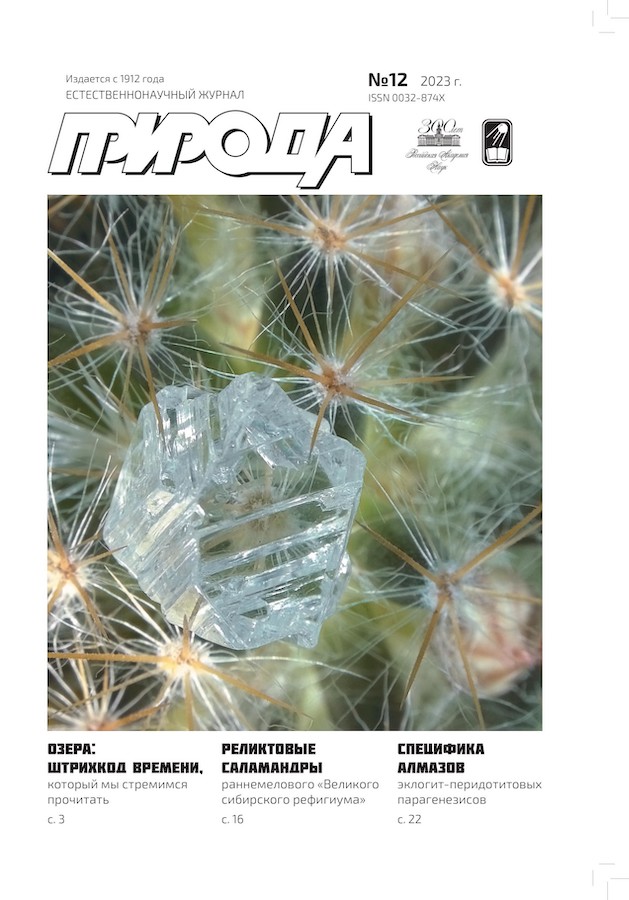
No 12 (2023)

Lakes: a Barcode of Time
Abstract
Palaeolimnology is the science that focuses on of ancient natural archives preserved in lake sediments. Lakes accumulate gigabytes of information on the evolution of the natural landscapes of the lake’s catchment area as well as the entire region in which the lake is located. The data contained in these palaeorecords can span millennia or even millions of years for large, long-lived lakes. The lake preserves information about vegetation, climate, geology, aquatic life, and even the people who inhabited its shores. This information creates some kind of a barcode of the time period that we seek to read. Lake palaeoarchives are used to reconstruct past environmental conditions both qualitatively and quantitatively. They are also used in the global climate modeling.
Priroda. 2023;(12):3-15
 3-15
3-15


Relict Early Cretaceous Salamanders of the “Great Siberian Refugium”
Abstract
Primitive salamanders found in the Lower Cretaceous localities of Shestakovo 1 (Kemerovo Oblast) and Teete (Republic of Sakha (Yakutia)) are relict forms for the Early Cretaceous. These salamanders are an important component of the unique fauna of the Early Cretaceous “Great Siberian Refugium”, a vast northeastern part of the Asian continent with numerous relict vertebrates of Jurassic origin. A possible reason for the existence of “Great Siberian Refugium” was the absence of serious climatic changes and catastrophic events in this area in the Late Jurassic — Early Cretaceous.
Priroda. 2023;(12):16-21
16-21
The Specifics of Diamonds of Eclogitic and Peridotitic Paragenesis: Petrological Applications
Abstract
Morphology, inner structure, impurity composition, and mineral inclusions of 50 diamond plates from six deposits of Yakutia have been studied. All pipes are predominated by аcrystals of ultramafic paragenesis. The nature of the diamond growth and distribution of some inclusions on the interface of growing diamond zones are found to be discrete. In comparison with P-type diamonds, E-type crystals are characterized by higher total nitrogen and hydrogen content as well as by high percent of zonal crystals. Higher productivity of early diamond generation of P-type diamonds has been shown for the Daldyn-Alakitsky region, while in the Malo-Botubinsky region, the significant part of diamonds was formed at the late phases of lithosphere evolution during metasomatic processes. We also present data on diamond-bearing xenoliths (mainly eclogites) from the Udachnaya and Nyurbinskaya pipes as well as information on the features of the internal structure and variations in the isotopic composition of carbon in diamonds from these unique mantle rocks.
Priroda. 2023;(12):22-30
22-30
Parasites Are Not Created Equal: On the Difference in the Strategy of the Plant’s Immune Response When Attacked by a Biotroph or a Necrotroph
Abstract
In nature, a host plant is affected not by a specific pathogen of faunal or floral origin, but by a mixed infection. The soil community of pathogen organisms is mostly represented by necrotrophs: imperfect fungi, nonseptate mycelia of lower fungi, and putrefactive bacteria. On the contrary, vegetative organs of plants are attacked by specialized pathogenic organisms that are spread in the form of spores or, in a case of a viral infection, by insect vectors. The spectrum of pathogens also depends on the phase of plant development. The consideration of positive and negative effects of pathogens from a mixed infection at the level of interference of immune response signaling pathways is important for creation of various immunization schedules.
Priroda. 2023;(12):31-35
31-35
Every Fish Is Not a Sturgeon: On the Problem of Nepheline Ordering
Abstract
Nepheline with idealized formula KNa3[Al4Si4O16] is a widespread rock-forming mineral of alkaline rocks. Nepheline from the high-temperature pneumatolyte association of the Grauliai deposit (Eifel volcanic region, Germany) has been investigated by means of single-crystal X-ray structure analysis and infrared spectroscopy. Hexagonal unit-cell parameters are: a = 10.0438(1), c = 8.4145(1) Å, space group P63. It was established that nepheline from Grauliai region is disordered in Al and Si over the framework tetrahedral sites. Nepheline is considered to be the second most important type of aluminum raw material and is widely used in ceramics, leather, rubber, textiles, wood, and the oil industry.
Priroda. 2023;(12):36-40
36-40
2023 Nobel Prize Laureates in Physics: Pierre Agostini, Ferenc Krausz and Anne L’Huillier
Abstract
The new Nobel Prize in Physics honors the pioneers of attophysics, Pierre Agostini, Ferenc Krausz and Anne L’Huillier. Their work on the experimental and theoretical study of the nonlinear interaction of high-power laser radiation with gas atoms made it possible to advance into the area of much shorter time intervals compared to previous femtosecond ones, to attosecond intervals. The generation of pulses of electromagnetic radiation on this time scale provides possibility to study the dynamics of processes occurring in atoms, molecules, and solids with electrons — for example, to monitor the dynamics of photoionization.
Priroda. 2023;(12):41-47
41-47
2023 Nobel Prize Laureates in Chemistry: Aleksey Ekimov, Louis Brus and Moungi Bawendi
Abstract
In 2023, the Nobel Prize in Chemistry was awarded to Aleksey Ekimov (Yekimov), Louis Brus and Moungi Bawendi for their work in the 80s and early 90s of the last century, which became the foundation of the physics and technology of zero-dimensional structures, quantum dots. Quantum dots are crystals of semiconductors of nanometer size (nanocrystals), with the properties determined by the quantum size eff ect. Nowadays quantum dots are widely used in various areas as optoelectronics, photovoltaics, biology, and medicine, and their synthesis is constantly being improved.
Priroda. 2023;(12):48-63
48-63
2023 Nobel Prize Laureates in Physiology or Medicine: Katalin Karikó and Drew Weissman
Abstract
The Nobel Prize in Physiology or Medicine in 2023 was awarded to American researchers Katalin Karikó and Drew Weissman “for their discoveries concerning nucleoside base modifications that enabled the development of effective mRNA vaccines against COVID-19.” The laureates for decades have been searching for strategies to create mRNA-based vaccines and drugs. A method of RNA modification, described by them in 2005, made the creation of mRNA vaccines and mRNA drugs possible. The resulted technology made it possible to use mRNA as a tool for delivering genetic information into cells and into the body. This breakthrough became the basis for the creation of mRNA-based vaccines, which have shown high effectiveness in the fight against infectious diseases and opened the prospect of creating individual anti-cancer mRNA vaccines. The work of Katalin Karikó and Drew Weissman formed the basis of the most widespread vaccines against COVID-19 from Pfizer/BioNTech and Moderna. Although the latest pandemic facilitated creation of a whole set of eff ective vaccines (for example, Sputnik-V), the mRNA vaccines are considered the most innovative and technologically advanced.
Priroda. 2023;(12):64-71
64-71