


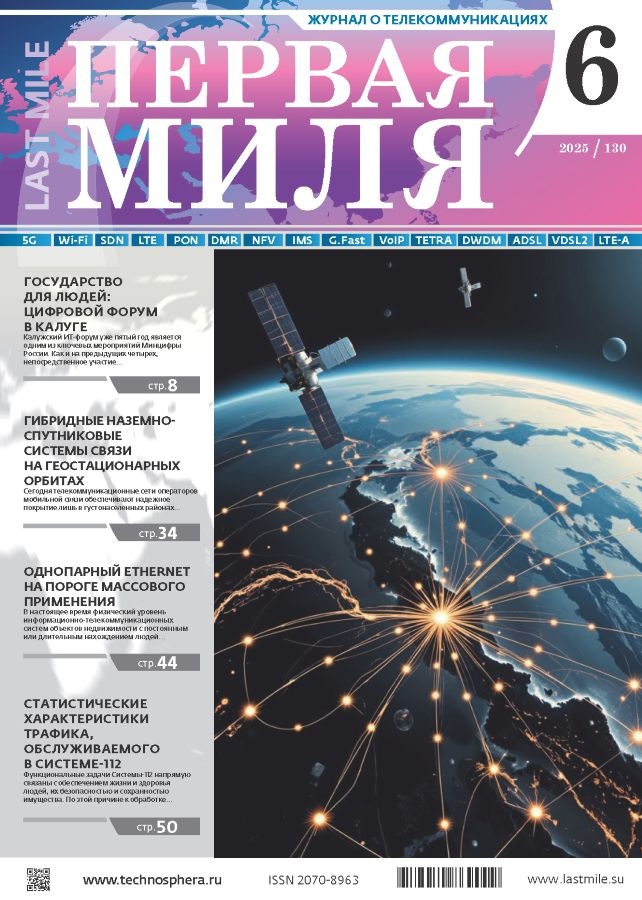
Last Mile
Scientific and technical peer-reviewed journal.
Editor-in-Chief
-
Sergey A. Popov, Ph.D., associate professor, has the degree "Master of Communication".
Publisher
- Associate Printing-and-Publication Centrer "Technosphera"
Founder
- Associate Printing-and-Publication Centrer "Technosphera"
Indexing
- RSCI
- CrossRef
- Ulrich's Periodicals Directory
- Google Scholar
- WorldCat
Frequency
- 8 issues a year
About journal
Journal Last Mile is a Russian scientific and technical journal. Is published in Moscow since 2007.
The publication presents the “last mile” wireless technologies state-of-art, technologies and equipment, design, and building access networks approaches. Within the journal's field of view, there is a wide topics spectrum: from theoretical aspects of designing telecommunication systems to subscribers broadband access networks practical issues, from the components base to telecommunication cables.
Major journal headlines
- Wireless broadband information transfer networks
- Wired broadband networks
- Packed based broadband information transfer networks
- Fiber Optics technologies and equipment
- Communication cables: optical and copper
- Passive communication networking equipment
- Test and measure equipment
- Professional mobile communications
- Information security
- Operator’s cloud
- Expert’s opinion
Current Issue
 Open Access
 Access granted
 Subscription or Fee Access
No 6 (2025)

ВЫСТАВКИ И КОНФЕРЕНЦИИ
State forthe people: digital forum in Kaluga
Abstract
On August 7–8 in Kaluga, under the auspices of the Ministry of Digital Development, Communications and Mass Communications of the Russian Federation, the VI All-Russian Forum "Digital Evolution" took place. Special attention was paid to organizing support measures for the participants of the Special Military Operation and their family members in a proactive manner and the use of artificial intelligence in state and municipal services.
 8-13
8-13


WIRELESS COMMUNICATION
Convergent next generation communication networks: architectural principles and implementation of deep integration of PMR and LTE
Abstract
The paper discusses modern approaches to building convergent communication networks that combine reliability of traditional professional mobile radio communication systems with the broadband capabilities of LTE/5G technologies. Using solutions from Hytera as an example, the architectural features, end-to-end integration mechanisms, and practical aspects of implementing such systems in industrial enterprises are analyzed. Special attention is paid to the technological aspects of integrating heterogeneous networks, ensuring uninterrupted communication, and creating a unified communication space for critical services.
18-21
Positioning in wireless local networks Wi-Fi standard IEEE 802.11az. Part 3. Influence of physical layer parameters
Abstract
The work concludes a series dedicated to positioning in wireless local networks Wi-Fi standard IEEE 802.11az. The paper analyzes the physical layer parameters that contribute to achieving decimeter-level positioning accuracy in wireless local networks of the IEEE 802.11az standard in a multipath scenario. The impact of channel width, guard interval duration, and MIMO technology is shown. Qualitative analysis is accompanied by quantitative assessment using simulation modeling to study influence of parameters on positioning accuracy, considering previously reviewed models of IEEE 802.11az networks and multipath radio channels at the physical layer.
22-32
SATELLITE TELECOMMUNICATIONS
Status analysis and development trends of hybrid ground-satellite communication systems in geostationary orbits
Abstract
This paper presents modern methods for achieving global communication coverage through NTN networks. The work provides an analysis of two key architectures: Non-geostationary-satellite networks (Non-GSO) and geostationary orbit systems (GSO). Particular attention is paid to implemented direct-to-device satellite projects via GSO, such as Tiantong and Skylo, which enable the use of standard smartphones without additional equipment. The advantages and limitations of each approach are examined, as well as their potential as an alternative to Non-GSO-based services. In conclusion, the prospects for implementing similar technologies in Russia using domestic satellite constellations to ensure connectivity are discussed.
34-40
CABLES AND PASSIVE EQUIPMENT
42-43
Single-pair Ethernetis on the threshold of mass application
Abstract
The current processes of standardization of single-pair Ethernet technology are considered and a conclusion is made about possibility of starting its mass use in the near future. It is indicated that the focal area of its application is the digital ceiling. The objective technical and economic attractiveness of single-pair Ethernet in the mass practice of implementing information system projects is shown.
44-49
БЕЗОПАСНОСТЬ
Statisticalcharacteristics ofthe trafficserved by System-112
Abstract
The results of the analysis of traffic statistical characteristics that was serviced by the operators of the System-112 in one of the subjects of the Russian Federation are presented. A number of patterns of the studied traffic were revealed. An algorithm is proposed for managing overloads that occur with a sharp increase in the number of requests to the System-112. The directions of further work are formulated.
50-56
EXPERT OPINION
For whom the bell tolls
Abstract
Modern emergency notification systems that accumulate information flows from potentially hazardous objects, signals from the public and emergency services, as well as distribute control signals from decision-making centers, are rapidly developing, transforming not only into universal and multiservice systems but also becoming a tool of state governance. In our country, they have undergone seven stages, during which concepts were formed, networks developed, equipment created, and new services connected.
58-64
Microprocessors without‘backdoors’: why Russia needsits own chips
66-67
PRODUCTION
68-69
DATA CENTERS
Fiber-opticsolutionsfor data centres with packetinterfaces based on Ethernet. Part 5. Choosing connectors and cablesfor data centres
Abstract
This paper series explores the use of fiber optic solutions to support high transmission rates in data centres, including standardisation of Ethernet solutions for flows from 100 to 1600 Gbps (Part 1); data centre solutions using fiber optic technology (part 2); evolution of pluggable optical transceiver modules (transceivers) for data centres (part 3); standardised coherent solutions for DCI data centre interconnect networks (part 4); and connector and cable selection for data centres (part 5).
70-78