

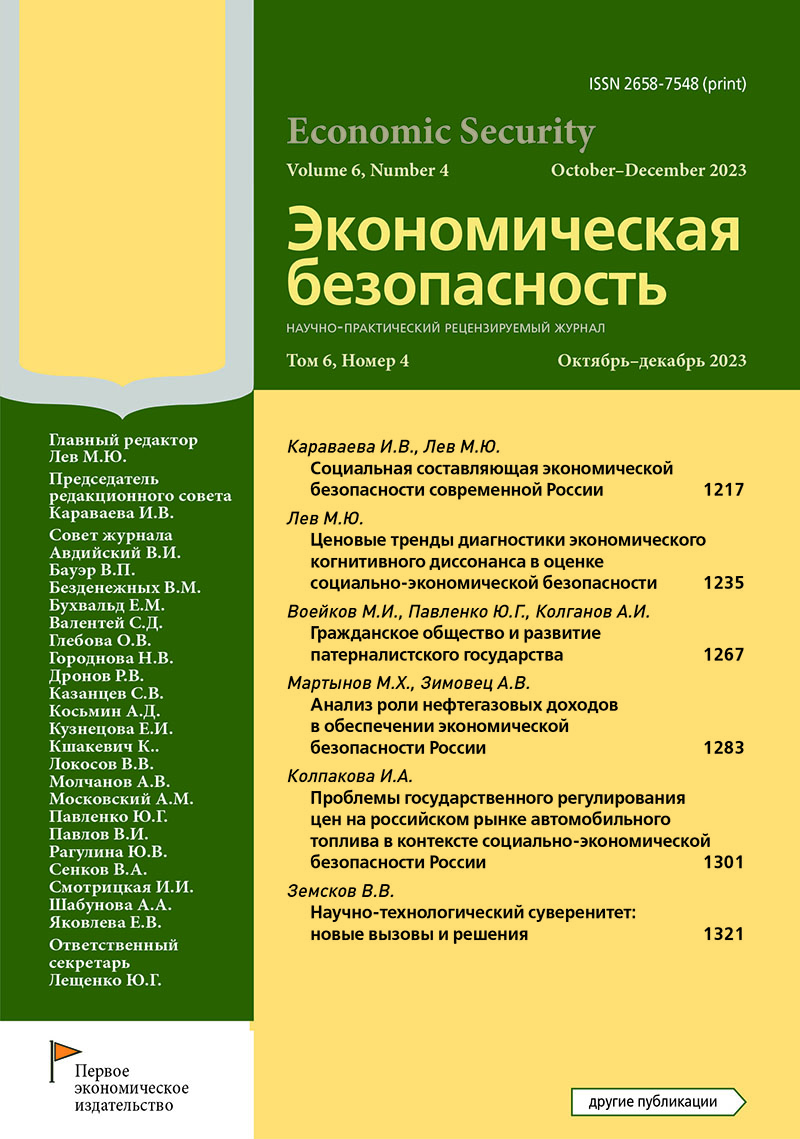
Economic Security

Peer-review quarterly economic journal

Editor-in-Chief

  • Lev Mikhail, leading researcher of the Institute of Economics of the Russian Academy of Sciences

Publisher

  • PRIMEC Publishers

About journal

Economic security - peer-reviewed journal devoted to modern tools and methods of economic security research from basic science to practical implementation and application in various economic sectors.
The main topics include the following issues: national and state economic interests and goals of Russia, defense and industrial security, international and foreign economic security, financial, energy, socio-economic and food security, as well as economic security of state competitiveness, economic security of business activity and monitoring of economic security indicators.
The journal publishes original research papers, analytical reviews, book reviews, announcements and resolutions of scientific and industry events, as well as other materials in this field of research.
All materials are subject to mandatory review with the involvement of leading Russian and foreign experts.

Indexation

Publications

  • quarterly, 4 issues per year
  • in English and Russian 

Announcements More Announcements...

 
No announcements have been published.

Current Issue

Open Access Open Access  Restricted Access Access granted  Restricted Access Subscription or Fee Access

Vol 7, No 3 (2024)

Cover Page

Full Issue

Open Access Open Access
Restricted Access Access granted
Restricted Access Subscription or Fee Access

Articles

Syndinic method for identifying and analyzing hazards for digital platform participants
Burak P.I., Bauer V.P.
Abstract
The digital platforms of the modern economy play a leading role in managing the reliability and sustainability of digital ecosystems, as they are institutions that determine the interconnectedness, efficiency, competitiveness, integration, assimilation, co-evolution and adaptation of companies of different economic affiliations that form the infrastructure of these ecosystems. Digital platforms are characterized by the presence of a large number of participants, resources, transactions, and other information flows that are heterogeneous in composition and function. One of the approaches to ensuring the effectiveness of digital platforms is the preventive management of the risks of their participants. Due to the complexity of solving the problem, the article presents an intermediate result of studying this issue. It concerns the consideration of the syndinic (qualitative) method of identifying and analyzing dangers for participants in digital platforms in the categories of syndinic deficiencies and dissonances, the study of which in the five-dimensional hyperspace of danger components (syndinics) precedes the selection and application of risk management tools. The results of the article linked to the subsequent solution of problems of ensuring the economic security of digital platforms.
Economic Security. 2024;7(3):499-522
pages 499-522 views
Prospects for creating a multipolar global financial system
Zhizhenko Y.P., Medvedeva M.B.
Abstract
This article examines the main trends in the development of the global financial system. The main trends are as follows: currency polycentrism and digitalization, the formation and functioning of decentralized finance (DeFi), and the relationship of this model of organizing finance with centralized finance. The authors analyze such phenomena as the rapid development of innovative technology in the financial market infrastructure, the process of changing the economic leader of the world economy (China is becoming the leader), and the growing global imbalances. It is concluded that due to the high exposure of financial markets to geopolitical risks, alternative currencies are increasing their share in the structure of international settlements and reserves, and gold is still an important global reserve asset.
Economic Security. 2024;7(3):523-534
pages 523-534 views
Quantum verification of the financial system for security purposes
Leshchenko Y.G.
Abstract
The study provides an analytical overview and evaluation of the Leap project, which tested a quantum-resistant and secure IT environment in the context of the participating central banks. The Leap project is a joint experiment between IH BIS, Banque de France, Deutsche Bundesbank and ECB aimed at quantum verification of the financial system. The article examines the prerequisites for quantum verification of the financial system on the basis of national strategies, initiatives and global funding for quantum technology. Leap project functionality was analyzed. The components of the Leap project, such as cryptographic flexibility, performance, and security, were evaluated. Finally, recommendations for the future policy of quantum technology are formulated, which will contribute to an effective transition to a quantum financial system.
Economic Security. 2024;7(3):535-558
pages 535-558 views
Digital currencies of central banks: foreign experience and Russian practice
Bolonina S.E., Buleev V.A.
Abstract
The article examines foreign experience and Russian practice in the field of CBDC. On the example of individual countries, the concepts of CBDC implementation are analyzed. The factors determining the driving forces of CBDC development are identified. The results of the study conducted by the Bank for International Settlements on the relevance of the introduction of CBDC (wholesale and retail) according to financial criteria in both developed and developing countries are presented. The main advantages of the introduction of the digital ruble in Russia are substantiated. The current Russian experience with the introduction of the digital ruble shows that the Bank of Russia has used an integrated approach in developing the concept and platform of the digital national currency. It is concluded that despite the listed advantages of the CBDC, its release may face a number of problems, including distrust of the authorities and their initiatives, misunderstanding and unwillingness of society to use a centralized digital currency.
Economic Security. 2024;7(3):559-576
pages 559-576 views
Theoretical and bibliographic study of economic security in the context of deglobalization, trade protectionism and GVC transformation
Drobot E.V., Makarov I.N.
Abstract
By the end of the first quarter of the 21st century, the problems of economic security are extremely relevant and arouse the interest of theorists and practitioners. This is due not only to the economic crises of recent decades, including the crisis caused by the COVID-19 pandemic, but also to the consequences of the aggravation of the confrontation of the countries of the collective West with the Russian Federation as a result of a special military operation in Ukraine. All this has led to disruptions in global value chains. Under these conditions, the growth of geopolitical tensions exacerbates the uncertainty of the economic situation and creates additional threats to the existence of global value chains that have been developing for several decades. The article highlights the main terms and concepts related to the peculiarities of global value chains in the first quarter of the 21st century. On this basis, the authors’cause-and-effect model of the impact of trade protectionism on the GVC transformation is developed. Keywords:
Economic Security. 2024;7(3):577-602
pages 577-602 views
Reducing integral structural risks of network structures on the example of forestry industry
Bezdenezhnyh V.M., Sinyavskiy N.G.
Abstract
The relevance of the issues discussed in the article is due to the fact that in practice corporate structures are often formed without taking into account risk assessment. The article emphasizes the expediency of structuring production processes taking into account the risk structure by introducing the concept of structural integral risk. To assess structural integral risks, the tools of graph theory and probability theory are used. The integral risk assessment is carried out on the example of a typical structure of a wood firm. The assessment of integral structural risks is carried out under the assumption of sufficiency of quality work, at least one technological chain connecting the initial and final stages of production. It is shown that if the structure is formed without taking into account the risks, the initial structural risk, i.e. the risk of poor quality operation of the company without additional measures, may be too large. For the considered example, measures to reduce the initial structural integral risk are proposed. These measures consist both in influencing individual elementary risks and their totality and in improving the risk structure.
Economic Security. 2024;7(3):603-614
pages 603-614 views
Mechanisms of developing the radio electronics in Russia
Podgaetskiy N.A.
Abstract
This article is devoted to a comprehensive analysis of the factors hindering the neo-industrialization of the radio-electronics in Russia. The article presents typical mechanisms for innovative development of countries with advanced radio electronic industries. The list of activities carried out by the government of the Russian Federation within the framework of the state strategy for the formation of an innovative model of electronic economic activity is highlighted. The results obtained show the need for fundamental changes in the system of government management of industry companies. The significance of the influence of information barriers on the effectiveness of the practical implementation of these measures for neo-industrialization of the industry is shown. The conclusions of the research will contribute to a systematic approach in management activities for the implementation of currently ongoing legislative and administrative initiatives to transfer domestic industry to the modern path of innovative development.
Economic Security. 2024;7(3):615-632
pages 615-632 views
Corporate risk culture planning: theoretical and practical aspects
Tsakaev A.K.
Abstract
The article reflects the results of a study on the issues of planning corporate risk culture in a new digital and polycentric reality. Corporate risk culture is considered as a basic element of the risk management system and an important part of the risk management policy. Improving the quality of the process and effectiveness of risk management in a public company cannot be achieved without continuous growth of corporate risk culture. The article provides a comprehensive consideration of planning corporate risk culture within the framework of risk management process, risk management system and risk management policy. It is proposed to conduct an independent assessment of the level of corporate risk culture of public companies. The assessment should be carried out by the Moscow Stock Exchange. To calculate the integral index of the level of corporate risk culture, a six-factor regression model similar to the Altman's Z-score model is used. To calculate the regression coefficients in the proposed model, it is suggested to use information about public companies that have gone bankrupt in the last 3-5 years. The author also talks about risk capital planning as an indicator of risk culture balance (the first of the six indicators of the model) and about the Consolidated Register and Risk Passports as tools for planning corporate risk culture.
Economic Security. 2024;7(3):633-652
pages 633-652 views
Current trends in the production and consumption of energy resources in terms of the country's energy security
Verstina N.G., .
Abstract
The article raises the question of the relationship between the country's energy security and the "production-consumption" of energy resources in the changed geopolitical conditions. Based on a comprehensive analysis of the global energy markets, the authors identify the current trends in the production and consumption of energy resources. The authors point out the leading countries, among which Russia has a stable position in the world. On the basis of forecasts, taking into account the methodology of fuel and energy balances (FEB), the study determines the features of ensuring energy security at the level of the world economy and in the context of individual countries, differentiated by types of both primary energy resources and resources produced with their use. The prospects of ensuring the energy security of the countries of the world are determined, taking into account their resource potential and economic structure. It is suggested to use the obtained results for strategic planning of energy development in Russia with priority attention to energy security issues.
Economic Security. 2024;7(3):653-672
pages 653-672 views
The evolution of utility rates in Russia: an institutional-historical digression
Lev M.Y.
Abstract
The article examines the theoretical justifications and rules for setting tariffs, which, even in theory, cannot be unambiguously identified to ensure the optimal use of resources by public utilities. In fact, in the absence of a generally accepted theory of state policy for regulating prices and tariffs, it is difficult to make general recommendations to the government, which should determine the utility pricing policy. To demonstrate this, the author proposes to begin with a brief review of the criticisms of the simple marginal cost rule during the early transition to a market economy. According to the author, such a historical approach will provide a basis for demonstrating perhaps less well-known (but no less crucial) analytical shortcomings of the two-rate tariff rule, both in its simple form and in the form of a modified club principle. In conclusion, the broad implications of all these arguments for the state policy of prices and tariffs from the point of view of institutional transformations of socio-economic security are identified. The results of the study may be in demand by legislative and executive authorities in ensuring socio-economic security in the context of utility rate regulation.
Economic Security. 2024;7(3):673-692
pages 673-692 views
Goal setting and strategy for ensuring technological sovereignty
Amosov A.I.
Abstract
The article discusses the long-term goals of implementing technological projects and programs necessary for socio-economic development, as well as eliminating threats to the existence of the Russian Federation and its technological sovereignty. The article analyzes the domestic experience of solving the problems of mastering industrial technology in the face of sanctions and military threats. The role of individual projects and programs in the strategy of technological development is evaluated. Acknowledgments: The article was prepared within the framework of scientific research conducted on the topic of the state assignment "Formation of a scientific and technological contour and an institutional model for accelerating economic growth in the Russian Federation".
Economic Security. 2024;7(3):693-718
pages 693-718 views
Administrative and production control and risk management priorities in Gazprom's industrial safety culture
Lyskova I.E.
Abstract
Based on Russian legislation and Gazprom's corporate standards of the Unified Industrial Safety Management System, the process of organizing administrative and production control over compliance with industrial safety requirements is characterized. Despite the fact that the key areas for the development of industrial safety culture have been updated and identified, no special assessment of the level of industrial safety culture is carried out at Gazprom. The behavioral safety audit is the exception. The article analyzes the peculiarities of conducting administrative and industrial control of industrial safety culture and defines the priorities of risk management in Gazprom's industrial safety culture.
Economic Security. 2024;7(3):719-743
pages 719-743 views