





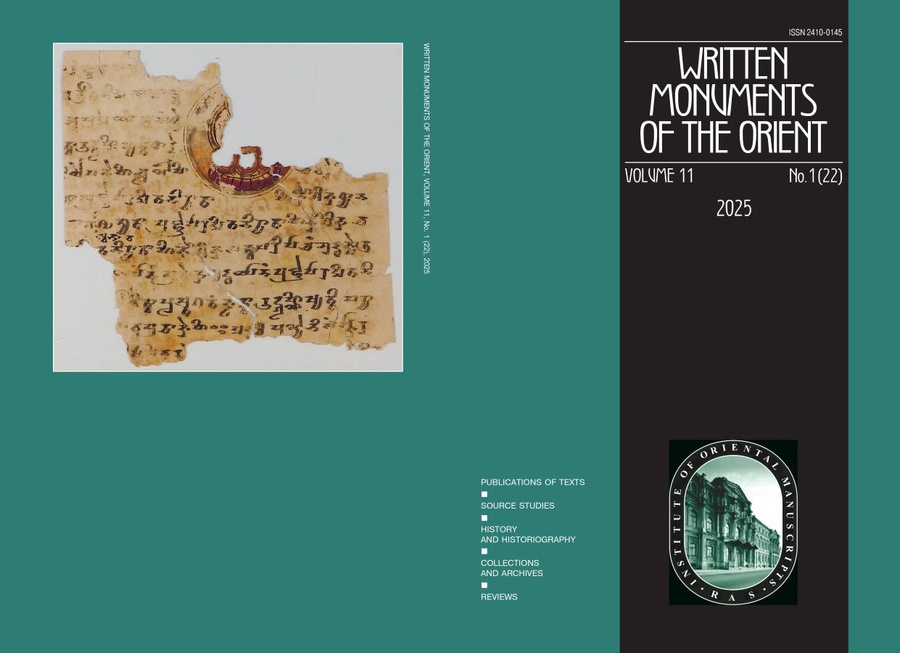
Written Monuments of the Orient

“Written monuments of the Orient” is an international English-language semi-annual academic periodical for the study of written cultural and historical heritage of the Orient. Since 2015, the journal “Written Monuments of the Orient” has been published by the Institute of Oriental Manuscripts (founded as the Asiatic Museum in 1818), Russian Academy of Sciences.
The global pool of authors comprises specialists in the history of ancient and medieval Asia.
The journal focuses on theoretical and practical problems of studying the written heritage of the peoples of the Orient, including articles on the materials of rare old collections like Dunhuang, as well as Tangut, Tocharian and Sogdian manuscripts.
“Written monuments of the Orient” is completely peer-reviewed by appointed external experts, thus fully participating in the international exchange of academic knowledge.
We propose to publish material of the following kinds:
- Theoretical articles on matters of Oriental textology (textual analysis, methods of source criticism, principles for the publication, translation and production of commentaries on Oriental texts).
- Publications of texts and translations of writings and extracts from them, as well as selections of material from written sources on particular problems of history or history of literature.
- Source studies and textological research (analysis of specific sources, sources related to particular issues, etc.).
- Descriptions and surveys of individual manuscripts and collections of manuscripts; reports about newly discovered manuscript materials.
- Reviews on textological works, publications of sources and source-study research, as well as surveys of such publications.
- Materials and papers on matters of historical terminology and on ancillary historical and textological disciplines (codicology, archeography, palaeography, diplomatics, sphragistics, numismatics, epigraphy).
最新一期
卷 11, 编号 1 (2025)
- 年: 2025
- ##issue.datePublished##: 18.08.2025
- 文章: 6
- URL: https://journals.eco-vector.com/2410-0145/issue/view/13273
- DOI: https://doi.org/10.55512/wmo.111
完整期次

Articles
Sanskrit Fragments of Mahāprajñāpāramitā (SI 2097, SI 3017, SI 3331/5) in the Serindia Collection (IOM RAS)
摘要
The present paper deals with the previously unstudied Sanskrit manuscript fragments of Pañcaviṃśatisāhasrikā Prajñāpāramitā-sūtra (“Sūtra on Perfect Wisdom in 25 000 lines”), kept in the St. Petersburg Serindia Collection (IOM RAS) under the call numbers within the “N.F. Petrovsky Subcollection” (SI 2097, SI 3017) and the “M.I. Lavrov Subcollection” (SI 3331/5). Sharing a set of codicological and paleographic features the two new fragments SI 3017 and the fragment SI 2097 are attested to be the parts of a single pothi-type folio of paper containing the sutra’s Sanskrit text recorded in the so-called South Turkestan Brāhmī script. The paleography allows to trace the origin of the manuscript localizing it to Khotan and dating it to the 8th–9th cc. AD. The uniqueness of another Prajñāpāramitā fragment (SI 3331/5) lies in the fact that it belongs to the most ancient examples of Sanskrit manuscripts copied directly in Khotan, and, therefore, to the oldest Prajñāpāramitā texts written on Central Asian paper in the so-called Early Turkestan Brāhmī script variation used for recording Buddhist texts in the 5th–6th cc. AD in Serindia. This paper includes a description of the fragments, transliteration, correspondences with the critical edition, an English translation and a facsimile.
 3-24
3-24


Characteristics of the Term Bodhisattva in the Saddhar-mapuṇḍarīka: Bodhi-saTTva vs Bodhi-saTvan
摘要
In his Glossary of Dharmarakṣa’s Translation of the Lotus Sutra [Saddharmapuṇḍarīka], Seishi Karashima describes a 開士 (kāi-shì) as “a man, who is on the way to enlightenment”. The term 開士 (kāi-shì) is generally accepted to be an older translation of 菩薩 (pú sà; Bodhisattva). The question remains as to why the words 開士 and 菩薩 are distinguished in Dharmarakṣa’s version, even though both meanings are Bodhisattva. How was a Bodhisattva understood when Dharmarakṣa made his translation in 286 CE? In this study, I will present the characteristics associated with these usages, and examine the differences between Sanskrit manuscripts (Central Asian manuscript SI P/5 and Gilgit manuscript No. 44 in Delhi collection) and manuscripts in other languages, such as Tibetan. Then, I will present my hypothesis that the root of the difference is related to the rendering of Bodhi-saTTva as Bodhi-saTvan.
25-52
Hōryūji's Dhāraṇī Texts Preserved in Tokyo National Museum
摘要
The article comprises an analysis of a manuscript fragment stored in the Manuscript Collection of the Hōryūji Monastery (Japan). The manuscript contains excerpts from the “Heart Sutra of Perfect Wisdom” (Prajñāpāramitā-hṛdaya-sūtra) and Uṣṇīṣavijaya-dhāraṇī. The study of the manuscript text allows us to speak about the synthesis of Buddhism and Śaivism in the Serindia oases. The author of the article concludes that this manuscript is of particular importance for the study of the history of Central Asian Buddhism.
53-75
Pre-History of a Collection: Owners’ Marks in the Manuscripts of Muḥammad ʿAyyād al-Ṭanṭāwī
摘要
The history and sources of the manuscript collection of Muḥammad ʿAyyād al-Ṭanṭāwī (1810–1861), an Egypt-born professor at the St. Petersburg University, are studied in this article through ownership statements and other notes found on the pages of the books. They demonstrate numerous ties that link the manuscripts with the historical, educational and cultural landscape of the 16th–19th cc. Egypt and contribute to our understanding of the importance of this collection as a whole entity. It does not just reflect Tanṭāwī’s personal scholarly interests, but rather provides a wider scope of vision encompassing the intellectual background that formed the Sheikh’s personality.
76-94
Asrār-nāma: a Sufi Manuscript Treatise from the Collection of Muhammad ʻAyyād al-Ṭantāwī at the M. Gorky Scientific Library of SPbU
摘要
The paper deals with the brief Ottoman Sufi treatise Asrār-nāma included in the 18th c. handwritten madjmūʻa (collection of works) kept at the Scientific Library of SPbU (call number Ms.O. 701). The traditional attribution of the work to the Naqshbandī shaykh ʻAbd Allāh Ilāhī (d. 1491) looks highly doubtful. The author of the treatise was under profound influence of Ibn al-ʻArabī’s “Unity of Being” (waḥdat al-wudjūd) doctrine, of which the work is a simplified presentation. Some details of the Sufi Path described in the treatise indicate that its author was also familiar with the teaching of the Khalwatiyya brotherhood. The article gives a general description of the manuscript, an outline of the contents of Asrār-nāma, as well as brief characteristics of the first three texts gathered in the madjmuʻa.
95-108
LI Zhengfen 李正奮 Yongle Dadian or Investigations Concerning Yongle’s Compendium of Chinese Literature 永樂大典考. Translated by M.J. Hagerty and H.C. Ho. Berkeley, California. Edited and published by Hartmut Walravens
摘要
Li Zhengfen 李正奮[1]
Yongle Dadian or Investigations Concerning Yongle’s Compendium of Chinese Literature 永樂大典考
Translated by M.J. Hagerty and H.C. Ho. Berkeley, California
Edited and published by Hartmut Walravens
The Yongle dadian 永樂大典 is considered the largest and most comprehensive traditional encyclopedia of the world; it had 22937 chapters (juan 卷) and was clearly and beautifully written and drawn, in large size format. It was commissioned by the Emperor Chengzu 成祖 (reigned 1402–1424, with the reign title 永樂, perpetual happiness), the third emperor of the Ming dynasty, in 1403 and completed in 1408. For unknown reasons it was never printed and disappeared without leaving a trace, fortunately only after a copy had been made in 1557. Even this copy was ill-fated, it was gradually decimated by the Second Opium War, the Anglo-French invasion of Peking and the Boxer Rebellion so that today only around 400 volumes are known to exist. The Yongle dadian is not arranged by subjects like the much better known and still extant Tushu jicheng 圖書集成 with “only” 10.000 juan, of 1726/28 (date of printing), but by phonetical criteria, namely by the rhymes of the洪武正韻 Hongwu zhengyun rhyme dictionary (1375, named after the reign period of the founder of the dynasty). In contrast to European encyclopedias, like the French Encyclopédie, or the Encyclopaedia Britannica, it did not consist of explanatory texts written by scholars for that purpose, but consisted of quotations of the original texts, the sources, often giving the full text of a book (this type of reference is known in China as leishu 類書). The story of the Yongle dadian is well known in outline. When the Chinese Republic was established, the cultural heritage as preserved in the imperial palaces, was surveyed and evaluated. Efforts were also made to track down the remaining extant volumes of the Yongle dadian which were dispersed in a number of countries. Today many are available in electronic format on the Internet. Scholars mainly focused on studying the contents of the individual volumes which presented in many cases quotes from sources no longer extant. The investigation of the compilation of this huge “encyclopedia” was left to the librarians, and there were several instructive articles by book experts like Yuan Tongli 袁同禮 (1895–1965; director of the Peking Library, later National Library) and Li Zhengfen 李正奮. The latter article is given here in English translation by Michael J. Hagerty (1876–1951),[2] of the US Department of Agriculture, and his lettré H.C. Ho.[3] They worked on the campus of the University of California, Berkeley, under the supervision of the botanist Walter Tennyson Swingle (1871–1951),[4] and Hagerty was mainly kept busy with translating Chinese source material on cultivated plants, like citrus and lychee. Swingle worked in close connection with the Library of Congress and for a number of years supplied the descriptions of new acquisitions in East Asian languages.[5] Thus, library matters were also of importance for his small research unit. The present paper (preserved among the Michael Joseph Hagerty papers of the Bancroft Library, University of Berkeley, California, call. no. BANC MSS 79/113 zLOCAL) was revised for publication, and the transcription was changed to the pinyin system. While the paper is now a historical document, it still gives a reliable picture of the compilation and development of Yongle dadian, not easily available otherwise in Western languages.
[1] For the original Chinese publication see Li 1926.
[2] On him see the introduction to Hagerty 2024.
[3] No information on H.C. Ho was found.
[4] Walter Tennyson Swingle, 1871–1952. On his life and works see Venning 1977.
[5] Walravens 2021.
109-128