



Elektronika: Nauka, Tekhnologiya, Biznes
Periodical scientific and technical journal.
Editor-in-Chief
- Alexander S. Sigov, Academician of the Russian Academy of Sciences, President of the Moscow State Institute of Radio Engineering, Electronics and Automation (Technical University).
Publisher
- Associate printing-and-publication centre «Technosphera»
Founder
- Associate printing-and-publication centre «Technosphera»
Indexing
- Russian Science Citation Index (RSCI)
- CrossRef
- Google Scholar
- Ulrich's Periodicals Directory
- WorldCat
Frequency
- 10 issues per year
About
Current Issue
 Open Access
 Access granted
 Subscription or Fee Access
No 8 (2025)

Competent opinion
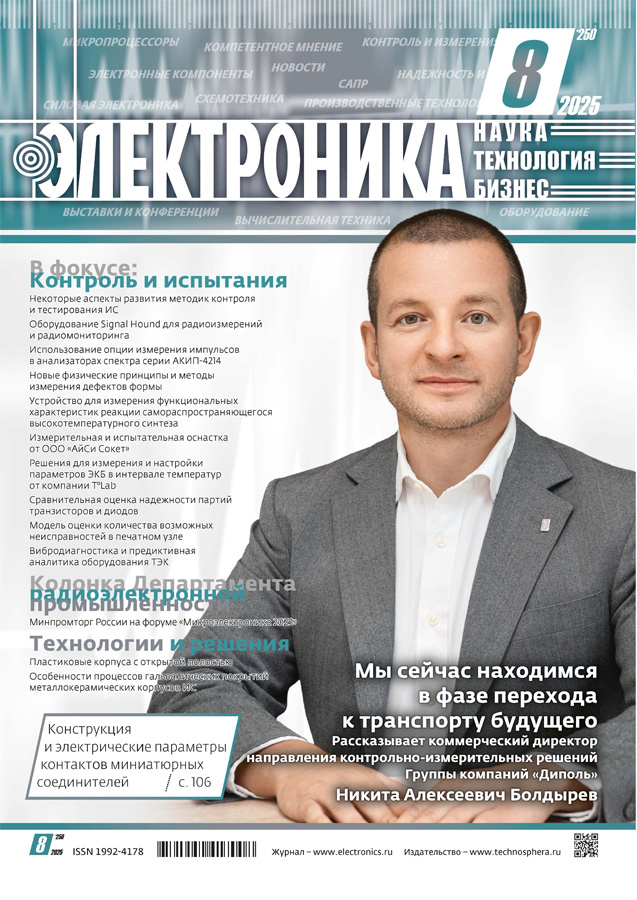
We are now in the transition phase to the transport of the future
Abstract
Рассказывает коммерческий директор направления контрольно-измерительных решений Группы компаний «Диполь» Н. А. Болдырев.
Современный автомобиль немыслим без электроники. Она не только управляет работой его основных агрегатов, но и обеспечивает информирование водителя, комфорт пассажиров и делает транспортное средство более безопасным. На дорогах появляется всё больше электромобилей, где широко применяются электронные устройства большой мощности. Всё идет к тому, что рано или поздно мы пересядем на беспилотные транспортные средства, в которых роль электронного оборудования невозможно переоценить.
Всё это накладывает высокие требования на качество и надежность современной и перспективной автоэлектроники, а следовательно, и на оборудование, с помощью которого проводятся ее контроль и испытания. Такое оборудование предлагает Группа компаний «Диполь», в которой эта область выделена в отдельное направление.
О данных решениях, особенностях контроля и испытаний в автомобилестроении, а также в целом о перспективах развития транспортных средств и электроники для них мы поговорили с коммерческим директором направления контрольно-измерительных решений Группы компаний «Диполь» Никитой Алексеевичем Болдыревым.
 12-18
12-18


Column of department of radio-electronic industry
Минпромторг России на форуме «Микроэлектроника 2025»
Abstract
Председатель Правительства Российской Федерации Михаил Мишустин выступил на пленарном заседании «Государственная политика в микроэлектронике: вызовы, решения, перспективы» и ознакомился с выставкой Российского форума «Микроэлектроника 2025». В деловой программе форума также принял участие министр промышленности и торговли Российской Федерации Антон Алиханов.
20-21
Test and measurement
30-40
Anniversary of Signal Hound: from a low-budget spectrum analyzer to large-scale industry solutions
Abstract
The article provides information on the history and development of Signal Hound product line, the company’s new solutions, and the advantages of its equipment for Russian users. It also compares a number of characteristics of Signal Hound spectrum analyzers and signal generators with those of other vendors’ instruments.
42-48
50-54
New physical principles and methods for measuring shape defects
Abstract
The article presents an overview of methods for measuring shape and continuity defects, analyzes their advantages and disadvantages. It describes measurement systems that do not require hard-to-find components and can be assembled from available element base.
56-60
A device for dynamic monitoring of the main functional characteristics of self-propagating high-temperature synthesis occurring in multilayer thin-film structures
Abstract
A device has been developed that allows for dynamic determination of the main functional characteristics of the self-propagating high-temperature synthesis occurring in multilayer thin-film structures. The article presents a block diagram and describes the device’s design.
62-66
Measurement and test fixtures. Software and hardware complexes from design to quality control
Abstract
IC Socket LLC develops and manufactures measurement and test fixtures, including sockets of any complexity. The article describes various types of such fixtures, including functional test boards, electro-thermal burn-in boards, carrier
boards and interface boards.
68-74
Reliability and validation
Solutions for measuring and calibrating electronic component parameters in a temperature range from T°Lab
Abstract
The article summarizes T°Lab’s experience in creating measurement and calibration rigs for electronic components across a wide temperature range. The proposed solutions simplify operations, improve reliability, and significantly reduce the cost of test equipment.
76-80
Comparative evaluation of the reliability of transistor and diode batches
Abstract
The article proposes six methods for comparatively assessing the quality and reliability of semiconductor device batches. Variable parameters and characteristics are described, and the methods’ reliability is analyzed. All methods are patented and tested on batches of semiconductor products manufactured at Russian electronics industry enterprises.
82-90
Model for estimating the number of possible faults in printed circuit assemblies
Abstract
The article discusses a model for assessing the number of faults in printed circuit assemblies, based on the analysis of factors influencing the occurrence of defects, such as technological errors, materials, operating conditions and assembly methods.
92-96
Vibration diagnostics and predictive analytics in fuel and energy equipment lifecycle management
Abstract
The article demonstrates typical sensor installation errors and the consequences of incorrect diagnostics, which led to resonance phenomena and the risk of fan failure in a three-section cooling tower. It concludes that a transition from a reactive to a proactive maintenance strategy is necessary.
100-104
Electromechanical Components
Miniature connector contacts: design and electrical parameters
Abstract
The article examines the design features and electrical parameters of miniature connector contacts with a pitch smaller than 1.3 mm. It demonstrates that a promising design is the twist pin contact with seven contact points, providing low contact resistance and high wear resistance.
106-112
Microwave electronics
Radio frequency connectors and cables as sources of passive intermodulation in wireless communication systems. Part 2
Abstract
Based on a large number of foreign and domestic publications, the article examines the physical processes that cause passive intermodulation in radio frequency connectors and cables used in wireless communication systems. Methods for reducing passive intermodulation are presented.
114-118
Design solutions
Open cavity plastic packages – advantages, problems and solutions
Abstract
The article examines the design features of open cavity plastic packages (OCPP) and the materials used in their manufacture, particularly liquid crystal polymers. The advantages of OCPP, such as improved high-frequency performance and increased thermal resistance, are analyzed.
120-126
Manufacturing technologies
128-131
Production engineering and management
Contract manufacturing: from a weak link to a strong chain. Part 2
Abstract
The article considers projects implemented by A-CONTRACT engineers over the company’s more than years of operation in the Russian contract manufacturing market, as well as innovative solutions to non-standard tasks arising in the production of high-tech electronic components and modules.
132-134