





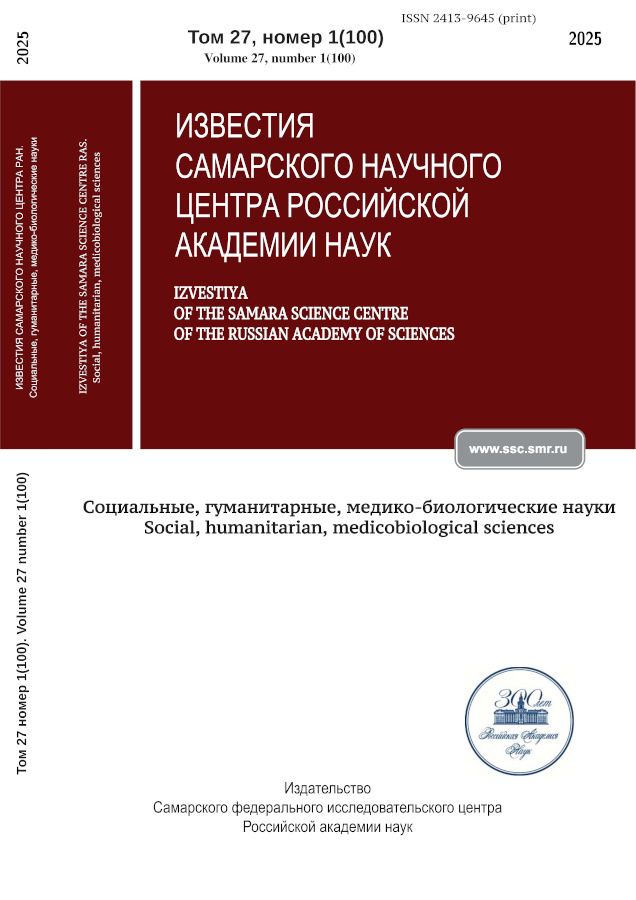
Izvestiya of the Samara Russian Academy of Sciences scientific center. Social, humanitarian, medicobiological sciences
Multidisciplinary peer-review journal.
Founder
- Samara Federal Research Center of the Russian Academy of Sciences
Editor-in-Chief
- Ella A. Radaeva, Dr. Sciences (culturology), science editor of the Samara Federal Research Center of Russian Academy of Sciences.
Periodicity
- Bimonthly
Publications
- in Russian and English
- in Open Access with CC BY 4.0 International license.
Indexed
- Russian Science Citation Index (RSCI)
- CyberLeninka
- Google Scholar
- WorldCat
- Ulrich's Periodicals Directory
About
The social, humanitarian and medicobiological area as a part of the Academic journal Izvestiya of the Samara scientific center of RAS has an archive since 2008 (see archive of the scientific area) history of publications since 2002 (Special issues of Izvestiya).
The journal is intended to publish the latest advances in the social sciences and humanities. Publication in the journal is also an opportunity to test the main provisions of dissertations for the degree of candidate of sciences, the academic title of doctor of sciences. Authors with an academic title or academic degree, as well as graduate students and applicants are allowed to publish.
The main sections
The Journal Izvestiya of the Samara RAS scientific center. Social, humanitarian, medicobiological sciences is included in the list of the reviewed scientific publications in which the main scientific results of theses for a degree of the candidate of science, an academic degree of the doctor of science have to be published. Date of inclusion of the edition in the list of VAK Russian Federation (Higher Attestation Commission) – 06.06.2017. The branches of sciences included in the list:
- 13.00.00 Pedagogical sciences (Codes and groups of specialties. Branches of sciences on which the aca-demic degree is awarded):
- 13.00.01 General pedagogics, history of pedagogics and education (Branch of sciences: pedagogical sciences);
- 13.00.02 the Theory and teaching method and education (on areas and education levels) (Branch of sciences: pedagogical sciences);
- 13.00.03 Correctional pedagogics (surdopedagogy and tiflopedagogics, oligophrenopedagogics and logopedics) (Branch of sciences: pedagogical sciences);
- 13.00.04 Theory and methods of physical education, sports training, improving and adaptive physical culture (Branches of sciences: pedagogical sciences, psychological sciences);
- 13.00.05 Theory, method and organization of sociocultural activity (Branch of sciences: pedagogical sciences);
- 13.00.08 Theory and method of professional education (Branch of sciences: pedagogical sciences).
- 24.00.00 Cultural studies (Codes and groups of specialties. Branches of sciences on which the academic degree is awarded):
- 24.00.01 Theory and cultural history (Branches of sciences: philosophical sciences, historical sci-ences, sociological sciences, art criticism, cultural studies);
- 24.00.03 Museology, preservation and restoration of historical and cultural objects (Branches of sci-ences: technical sciences, historical sciences, art criticism, cultural studies).
Local Registration
The journal is registered by the Federal Service for Supervision of Communications, Information Technology and Mass Media (Roskomnadzor). Registration certificate ПИ № ФС 77 - 64960 on 03/04/2016.
Current Issue
Vol 27, No 1 (2025)

ПЕДАГОГИЧЕСКИЕ НАУКИ
Summer philological school as a form of career guidance work
Abstract
The article describes the experience of holding summer philological schools for school students on the basis of Samara State University of Social Sciences and Education. The possibilities of using summer schools in career guidance of students are shown. The authors of the article offer an original concept for each shift: thematic planning of classes, the content of training modules, formulate learning outcomes and ways to achieve them. The format of the summer philological school allows to use the most diverse methods and technologies of education for the formation of reading culture of a child: lectures and practical classes, master classes, literary walks and literary excursions, film laboratories on script creation, creative workshops on author's text creation and thematic quests. It is shown how intensive summer training at the university site allows to build a strategy of preparation for subject olympiads and state examinations, to determine the subject of individual scientific project at school, and also promotes career guidance of students.
 3-8
3-8


The problem of forming a professional image of a higher education teacher
Abstract
Dynamic changes in the global space, increasing interest of foreign citizens in obtaining higher professional education in Russia determine the relevance of forming a professional image of a higher education teacher. It is the university teacher who forms communicative competencies in students from different countries, ensuring productive acquisition of oral and written speech, understanding of the expressiveness of the text, adequate use in business communication. The most effective discipline, within the framework of which the teacher forms not only communicative, but also socio-cultural competencies in foreign students, is Russian as a foreign language. The article analyzes the concept of "teacher image", considers the levels of its formation, "teacher reference", which is closely related to the term "image", as well as the features of the image of a teacher of Russian as a foreign language. The results of the study are presented, which help to create an up-to-date professional portrait of a teacher of Russian as a foreign language. Diagnostics was carried out using the author's questionnaire. The results showed that for most foreign students, the personal qualities of the teacher (sense of humor, responsiveness, sociability, tact, etc.) are important, as well as a high level of speech competence. The work notes that teachers need to form, first of all, a communicative image. The authors analyzed the main components of competent speech of a teacher of Russian as a foreign language and concluded that he is a guide for foreign students into the world of Russian language and culture through the implementation of modern approaches and technologies.
9-16
Ways to motivate students' project activities
Abstract
Modern trends in the development of education are aimed at forming a harmonious personality, comprehensively erudite, capable of self-education. A huge information flow presupposes the ability of a student to highlight the main thing, analyze, structure, summarize incoming information and make correct conclusions. Currently, pedagogy has a sufficient stock of educational technologies, but it is project activities that allow solving a large number of diverse tasks. The main idea of projects is independent search, research, problem-solving, creative activities of students. For the successful implementation of such work, it is necessary to actively involve schoolchildren and students in project activities, therefore the motivational component of this process is so important. Creating favorable conditions, observing certain factors and causal relationships will serve as a good motivation for planning and implementing a project. This article provides stages of project implementation, considers types of project work, analyzes ways of motivating students to participate in such activities. The results of the conducted research on the topic of project activities are summarized in their practical implementation and successful completion of many projects, which have received various awards; the results of the project work have been published in international journals and conference proceedings.
17-22
The role of soft skills in the development of constructive interaction of subjects of the educational process
Abstract
In the modern world, professional education of future teachers is moving to a new level, where the development of soft skills during the study process at a university becomes an important component of their further implementation in work. The article pays special attention to the issues of introducing competencies, such as soft skills and hard skills, into the educational activities of students, which contributes to their personal and professional development. The authors consider the influence of soft skills on the creation of a favorable educational environment, effective teaching and education of the younger generation, as well as their role in the development of constructive interaction between the subjects of the educational process. The importance of soft skills, such as communication, cooperation, self-development and focus on results, for successful interaction between teachers, students and parents is emphasized. An analysis of studies demonstrating the relationship between the level of soft skills development and the quality of interaction in the educational sphere is provided. The article substantiates the need to develop soft skills in students of pedagogical universities as an important condition for successful professional activity.
23-30
The role of the definite article in English and some ways to reproduce it in Russian translation
Abstract
The paper deals with the ways of reproduction of the definite article in translation from English into Russian. The definite article has no translation equivalent in Russian; as a result, it is often omitted in translation. Thus, the meaning of a sentence gets distorted and the text coherence is broken. This is the reason why it is important to pay more attention to the article’s functions and the ways of its reproduction in translation when teaching English and translation theory to students. On the basis of analysis of scientific papers devoted to the topic we have identified the main function of the definite article, namely the denotation of a previously mentioned object. This way the definite article maintains the text coherence. In order to preserve this coherence in translation a translator must be able to choose the proper ways to reproduce the function of the definite article; this improves the quality of the translation and makes it easier for a reader to understand it.
31-35
PHILOLOGICAL SCIENCES
Traditions of the Silver Age in the book of V.F. Dudarev «Vetla»: the problem of the entelechy of culture (ontological aspect)
Abstract
The paper attempts to show the phenomenon of entelechy of culture in modern poetry. The material for ontohermeneutics was the poetic heritage of the poet, cultural figure, editor-in-chief of the magazine “Youth” V.F. Dudarev. The object of the article is the phenomenon of entelechy of culture, manifested in the poet's work. The subject of the study is the artistic implementation of the codes of the preceding culture of the 20th century, the Silver Age period, dialogically triggered in the poetry of V.F. Dudarev. The concept of “entelechy” is considered in detail in the ontological aspect in an inextricable connection with the concept of “dialogue of cultures”. We turn to precedent names in the poetics of V.F. Dudarev, to the image of Anna Akhmatova, which the modern poet creates in the poem “Poets”. The lyrical hero of V. Dudarev observes the appearance of Akhmatova in St. Petersburg, ontologically comprehending her repeated arrival in this world. The results of the study consist in identifying the cultural and philosophical potential of modern poetry for further study of the category of entelechy as a phenomenon of Russian artistic culture, the national existence of our literature. The results of the work may be of interest to literary scholars who include literature in the space of the great Bakhtinian dialogue of cultures, and can also be used in teaching courses on cultural studies and philosophy.
36-40
Apophatics of artistic thinking of V.S. Vysotsky: folklore frames in the poem «My funeral»
Abstract
The object of the article is the phenomenon of apophatics in modern artistic culture, which manifests itself in poetry through folklore cases and national constants. The subject of the scientific work is the analysis of the interaction of folklore and literature, which organizes vertical transmission in culture and allows us to trace the processes of apophaticization of creativity. The material was the work of the Russian poet V.S. Vysotsky, who represents the phenomenon of the author's song. In the center of the hermeneutic analysis is the famous poem "My Funeral", which was set to music by the author and became a famous song. Much attention is paid to the poetics of sleep, since sleep is apophatic in nature and is equated, according to Slavic folk beliefs, with death. The relevance of the undertaken study is due to the growing need to comprehend the ontological issues of Soviet poetry, which for a long time were taboo in Russian literary criticism of the last century. The authors of the study pay great attention to the border ethos in the poet's poem, the phenomenon of sleep associated with the space of another world and anti-world. The forms of manifestation of the folklore tradition in the poetics of V.S. Vysotsky are analyzed. The methodology of the study is reduced to a holistic hermeneutic analysis of the artistic text. The results of the study may be of interest to cultural scientists and literary scholars who consider literature in the space of a large dialogue of cultures.
41-47
The musical code of Varlam Shalamov's poetry
Abstract
The article is devoted to the problem of intermediality, the interaction of literature (poetry) and music in the lyrical heritage of V. T. Shalamov. It is noted that the boundaries and forms of manifestation of the concept of "musicality in literature" are not sufficiently formed in literary and cultural studies. In the poetic heritage of Varlam Shalamov, such vivid manifestations of intermediality as the penetration of musical motifs and images into the lyrical text are found; examples of "musicalization" of poetic texts using sound repetitions, poetic intonation (in particular, using inversion) are considered. The article focuses on the variety of metrical and strophic techniques and forms to create a special musical sound of the poet's poems. The intensity of synthetic trends in the culture of the XXI century It is confirmed in the article by the analysis of the cantata by the modern composer Mikhail Gogolin "Silentium" based on V. Shalamov's poems. The melodic interpretation of the poet's famous and less popular poems fully reflects their musicality, the verbal text is modified through music, and sometimes receives a different interpretation.
48-55
Antonymy as unreplaceable kommunicative resourse (case study of L. Feuchtwanger’s novel «Exile»)
Abstract
The article is devoted to the study of a particular aspect of the phenomenon of linguistic antonymy – its irreversibility in the processes of communication, the impossibility of its replacement by other means of linguistic expression in certain types of speech contexts. The article substantiates the point of view about the deep essential rootedness of antonymy in extralinguistic reality, as well as its priority status in the systematics of linguistic phenomena, which is explained by the fundamental constructive significance of the principle of binary-oppositional structuring in the ontology of the physical world, consciousness and linguistic activity. The picture of the world provides many examples of binary archetypes functioning as a generative model of complexly organized systems. Mythology, which is the first human experience of artistic and ideological reflection on reality, is built on a system of the simplest archetypal oppositions, such as "friend or foe", "light-darkness", "good-evil", "chaos-order", "center-periphery", etc. In the history of intellectual culture, the principle of binary oppositions acts as the most important factor in the implementation and representation of the activity of consciousness, human thinking, and cultural experience. In language, semantic opposition manifests itself as an experience of naturally formed systematization in the sphere of semantic relations, which precedes scientific analysis. In the processes of communication, antonymy acts as a unique resource of linguistic representation, which is in a relationship of interdependent functional correlation with certain types of contexts and object-reference situations. In works of literature, the discursive correlate of linguistic antonymy is artistic contrast, which is realized primarily and most vividly in the classical models of antithesis and oxymoron. Rich illustrative material of this kind is provided to the researcher by the novel by Lion Feuchtwanger "Exile" analyzed in the article.
56-69
КУЛЬТУРОЛОГИЯ И ИСКУССТВОВЕДЕНИЕ
Peculiarities of legislative systems limiting the distribution of literature in libraries in the USA and Russia
Abstract
The article examines the topic of restrictions in the book sphere in libraries of Russia Federation and the USA at the current state. The topic of the study is revealed by identifying the features of the legislation of the two countries using specific examples of seizures and restrictions books in American school libraries and Russian libraries. The criteria for comparing restrictions were based on organizational foundations, the role of state and public organizations, the features of their interaction and the motives for bans. Based on a selection of examples, which was determined by the chronological frame and the scope of their distribution, parallels are drawn between libraries institutes of the USA and Russia. As a result of the study, it is concluded that the current state of the regulatory activity of these countries has both many common features and differences. Thus, in these countries, information products are labeled, and the reasons for wanting to protect children from certain works are similar. However, an analysis of the Russian legislative system allows us to assert that it is directly related to restrictions on the distribution of controversial literature, and materials can be excluded from open access only by a court decision and in accordance with the laws in force in the country, unlike the United States, where bans on books often conflict with the First Amendment to the Constitution and occur under public pressure.
70-80
Macro-narrative algorithms: 24-element cycle of describing reality (using the novel by L. Tolstoy "Anna Karenina")
Abstract
The article develops an ontological model in relation to which the narrative is presented as an 8-element cycle, applied to both microstructures (episode) and macrostructures of the narrative (plot). The study is conducted in the context of ancient macroalgorithmic models, which are still popular in the countries of Southeast Asia. In ongoing storytelling, there is periodic application of the 8-element model. Three such cycles are accepted as a narrative cycle, the content of which is a large-scale description of a certain reality. The 24th stage of the narrative is followed by the beginning of the description of a new reality at the 25th/26th stages. The author determines the properties of four levels of the 8-element episode. The obtained characteristics are tested at the micro level of the narrative and at the macro level, represented by eight parts of the novel "Anna Karenina" by L. Tolstoy. It was found that there is a change in socio-political reality upon completion of the 24th stage of narrative, after this stage public opinion acquires greater significance.
81-88
«Friends and strangers» in creative workshop Kira Kovalenko
Abstract
The article is devoted to the concept of "us - them" and its reflection in the metalanguage of modern Russian cinema using the example of the creative workshop of Kira Kovalenko, a student of A. Sokurov. Her film "Sofichka" is dedicated to the difficult life situations of an Abkhaz girl who tries to find support in the circle of close relatives. The film "Sofichka" is based on the story of the same name by Fazil Iskander. Relationships in the family and the divisions in it into "us - them" are a sign of today. Despite the youth of the film director, we can talk about an accomplished master, whose idiostyle requires careful study and analysis. The article examines the features of the film director's style. Kira Kovalenko introduces us to the image of an Abkhaz girl who evokes admiration from both "us" and "them". The director in this film narrative combines geographical, historical and psychological layers - classes are combined. Each of them characterizes a separate facet in the character of the main character. Using for this purpose different stylistic devices, including "anaphoric screen", linguistic (the characters speak the national language), with subtitles - K. Kovalenko achieves the desired effect of viewer perception: the path of a simple Chegem girl evokes unquestionable respect, since it contains all the best that is characteristic of the culture of the Abkhaz people.
99-104
Public sculpture as a factor in shaping aesthetic experience and urban identity
Abstract
The article analyzes the role of public sculpture in shaping citizens' aesthetic experience and urban identity. The research is based on an interdisciplinary approach combining methods from aesthetics, sociology of art, and urban studies. The methodology includes literature analysis, comparative research, and case studies. The author examines the diverse functions of public sculpture: aesthetic, symbolic, social, and communicative. Based on the analysis of theoretical works and practical examples ("Cloud Gate" in Chicago, "Muzeon" Park in Moscow, "Hong Kong Sculpture Project," "Gateway Arch" in St. Louis, "People on the River" ensemble in Vyksa), the key factors influencing the perception of public sculpture are identified: cultural context, artistic quality, spatial integration, and community involvement. Recommendations for effective integration of sculpture into urban space are proposed, including the development of clear selection procedures, engagement of local residents, interdisciplinary collaboration, educational programs, and post-project monitoring. The necessity of a comprehensive approach that takes into account artistic, social, and urban aspects to enhance aesthetic impact and strengthen urban identity is substantiated.
105-110
Philosophical and cultural analysis of theatrical interpretation
Abstract
The range of problems of theatrical hermeneutics is based on the correlation of various types of interpretation, which consist in identifying the semantic structure of the literary source, staging concepts, performing expression, audience reception, etc. The historical existence of the work is characterized by a number of possible concretisations. The author analyzes the theatrical interpretation in the article, the distinctive feature of which is its relative freedom, which means the absence of the final meaning of the work and, as a result, the performance. Hermeneutics is justified by the author from the point of view of theatrical culture, which allows us to consider theatrical interpretation as a multi-stage process characterized by the synthesis of various types of interpretations. It is proved that the theatrical text reveals a multiplicity of meaning, which determines the multiplicity of equal interpretations. The principle of multiple interpretations, in turn, implements the principle of non-linearity in the organization of discourse. Text categories such as multiplicity, incompleteness, non-linearity, and openness form the hypertextuality of literary texts. Due to the openness of the work, the text can be used as sequential and inconclusive interpretations, which creates a variety of interactions between the text and the scene. The author identifies three levels of theatrical interpretation: 1) interpretation of a literary work by the director; 2) interpretation of the director's idea of the work by the actor; 3) spectator reading-interpretation of the author's work.
111-119
The object world as a field of visualization and reclassification of culture
Abstract
All social transformations in history have always relied on culture in one way or another, seeking justification and support in it. From this perspective, the objective world of society not only reflects the urgent demands of society, combining current social and ideological paradigms, but also provides a person with many real opportunities to promote and renew culture. In this article, the appeal to culture is based primarily on rethinking its material attributions, which are considered through their coupling with cultural practices and technological innovations. All this makes us look at the world of things more broadly, finding answers to many urgent questions of our time in cultural artifacts, that is, to see in the forms and articulations of objects what is hidden behind their usual material shell. A thing is not indifferent to the preferences and values of a person. In the space of social interaction, a thing acquires the status of a character, an actor, a participant, a designer of a new cultural reality. Things also serve as signs of distinction and a way to attract culture. At the same time, it is the cultural context that largely shapes the social significance of an artifact and makes it not only an economically useful object, but also an aesthetically attractive and socially status item. Information and digital technologies expand the boundaries of the world of things, and by challenging culture, enrich it with new art objects. In the process of subject transformation, things are increasingly included in communicative innovations and current cultural practices. The dialogue between a person and a thing in a changing society is positioned as an area of creativity, visualization of memory and reclassification of culture. Some aspects of subject transformation in creative practices of modern culture are considered in this article.
89-98