

Russian Journal of Innovation Economics

RUSSIAN JOURNAL OF INNOVATION ECONOMICS is devoted to assessing innovations and innovative development in the economic sphere. The journal publishes the results of studies, reviews and reports in the field of innovation economics and innovation management.

Indexation

Publications

  • quarterly, 4 issues per year
  • in English and Russian 

Announcements More Announcements...

 
No announcements have been published.

Current Issue

Open Access Open Access  Restricted Access Access granted  Restricted Access Subscription or Fee Access

Vol 13, No 4 (2023)

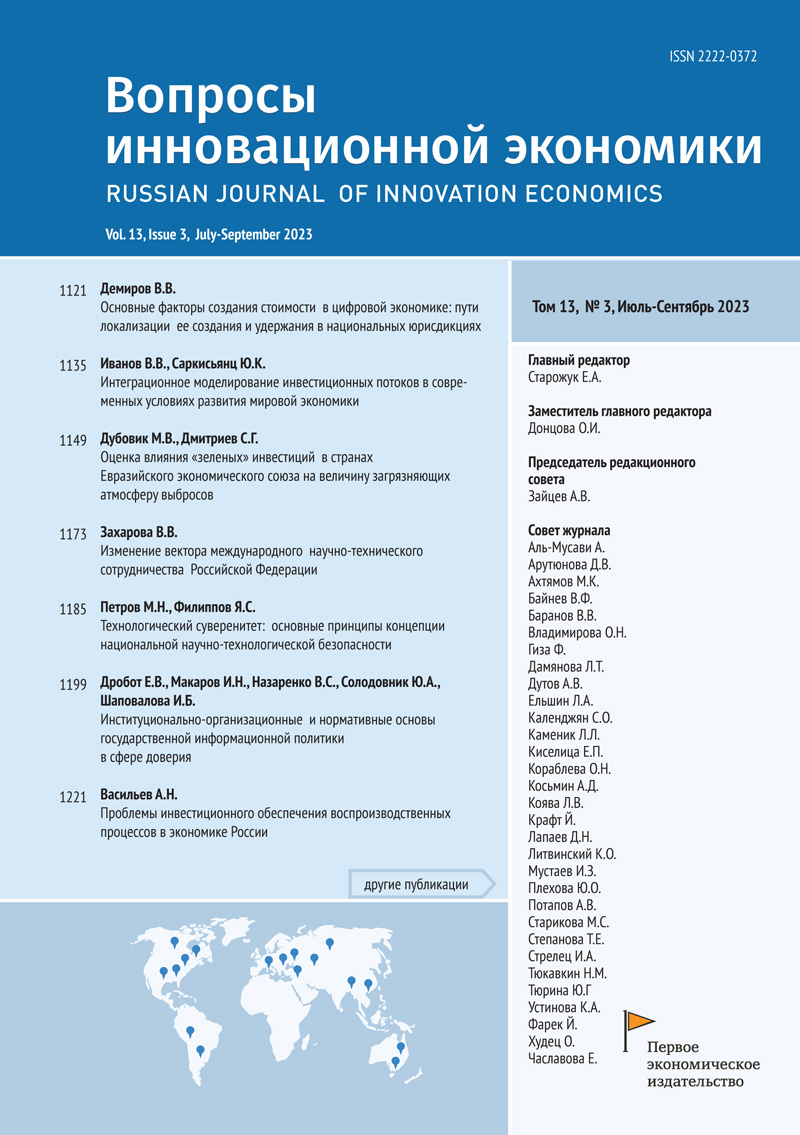
Cover Page

Full Issue

Open Access Open Access
Restricted Access Access granted
Restricted Access Subscription or Fee Access

Articles

The concept of seamless interaction of participants in cross-border cooperation
Khmeleva G.A., Kurnikova M.V., Chirkunova E.K.
Abstract
Cross-border cooperation is a priority direction of the state foreign economic policy. The article presents the results of a study on the role of digitalization in the development of cross-border cooperation. It shows that the platform approach, together with digital technology, is now firmly at the forefront of public service development worldwide, including international cooperation. Cross-border cooperation has not been neglected. The concept of a cross-border cooperation service with implementation on the portal of public services of Samara region, designed for seamless interaction of participants, allowing foreign citizens to receive useful services and information about the Russian side, is proposed. The results of the study will be useful both for scientists dealing with problems of cross-border interaction and for public authorities. Acknowledgments: The reported study was funded by RFBR and FRLC, project number 21-510-23002.
Russian Journal of Innovation Economics. 2023;13(4):1741-1754
pages 1741-1754 views
The impact of modern scientific and technological progress on the trends and structure of international trade
Tolmachev P.I., Rybinets A.G., Komonov E.O.
Abstract
Based on the statistical data of leading organizations, the article examines the factors of increasing commodity flows between countries and regions of the world and analyzes their dynamics and structure. The authors conclude that scientific and technological progress has had the greatest impact on increasing the accessibility of companies to world markets. This is especially pronounced in the service sector, which is more likely to demonstrate the possibilities of using various types of information and communication technology, which at the same time can become an object of international trade. The authors also emphasize the importance of scientific and technological achievements for other sectors and conclude on the direct impact of ICT on global value chains.
Russian Journal of Innovation Economics. 2023;13(4):1755-1766
pages 1755-1766 views
Attracting foreign direct investments in sustainable energy technology in Africa
Sapuntsov A.L.
Abstract
The article examines the possibilities for the implementation in African countries of the provisions of the sustainable energy concept set within the framework of achieving the UN Sustainable Development Goal No. 7. The analysis of trends in the global movement of foreign direct investments and the activities of multinational enterprises in terms of locations and key performance indicators is carried out. In the context of the subregions of Africa, the conditions for the receipt of foreign direct investments are summarized; and the main projects implemented with their participation are presented. The author concludes that it is necessary to attract capital and technological resources from abroad to the energy sector of African countries. This will ensure the activities of hydroelectric power plants and innovative companies for the production of green hydrogen and green ammonia, desalination of water using solar energy and similar innovative facilities. The modernization of coal-fired thermal power plants in South Africa is of particular interest within the framework of sustainable energy. It is planned to apply Russian technology in the course of such modernization.
Russian Journal of Innovation Economics. 2023;13(4):1767-1782
pages 1767-1782 views
Regional integration as a factor of economic development: the Abidjan–Lagos corridor project in West Africa
Nushe K.G.
Abstract
The article analyzes the level of integration of different regions of the world and highlights the low level of intra-African trade compared to other regions. Based on various indicators, the level of integration between West African countries is analyzed. The poor quality of the region's road infrastructure has been shown to be an obstacle to the free movement of people and goods, and thus to economic development. The necessity and need for the implementation of the Abidjan-Lagos corridor project for more advanced economic integration is substantiated. The author highlighted the advantages of implementing this project and analyzed the management system for the project and border checkpoints. Criteria for assessing the effectiveness of project implementation and measuring progress in achieving set goals are also defined. It has been demonstrated that the implementation of the project will benefit not only the interested countries, but also other countries in the region. This article examines a problem that may be of interest to economists, undergraduates, postgraduate students and organizations studying the development process of countries in the West African region.
Russian Journal of Innovation Economics. 2023;13(4):1783-1794
pages 1783-1794 views
Challenges and prospects of economic development of the South Pacific countries amidst global changes of the first quarter of the 21st century
Drobot E.V.
Abstract
At the end of the first quarter of the 21st century, the South Pacific countries have faced the consequences of a number of problems that are global in nature. These are the consequences of the COVID-19 pandemic, disruptions to global supply chains, and the effects of climate change. Due to the region’s heavy dependence on external demand, the South Pacific economy has been severely affected by these and other related problems. The expansionary economic policies of the governments and central banks of the South Pacific countries, international aid and lending supported the region. Nevertheless, at present, the South Pacific countries continue to face economic, environmental and other challenges that pose obstacles to medium-term growth and development. In this study, the author characterizes the economic landscape of a number of the South Pacific countries (Fiji, Papua New Guinea, Samoa, Solomon Islands, Timor-Leste, Tonga, and Vanuatu). The article presents an assessment of the economic consequences of the COVID-19 pandemic for the South Pacific countries. The measures taken by the state policy aimed at restoring the South Pacific economy in the post-pandemic period are considered. The medium-term challenges to the economic growth of the South Pacific countries caused by the high level of public debt and climate change are analyzed. The article will be of interest to specialists dealing with the problems of the South Pacific development, as well as to anyone interested in international economic relations.
Russian Journal of Innovation Economics. 2023;13(4):1795-1824
pages 1795-1824 views
China's investment activity in the Belt and Road Initiative
Bolaev A.V.
Abstract
This article reveals the key areas of China´s investment activities in foreign countries within the framework of the Belt and Road Initiative. Based on the analysis of statistical data presented on the China Global Investment Tracker (CGIT) portal, the dominant position of Chinese state-owned companies in terms of investments in neighboring countries was revealed. It is shown that in the context of the new reality and changes in the geopolitical situation, economic uncertainty arises when making investment decisions, which entails a decrease in the confidence of Chinese investors when resolving investment issues, an increase in risks, and difficulties in investment planning for the long term. The preferred areas of Chinese investments in foreign countries have been identified. They are as follows: the energy sector, metalworking, and transport. A tendency to reorient Chinese investments in high-tech sectors of the economy, towards the introduction of clean energy sources and the green economy has been identified. The presented results may be useful to specialists involved in international investments and potential investors.
Russian Journal of Innovation Economics. 2023;13(4):1825-1834
pages 1825-1834 views
Features of the country's innovative development: China's experience
Chentsova E.P., Chentsov M.S.
Abstract
The article gives an overview of theoretical researches on innovative development. It is shown that innovative development is considered as a strategy of advanced development, an innovative breakthrough strategy, a modernization strategy, a model of economic development based on innovation, the process of transition to an innovative type of economy, systemic development based on the use of fundamentally new technology, intellectualization of production, a mechanism of systemic reproduction based on innovation, timely change of obsolete technology and production cycles, etc. The article presents the semantic core and the authors' interpretation of the concept of innovative development of the country. The conceptual apparatus of innovative development is updated. The directions of evaluation of innovative development in the context of the state are outlined. The peculiarities of China's innovative development are revealed. The causes of the Chinese miracle are analyzed. The problems of the importance of education, science, patenting and inventive activity are examined. The aspects of scientific and technological development of both large giants and the state as a whole are reflected. The results of the country's development are summarized; and the prospects for its further functioning are outlined. The key issues for future research related to problems of states' innovative development are identified.
Russian Journal of Innovation Economics. 2023;13(4):1835-1854
pages 1835-1854 views
Trends in asset redistribution against the backdrop of Chinese and US economic decoupling
Kharlanov A.S., Tolmachev P.I., Evans Y.N.
Abstract
The authors analyze current trends in artificial intelligence (AI) and big data, the ongoing transformation of ICT, used startups and greenfields in the field of digitalization of the world economy, and the development of globalized national industries. In the post-crisis recovery, this requires new approaches, adapted business models for the post-industrial knowledge economy and consumer economy, and also determines vectors of alternative development paths for sovereign states, which are trying to reduce the level of influence of global governance structures and transnational actors on them, who are trying to preserve the ideas of hegemonism and colonial development between the metropolises and their serving peripheries of the Third World in the further disintegration of the American-style world. The authors also define the place of Russia and the tasks for its development in the field of digital and end-to-end technology in the context of the ongoing rivalry between the United States and China.
Russian Journal of Innovation Economics. 2023;13(4):1855-1866
pages 1855-1866 views
Prospects for the development of Russian-Chinese investment relations within the framework of the One Belt One Road project
Bolaev A.V.
Abstract
One of the sources of financing the national economy is the attraction of foreign direct investments, which is practiced in many countries of the world. The purpose of the article is to analyze the possibilities and directions of investment cooperation between Russia and China in the new geopolitical conditions. In accordance with the theory of internalization, the factors influencing the choice of investment partners are described. It is shown that Russia is an attractive investment destination for Chinese investors. The most attractive areas of investment cooperation between Russia and China, including in the field of green economy, scientific research and technological innovation, have been identified. The factors hindering the further expansion of investment cooperation between our countries are considered; and ways to attract Chinese investments to Russia within the framework of the Belt and Road project are formulated.
Russian Journal of Innovation Economics. 2023;13(4):1867-1880
pages 1867-1880 views
State planning in Japan, France and South Korea: is it a useful experience for Russia?
Ivannikova A.A., Udalov I.D.
Abstract
The article is devoted to a theoretical analysis of the characteristics of the Russian economy and its correlation with foreign development models, in particular the Japanese, French and South Korean ones. Based on the identified characteristics, it is proposed to consider the main provisions of domestic economists regarding the prospects for creating state planning institutions. The main features of the domestic economic model, the prerequisites for its comparison with foreign ones are highlighted; and the key aspects of foreign experience of economic development in a “difficult” period for countries are described. Based on the analysis of foreign practical and domestic theoretical models, the main components of foreign experience for its possible testing in Russian conditions were proposed. Acknowledgments: The study was carried out within the framework of fundamental research No. 1022040500863-5-5.2.1;5.2.4 "Theoretical foundations for the formation of a new paradigm for the management of socio-economic, technological and financial development of Russia: interdisciplinary synthesis of evolutionary and wave concepts" commissioned by the Financial University under the Government of the Russian Federation.
Russian Journal of Innovation Economics. 2023;13(4):1881-1898
pages 1881-1898 views
New trends in the analysis and modeling of the flows of international capital
Ivanov V.V., Sarkisyants Y.K.
Abstract
Significant changes in the global economy caused by the unstable geopolitical situation and extraordinary macroeconomic conditions dictate the need to create new approaches to analytics. One of the most volatile components of cross-border capital flows is direct foreign investments. The authors analyzed current trends and approaches to forecasting of direct foreign investments. As result of the research, a model based on modern mathematical methods was developed. This article presents and describes the architecture of intelligent forecasting of foreign direct investment based on the compositional method of machine learning. The authors highlight the key advantages of the developed approach in comparison with traditional forecasting methods.
Russian Journal of Innovation Economics. 2023;13(4):1899-1908
pages 1899-1908 views
International digital currency market in foreign economic activity
Ivanov V.V., Zakharchenko S.I.
Abstract
The article presents an analysis of the development of the digital currency market and the impact of this process on the global monetary system, with a focus on the growing interest of government institutions in digital currencies of Central Banks. The authors consider key trends and changes in the digital currency market in 2023, including the impact of regulatory measures on the development of the digital currency market. The authors propose an innovative economic model for integrating digital currencies into international trade. This includes an analytical model for choosing digital instruments for international settlements with exchange rate analysis, assessing the impact of selected digital instruments on the economic system when using them, an economic model for setting rates between national digital currencies and a single digital currency of the integration association, taking into account the dynamics of the foreign exchange market, economic indicators of the participating countries and international financial flows, and an economic model of functioning global processing centers for servicing smart contracts in various digital currencies, to determine the most optimal form of functioning, taking into account the legal aspects and the costs of creating the necessary infrastructure. This model can be used to optimize international trade between the member countries of integration associations when introducing digital currencies as a new payment method. The article will be interesting for a wide range of specialists, including economists, financiers, researchers in the field of digital technology and blockchain, as well as heads of banks and financial institutions interested in innovations in the field of digital currencies.
Russian Journal of Innovation Economics. 2023;13(4):1909-1926
pages 1909-1926 views
Special features of the introduction and use of the Bank of Japan's digital currency
Pashikhina E.V., Kashbraziev R.V.
Abstract
This article discusses the implementation of a new monetary circulation system using electronic currency. The introduction of the Central Bank Digital Currency implies a transition to digital payment and settlement systems managed by central banks. The study includes a study of the phased development of plans for the introduction of Japan's digital currency. The specific purpose of the study was to identify the features of the introduction and use of the Bank of Japan's digital currency. In the course of the research, the author set and solved certain tasks, which include analyzing strategic plans to study the functionality of the digital currency of central banks, studying the features of the development of the Digital Yen of the Bank of Japan, and highlighting the prospects for the introduction of a new digital currency on the financial platform of the Bank of Japan. With the help of this analysis, the features of how the country under study is gradually introducing a digital currency within its financial system have been identified. Based on the experience of Japan, the relevant functions of the Central Bank of the state were considered, which in their essence are the foundation for the introduction of the Central Bank Digital Currency, not only in a single country, but also in the world. Solving the problems of digitalization of the currency and monetary system, according to the experience of Japan, the author identified the features of the Central Bank Digital Currency as a new instrument of financial interaction between economic entities.
Russian Journal of Innovation Economics. 2023;13(4):1927-1940
pages 1927-1940 views
Artificial intelligence in India's digital economy
Matyushok V.M., Smolev D.V.
Abstract
The article examines the current trends and prospects for the development of artificial intelligence in India's digital economy. The main factors of artificial intelligence development are highlighted. The are as follows: new machine learning algorithms RD, including in scientific and technological clusters in large cities of the country; a high level of digital infrastructure development; availability of an element base of own production; and access to large amounts of high-quality data for training artificial intelligence models. India's potential in creating its own developments in the field of artificial intelligence is being assessed. The possible impact of the development and implementation of artificial intelligence on the digital economy of India is analyzed. It is noted that it is important to improve the Indian education system to meet the need for highly qualified labor and prevent the growth of unemployment. This article may be useful for experts and researchers in the field of artificial intelligence and digital economy who are interested in the economic prospects of digital transformation in India.
Russian Journal of Innovation Economics. 2023;13(4):1941-1956
pages 1941-1956 views
The concept of technological development of Russia: intentions of implementation
Medvedeva N.V.
Abstract
The article is devoted to the analysis of the status and content of the concept of technological development of the Russian Federation until 2030, which is of fundamental importance for ensuring the achievement of technological sovereignty. Attention is focused on the definition of the intentions of implementation of the concept of technological development as a factor of motivation to action in achieving the goals of technological development. Intentions are mechanisms for the implementation of technological development goals, in which activities are grouped that determine the intended actions and differ in their imperative and resultant nature. The author concludes that there are signs of consistency of intentions to implement the concept of technological development. At the same time, it is emphasized that the consistency of intentions is based on the concept of the power of intentions, which ensures the implementation of the trajectory of actions and reduces the gap between intentions and actions. The intentions containing updated (taking into account certain deviations from the previously established rules) and fundamentally new (taking into account the right to risk) approaches to technological development are presented. The article may be useful for government officials, businessmen, students and postgraduates, as well as anyone interested in technological development.
Russian Journal of Innovation Economics. 2023;13(4):1957-1972
pages 1957-1972 views
Financial and organizational tools for the transformation of the domestic economy
Ivannikova A.A., Popov A.K.
Abstract
The article is devoted to the problems of providing conditions for the modernization of the domestic economy amidst the current challenges. In order to increase their efficiency, the research attention is focused on the issues related to the transformation of financial institutions of the Russian Federation. As a tool for operational monitoring and implementation of strategic projects, it is proposed to attract ecosystems for consolidation and coordination resources in a single organizational circuit. The issue of building a two-way communication channel to clarify the needs of the population through the integration of the ecosystem in the contour of public-private partnership in the implementation of strategic projects is considered. Acknowledgments: The study was carried out within the framework of fundamental research No. 1022040500863-5-5.2.1;5.2.4 "Theoretical foundations for the formation of a new paradigm for the management of socio-economic, technological and financial development of Russia: an interdisciplinary synthesis of evolutionary and wave concepts" commissioned by the Financial University under the Government of the Russian Federation.
Russian Journal of Innovation Economics. 2023;13(4):1973-1992
pages 1973-1992 views
Organization and development of the state monitoring system of the Russian industry digital maturity
Kuznetsova E.K., Ivashkevich T.V.
Abstract
Based on the study of the conceptual and terminological apparatus of the digital economy, the legal and methodological foundations of strategic state management of industry as one of the key sectors of the domestic economy, the authors analyzed the state monitoring system of the Russian industry digital maturity. The best international practice of ensuring economic security, a client-centric approach to meeting public needs and new information technology are reflected in the activities of public administration bodies when choosing tools for implementing strategic priorities. Structural digital transformation of key sectors of the national economy as one of the goals of strategic public administration in Russia is carried out. The challenges and risks of the new technological mode are taken into account. Monitoring of the digital transformation of industry is linked to a Single Plan to Achieve National Development Goals until 2030 based on information relevant technological solutions. Despite the creation of state monitoring of industry as a modern system with new service content and functions, the problems of a set of indicators for monitoring the level of digital maturity of medium and small businesses, the use of departmental information systems by federal authorities for the implementation of the strategic goal "Digital Transformation" remain unsolved. In the scientific article, the authors propose measures to adjust indicators when assessing the level of digital maturity of domestic industrial companies and directions for improving state information systems.
Russian Journal of Innovation Economics. 2023;13(4):1993-2004
pages 1993-2004 views
Studying the practical and systemic problems of the Fourth Industrial Revolution technology in various branches of the Russian industry
Klimachev T.D., Karasev D.A.
Abstract
The article discusses practical examples of the use of Industry 4.0 technology in various branches of Russian industry. The authors has conducted a systematic analysis of the problems of Industry 4.0 technology implementation. The authors note the impact of sanctions pressure on the pace of digital transformation of Russian industry. The differences in the level of equipment with Industry 4.0 technology of companies in different industries are highlighted. The reasons for their different levels of digitalization are analyzed. Next, an analysis of the practical experience of using Industry 4.0 technology is carried out. There are also industries where the introduction of Industry 4.0 technology is faster than in others. As a result of the study, the authors highlight the systemic problems of the introduction of Industry 4.0 technology at Russian industrial companies and also propose a possible set of measures to accelerate their digital transformation.
Russian Journal of Innovation Economics. 2023;13(4):2005-2024
pages 2005-2024 views
Developing industrial business models: Industry 4.0, business sustainability and continuity, quality management
Krakovskaya I.N., Kazakov E.A., Shumkina A.A.
Abstract
The article discusses the problems of adapting industrial business models to the conditions of digital economy. The necessity and importance of sustainability and business continuity management are substantiated. The article takes into account the expanding boundaries and magnitude of the impact of digital risks and threats at all stages of the industrial company lifecycle. Based on the classical description of the structure of business models, an interpretation of the directions of their improvement is proposed. The realities of Industry 4.0 are taken into account. On the basis of current regulatory documents of quality management, the key elements of ensuring the sustainability and continuity of the organization's activities are analyzed. The authors hare integrated these elements into a generalized structural model of the sustainability of an industrial company. A conceptual logical scheme for the transformation of the business model of an industrial company in the context of ensuring the sustainability and continuity of business in the digital economy, visualized in the ARIS tool environment, has been developed. The results obtained can serve as a basis for the development of theoretical and methodological provisions and the practice of business continuity management in the context of Industry 4.0. Acknowledgments: The research was carried out at the expense of the grant of the Russian Science Foundation No. 22-28-00489 "Development of business models of the industrial sector in the context of digital transformation challenges", https://rscf.ru/project/22-28-00489/
Russian Journal of Innovation Economics. 2023;13(4):2025-2038
pages 2025-2038 views
The policy of machine tool industry development in modern Russia: stages, results and prospects
Afanasyev A.A.
Abstract
The article discusses the specifics of the policy of machine tool construction in modern Russia. The relevant stages related to the preparation and implementation of the course for the reconstruction of the machine tool industry in our country are highlighted. At the same time, the prospects for its formation are linked to the implementation of the project of technological sovereignty. In this regard, the main government programs, strategies, and action plans from 2011 to 2023 that shape industrial policy in this area are being considered. The analysis of changes in their goals, objectives, mechanisms and tools, and the results achieved is carried out. The article reveals the lines of formation of three large segments of the Russian machine tool industry: firstly, companies that are part of the management perimeter of Rostechnology Group; secondly, the machine tool cluster in the orbit of Rosatom Group; thirdly, the private machine tool sector.
Russian Journal of Innovation Economics. 2023;13(4):2039-2058
pages 2039-2058 views
Methodology for assessing the effectiveness of innovation processes in medium-tech manufacturing industries of the Russian Federation
Rayskaya M.V., Aksyanova A.V.
Abstract
The existing approaches to assessing the effectiveness of innovation activity at different levels of the economy are considered. A system of indicators of innovation activity has been developed, which can be used to assess the effectiveness of innovation processes at the industry level. The values of these indicators for medium-tech manufacturing industries of the Russian Federation are calculated. Economic and mathematical modeling using a cluster analysis tool based on the proposed indicators is carried out. The general characteristics and differentiations in the structure of the efficiency of innovation activity of medium-tech manufacturing industries of the Russian Federation with the allocation of typological groups of industries are revealed. Conclusions about the practical applicability of the proposed approach in terms of instrumental monitoring of the effectiveness of innovation processes and management decision-making are drawn.
Russian Journal of Innovation Economics. 2023;13(4):2059-2074
pages 2059-2074 views
The role of innovation infrastructure in Russia's spatial policy amidst mobilization economy
Makarov I.N., Pivovarova O.V., Drobot E.V., Selishchev O.V., Yushkov M.A.
Abstract
The economic model within which the economy of our country existed and functioned for a long time, with the beginning of Russia's confrontation with the collective West, ceased to be relevant and to meet the needs not only of further sustainable development, but also of current survival. At the same time, industry (along with agriculture and a number of other strategically important spheres of activity) is the economic basis for the sustainable development of a spatially and structurally balanced socio-economic system of a self-sufficient state. This system needs constant updating of its production base in order to maintain competitiveness and avoid high levels of obsolescence, i.e. it needs a continuous flow of production innovation. Therefore, the development and implementation of the state spatial policy, which includes such a mandatory direction as the formation of a system of spatially distributed but centrally managed innovation infrastructure, capable of generating the flow of production innovation, including the use of the tools of public-private partnership, in the inevitable formation of a mobilization economy, seems to be the most important task of the state today.
Russian Journal of Innovation Economics. 2023;13(4):2075-2084
pages 2075-2084 views
Industrial and spatial development of territories based on project management amidst digitalization
Donichev O.A., Bykova M.L., Grachev S.A.
Abstract
The article deals with the issues of industrial and spatial development of territories depending on the costs of technological innovation. The analysis of industrial-territorial and innovative development in the context of the introduction of digital technology made it possible to conclude that spatial and industrial development is largely due to activities based on the dissemination of science and innovation. The study also provides a correlation analysis of the relationship between the number of publications by Russian authors on the problems of the digital economy in the Scopus indexing system and indicators of spending on technological innovation in the Russian Federation. On the basis of the established dependencies, a corresponding development trend is built. This trend characterizes the increase in the index of production growth. The conducted research and calculations have shown that the development of science and the introduction of digital technology have a significant impact on the technological improvement of production in Russia and the regions. Further introduction of innovation in design and research activities contributes to the development of territories. Approaches within the framework of the study of the peculiarities of the development of the Russian Federation are applicable to similar assessments of the regions, while special attention should be paid to science as a source of development of ideas for industrial and spatial planning.
Russian Journal of Innovation Economics. 2023;13(4):2085-2102
pages 2085-2102 views
Problems of predicting the development of smart cities
Semyachkov K.A.
Abstract
The purpose of this study was to identify and systematize the problems of predicting the development of smart cities. The article shows that the modern development of socio-economic systems at various levels, including cities, is impossible without digital solutions and innovations in the field of working with digital data and means of communication. The study notes that currently, in the scientific community, in government agencies, and among representatives of private companies, active work is underway to create theoretical concepts, as well as practical tools for justifying and using digital technologies as part of the development of urban areas. The article discusses the goals and objectives of forecasting the development of smart cities. The author discusses specific examples of tools for assessing and forecasting the development of smart cities, their features and disadvantages. Two main groups of tools for assessing the levels of smartization of territories have also been identified. Firstly, these are tools based on a set of indicators of the urban environment, on the basis of which rankings are created. Secondly, these are indicators related to the evaluation of a specific smart city project. It is noted that, in fact, the existing tools for assessing smart cities have a number of limitations and, most importantly, lack predictive capabilities. Based on the systematization of research on the topic of smart cities, a number of problems related to forecasting the processes of digital transformation of urban areas and the introduction of socio-economic models of the digital economy have been identified. The article examines at a more detailed level each problem associated with forecasting the development of smart cities, and suggests ways to solve the identified problems.
Russian Journal of Innovation Economics. 2023;13(4):2103-2118
pages 2103-2118 views
Economic and mathematical model for optimal financing of sustainable development of Arctic energy projects in industrial, manufacturing, and producing clusters
Makarov I.N., Drobot E.V., Nazarenko V.S., Ryazantseva E.A., Selishchev O.V.
Abstract
This article is devoted to the development of an economic and mathematical model for ensuring optimal financing of sustainable energy projects implemented in the Arctic on the basis of public-private partnership in the organization of an industrial , manufacturing, and producing cluster. As a basic assumption, the following thesis is put forward. The implementation of the state policy for the energy development of the Arctic is possible in the form of a state target program implemented with budgetary, extra-budgetary, and private funds. The article proposes an economic and mathematical model of the optimal policy of sustainable development of industrial companies and the industrial complex, which takes into account the parameters and priorities of this development in the Arctic.
Russian Journal of Innovation Economics. 2023;13(4):2119-2142
pages 2119-2142 views
Creative cross-innovation clusters as drivers of modern economic development
Kazakova M.V.
Abstract
In the modern world, one of the key factors of development and sources of innovation, in addition to information and knowledge, is creativity, that is, the ability of people to find non-standard, creative ways to achieve goals. In the future, this will allow setting the right vector towards the emergence and development of academic and applied research in this field, drawing the attention of experts and those responsible for making political decisions to the role of creative clusters and their interaction with other sectors of the economy as a potentially key factor in the modern development of the country. The current stage of development of the world economy is characterized by the active growth of cross-innovative creative clusters. At the sites of these clusters, creative professionals interact with companies in the real sector of the economy, generating know-how, products and services and stimulating the dynamic development of various territories. The article analyzes the foreign experience of cross-innovative creative clusters, which, taking into account the observed trends, will become the main drivers of global economic development in the future.
Russian Journal of Innovation Economics. 2023;13(4):2143-2158
pages 2143-2158 views
Harmonization of ESG rankings of domestic corporations as one of the directions of implementation of sustainable development in Russia
Baranova I.V., Gapon M.N.
Abstract
At the present stage of development, the world economy continues to rethink the need to introduce the concept of sustainable development into the activities of corporations, aimed at using an interdisciplinary approach, taking into account a combination of environmental, social and managerial factors. The process of integration of ESG factors is often slow and not without difficulties. Among other things, this is due to the problems of calculating ESG rankings, which are often incomparable and, as a result, prevent obtaining objective indicators of the involvement of economic entities in the process of implementing the principles of sustainable development. The problem of ESG rankings divergence is complex. It is recognized by experts at the international level and needs scientific justification of the sources of its occurrence, including issues of theory and methodology of assessment, the formation of a regulatory and resource base, as well as possible ways to solve it. The presented research was based on foreign and domestic materials devoted to the theory and practice of ESG data processing. Within the framework of this article, the authors identified and systematized the reasons for the divergence of ESG rankings, proposed their own interpretation of the concept of harmonization of ESG rankings and a step-by-step approach to the process of harmonization of ESG rankings. The developed recommendations can contribute to achieving convergence in the calculation of ESG indicators and interest all participants in the ESG transformation process at the national level, including ranking agencies, domestic corporations, investors, etc. All this will ultimately contribute to the implementation of the concept of sustainable development in Russia.
Russian Journal of Innovation Economics. 2023;13(4):2159-2174
pages 2159-2174 views
Creating an ecosystem for startup scalability
Burdenko E.V.
Abstract
The article provides a retrospective analysis of the creation and development of ecosystems for scaling startups in the United States and the European Union. The information base for the research was provided by scientific research of scientists from around the world, as well as statistical data. It is shown that the elements of the ecosystem are universities, government agencies, large corporations, financial and scientific organizations. The accumulated positive experience in the creation of technoparks in the United States has been used in European countries since the 1970s to stimulate technological innovation, but their development has been slower. The article concludes that when transferring the positive experience of others, it is necessary to take into account the established national system of higher education and scientific organizations. This research is of interest to both students and scientists.
Russian Journal of Innovation Economics. 2023;13(4):2175-2186
pages 2175-2186 views
Vectors of support for small and medium-sized innovative businesses in the region
Volkova I.A., Galynchik T.A., Danilova S.V.
Abstract
In Russia, the development of innovative business is an important factor in ensuring economic security. Small and medium-sized businesses are able to create the latest technology that form the basis for the strategic development of the region and the country as a whole. The innovative potential of the business is not used enough, since companies do not have the necessary amount of resources. Small and medium-sized businesses need targeted support, first of all, from the state authorities. The article analyzes the factors of endogenous and exogenous nature that determine the innovative business activity. The problems and prospects of development of the northern territory on the example of Nizhnevartovsk are considered. During the analysis, problems and tasks were identified. Within the framework of these problems and tasks, it is necessary to support innovation activity in order to improve the business climate and maintain growth trends and development of small and medium-sized businesses. The results of the study will be of interest to representatives of the federal and regional levels of government, whose activities are related to innovation processes in the region.
Russian Journal of Innovation Economics. 2023;13(4):2187-2200
pages 2187-2200 views
Improving the instruments of state support for regional innovative entrepreneurship (on the example of the Vologda region)
Ivanov S.L.
Abstract
This article is devoted to identifying problems that arise in the process of implementing instruments of state support for innovative entrepreneurship in the region. For this purpose, the author developed and tested appropriate tools that allow to identify the specifics and problems of managing the development of innovative entrepreneurship at the regional level (through expert interviews), as well as taking into account the type of functional orientation of methods and tools for supporting the type of entrepreneurship under consideration. As a result, directions for improving regional instruments of state support for innovative entrepreneurship (on the example of the Vologda region) were developed. The results obtained during the study can be useful to representatives of regional authorities when developing regional strategies for innovative, scientific and technological development. This will improve the quality of the implemented innovation policy in Russian regions.
Russian Journal of Innovation Economics. 2023;13(4):2201-2222
pages 2201-2222 views
The main approaches to assess the viability of an organization in the selection of innovative projects
Ponikarova A.S.
Abstract
The main approaches to the assessment of innovative projects presented in the article differ from the existing directions by a new set of indicators. They allow not only to determine the economic efficiency of the proposed innovative changes, but also to analyze the degree of the company's readiness for innovative changes and to assess the availability of the company's resources during the innovative development. Author's approach is based on the concept of survivability, as a special ability of the system to maintain the ability to implement basic functions even under the influence of disturbances and risks. They accompany the whole set of innovative changes in view of the heterogeneity of the transformation of the components of production potential, the degree of balance of management decisions and the peculiarities of replacing the elements of these components in the course of innovative development. The author considers the prerequisites for the emergence of a new approach in assessing innovative approaches, its relevance and difference from existing ones, characterizes new components and identifies the main points of application and promotion of the methodology as a tool of modern risk management. The methodological developments proposed in the article may be of interest to domestic and foreign scientists who deal with the problems of analyzing and evaluating innovative projects and determining their effectiveness.
Russian Journal of Innovation Economics. 2023;13(4):2223-2234
pages 2223-2234 views
Portfolio strategies of individual and collective investors
Belokobylskiy R.A., Kuzymina O.Y.
Abstract
The current unstable situation in the Russian financial market requires close attention. The increased volatility of financial instruments makes many investment portfolios high-risk, often leading to a significant loss of traders' capital. This problem is particularly acute for newcomers to the stock market, who suffer the greatest financial losses due to their unprofessional actions. In such conditions, the importance of researching the differences in the process of portfolio formation by individual and collective investors increases. The article analyzes in detail various portfolio strategies, identifies their disadvantages and shows their advantages for different types of investors. The authors provide empirical evidence that in crisis situations it is better for newcomers to the market to buy ready-made financial products designed by professionals than to build their own portfolio. The article may be of interest to a wide range of readers who are passionate about managing their own capital, as well as professional participants in the investment market.
Russian Journal of Innovation Economics. 2023;13(4):2235-2246
pages 2235-2246 views
Informal institutional environment in the development of sharing economy platforms
Veretennikova A.Y., Kozinskaya K.M.
Abstract
The development of digital technology contributes to the increasingly rapid integration of sharing economy platforms into current socio-economic and organizational relations, significantly transforming the nature of their implementation. At the same time, the role of trust, cultural characteristics, mentality, and attitude to solving certain problems in the development of the sharing economy is discussed very briefly in the scientific literature. In this regard, the purpose of this study is to identify the characteristics of the influence of the informal institutional environment on the development of the sharing economy. The article presents an approach to assessing the sharing economy based on platform traffic analysis using the Semrush analytical service. Hypotheses about the influence of trust in society, trust in business, the level of individualism, and uncertainty avoidance on the development of the sharing economy are formulated and tested. The study used the method of data standardization, correlation, and regression analysis. It is shown that the most significant factor is the level of individualism, as well as the general level of socio-economic development of the country. The theoretical significance of the results obtained lies in identifying the characteristics of the influence of the informal institutional environment on the development of sharing economies. The practical significance lies in the possibility of using the obtained data to determine trends in the development of the sharing economy.
Russian Journal of Innovation Economics. 2023;13(4):2247-2268
pages 2247-2268 views
Developing pharmaceutical RD amid international anti-Russian sanctions
Dorzhieva V.V.
Abstract
The most important condition for ensuring innovative development and technological sovereignty in the pharmaceutical industry, which belongs to high-tech sectors of the economy, is the formation of competitive RD. The global pharmaceutical RD sector is characterized by a high level of investments and a high degree of competition. Russia is significantly inferior to the EU and the USA in terms of the main indicators characterizing the level of development of the national pharmaceutical RD. The article examines the impact of international anti-Russian sanctions on the pharmaceutical RD development. The challenges and risks arising as a result of the RD introduction are discussed. It is shown that the sanctions, despite the fact that they were not formally imposed on the supply of medicines and medical equipment as related to humanitarian goods, were a factor that caused breaking logistics supply chains, reduction of investments in pharmaceutical RD, suspension of Russia's participation in global pharmaceutical RD projects, termination by pharmaceutical multinational corporations activities in Russia related to clinical research and registration of original innovative medicines.
Russian Journal of Innovation Economics. 2023;13(4):2269-2282
pages 2269-2282 views
Hospitality and tourism digital transformation trends in modern conditions
Khamirzova S.K., Kumpilova A.R., Kalashnikova S.V., Khachemizova E.A.
Abstract
Amidst the global digitalization of the economic space, the hospitality and tourism industry is one of the most promising sectors of the economy in the context of the introduction and widespread of new forms and types of digital technologies. In this regard, digital transformation is becoming the main trend determining the vector of development of the hospitality and tourism industry. This study identifies the advantages of digital technology in increasing the innovation activity and efficiency of the tourism business. The directions of application and types of digital technologies and services in the hospitality and tourism industry are analyzed. The expediency of digital ecosystems based on the creation of a single information space that unites all stakeholders of the hospitality and tourism industry is substantiated. The high efficiency of innovative ecosystems is emphasized. It consists in a powerful synergetic effect from the interaction of stakeholders in the industry, as well as in better meeting the needs of tourists. Acknowledgments: The study was carried out at the expense of a grant from the Moscow State Technical University.
Russian Journal of Innovation Economics. 2023;13(4):2283-2296
pages 2283-2296 views
How regional agricultural organizations are making use of digital technology
Astashova E.A., Zakharova T.I., Kuznetsova N.A., Zinich L.V.
Abstract
In the conditions of intensive development of production and processing of agricultural products, qualitative changes in the technical and technological level of the agro-industrial complex, the active development of digitalization of the economy, the introduction of digital technology into the management and social business processes of agricultural producers is of particular importance. Digital technology acts as a driver of sustainable development not only of the company but also of the region as a whole. At the same time, in order to develop truly effective measures for the introduction of new technology, it is necessary to first assess the level of digitalization of agricultural producers, and then propose measures for digital transformation. The article presents a comprehensive analysis of digital technology application in regional agricultural organizations. The study analyzes the technical equipment of agricultural producers of the Omsk region and the digital technology they use. The main problems and limitations for the introduction of digital technology in the agro-industrial complex are identified. The conducted research will allow to classify agricultural producers according to the level of technical equipment and the level of applied digital technology, which will provide a differentiated approach to digital transformation. Acknowledgments: The work was carried out within the framework of the assignment of the Ministry of Agriculture and Food of the Omsk region (state contract No. 8-2022).
Russian Journal of Innovation Economics. 2023;13(4):2297-2316
pages 2297-2316 views
The impact of innovation on improving the efficiency of organizations (on the example of the fishing industry of Primorsky Krai)
Volodina S.G.
Abstract
Many fishing organizations are using both outdated technology and innovative equipment because of the significant capital investment required to implement innovation, which is often difficult to access. In this regard, it is necessary to determine the impact of innovation activity on increasing the economic effect, which is expressed in the growth of production of fish products with high quality properties and characteristics, cost reduction, profit increase, etc. The article analyzes statistical data on the dynamics of investments in the fixed assets and sources of financing of capital investments in the fishing industry of Primorsky Krai. An example of one of the large companies of the fisheries complex is considered. An assessment of the impact of innovation on the effectiveness of production activities, indicators of financial and investment efficiency is given. The economic effect of the innovation introduction using the annuity method is determined. The specifics of the company's activities is taken into account. The article deserves the attention of the heads of fishing organizations to analyze the prospects for improving the efficiency of core activities when introducing innovation.
Russian Journal of Innovation Economics. 2023;13(4):2317-2328
pages 2317-2328 views
Development of the market for the provision of personal mobility equipment in Russia
Gulyy I.M.
Abstract
The market for the provision of personal mobility equipment services is the most dynamically developing segment of the passenger transportation market. The growth rate of trips using personal mobility equipment (electric scooters, electric skateboards, gyroscuters, segways, monowheels and other similar means) in Russia from 2020 to 2023 differs by a multiplicity of several tens. Individual mobility equipment services have their own niche in the transport services market in terms of medium-range communication: this is about 5-7 km, the average speed of personal mobility equipment reaches 15 km per hour, which is comparable to the average speed of ground passenger transport (buses, trams, etc.). The author of the article substantiates the most important effect of the development of the market for the provision of personal mobility equipment, which consists in the reduction of the time spent by a person when moving from the place of residence to work and business events, i.e. in the increase of the general parameter of population mobility. Personal mobility equipment reduces the total transport component of public time and save time for household, cultural and business needs of people. The research materials are addressed to transport specialists, designers of transport development events in agglomerations and megacities, employees of transport organizations, and all stakeholders of the transport services market.
Russian Journal of Innovation Economics. 2023;13(4):2329-2338
pages 2329-2338 views
Approaches to the assessment of comfort as a criterion for the quality of public services: the experience of multifunctional centers in St. Petersburg
Smirnova Y.L., Tokareva L.S., Aleksandrov M.M., Minaev N.N., Rozova A.Y., Donskaya O.N., Manina A.A., Volchkova I.V.
Abstract
The research is aimed at solving the problem of assessing the quality of public and municipal services, in particular, at developing effective methods for evaluating the work of multifunctional centers, which is important for increasing citizens' satisfaction with interaction with authorities. The study examines the theoretical aspects of the quality of public services, as well as methodological approaches to assessing the comfort of multifunctional centers in St. Petersburg. The authors propose a system of parameters for assessing the comfort of receiving public services, consisting of parameters for evaluating the organization of the service provision process, as well as parameters for evaluating the service provision process. The results of surveys of visitors and employees of multifunctional centers in St. Petersburg, aimed at identifying key parameters and criteria of comfort, are of particular value. Based on the data obtained, the authors propose a system of parameters for assessing the comfort of multifunctional centers, which is the basis for developing a typology of multifunctional centers according to the criterion of comfort of receiving services. The conclusions presented in the article can serve as a basis for the development of measures to improve the work of multifunctional centers, as well as to improve existing approaches to assessing the comfort of providing public services. The article will be of interest to a wide range of specialists: experts in the field of public administration and local self-government, managers and specialists of multifunctional centers, as well as researchers studying various aspects of improving the quality of public and municipal services.
Russian Journal of Innovation Economics. 2023;13(4):2339-2358
pages 2339-2358 views
Optimizing the activities of multifunctional centers in St. Petersburg: accessibility analysis and assessment of the population's need for public services
Smirnova Y.L., Tokareva L.S., Aleksandrov M.M., Minaev N.N., Rozova A.Y., Donskaya O.N., Manina A.A., Volchkova I.V.
Abstract
The study is aimed at solving the problem of optimizing the activities of multifunctional centers, in particular, to analyze the accessibility of multifunctional centers in St. Petersburg for applicants, as well as to assess the needs of the population for public services provided in multifunctional centers, which is important for creating a customer-oriented environment for the provision of public services. The article discusses the issues of the activities of multifunctional centers in St. Petersburg. The article presents an analysis of the dynamics of applicants' appeals, an analysis of the coverage of the population through the windows of multifunctional centers in various districts of the city, an assessment of the need for public services in multifunctional centers of St. Petersburg in order to identify the possibility of optimizing the process of servicing applicants. The presented forecast of the increase in the number of calls to multifunctional centers is based on the current trends and expected changes in the provision of services. The obtained results are important for optimizing the work of multifunctional centers, improving the quality of services, increasing the efficiency and accessibility of public services in multifunctional centers of St. Petersburg, as well as for developing mechanisms to improve the service system for citizens. The article is addressed to researchers and practitioners in the field of public administration, municipal development, analysts, managers and employees of multifunctional centers, as well as specialists studying the quality of provided public services.
Russian Journal of Innovation Economics. 2023;13(4):2359-2378
pages 2359-2378 views
New approaches to the definition of sustainable innovation
Zotov M.A.
Abstract
The research conducted in the article is devoted to the study of methodological approaches to identifying sustainable innovation as a separate independent category. Modern conditions require constant improvement and introduction of new processes, products and business models to ensure long-term competitiveness and financial viability. The author analyzes the historical conditions for the emergence of sustainable innovation from traditional one. The characteristics of social and environmental innovation and their interrelationship are considered. At the same time, special attention is paid to the impact of sustainable innovation, achieving synergy from its development and implementation. It is based on achieving a \"triple win\" by simultaneously achieving economic, social and environmental effects. The article proposes a scheme for the emergence of sustainable innovation as a new economic category. This scheme reflects the main essence of the new economic category and is based on a combination of the processes implemented by the company and the balance of their results. The methodological developments proposed in the article may be of interest to domestic and foreign scientists dealing with the development and implementation of sustainable innovation.
Russian Journal of Innovation Economics. 2023;13(4):2379-2396
pages 2379-2396 views
Components and typology of sustainable innovation
Zotov M.A.
Abstract
The study examines new approaches to typologization of sustainable innovation as a new category in innovation management. This is due to the fact that the current business conditions require new innovative impulses from domestic companies, which contribute not only to new characteristics of products, goods and services but also to the new quality of innovative transformation. To this end, the author studied the existing approaches to the classification of sustainable innovation and developed new criteria for the classification into separate groups. At the same time, according to the author, the proposed typologization of sustainable innovation by a set of features deserves special importance. These features are as follows: the content of innovation, its orientation and the level of implementation. For a more detailed disclosure of the proposed typology, the study examined the composition of sustainable innovation, revealed essential characteristics and features. All this, according to the author, will allow to further develop a comprehensive model for managing sustainable innovation in order to increase the competitiveness of both individual organizations and the economy of industries as a whole. The methodological developments proposed in the article may be of interest to domestic and foreign scientists dealing with the problems of development and implementation of sustainable innovation.
Russian Journal of Innovation Economics. 2023;13(4):2397-2410
pages 2397-2410 views
Intellectual property products: prospects for improving accounting methodology in macroeconomic statistics
Neretin O.P., Abroskin A.S., Aleksandrova A.V.
Abstract
In the context of the intellectualization of the world economy, it is important to understand the significance of the impact of intellectual property products on macroeconomic indicators, for which a scientifically based assessment tool is needed. However, due to the inconsistency of methodological provisions relating to the measurement of various components of the intellectual property products, such constructions have not been properly developed. In the context of the orientation of the state policy of the Russian Federation to achieve technological sovereignty through restructuring of the economy, the disclosure of the potential of intellectual property products becomes particularly acute. An intellectual property system that is resistant to external challenges and that guarantees the achievement of technological sovereignty becomes an important strategic resource and an effective tool for economic development. The article discusses the prospect of developing new methodological solutions that allow the most reliable assessment of the contribution of intellectual property products to the economic development of Russia. The authors' developments on the adjustment of the gross domestic product indicator, taking into account the capitalization of individual components represented in the group of intellectual property products, are presented. The results obtained serve as the basis for solving an important methodological problem: improving methodological tools for measuring the impact of economic turnover of intellectual property products on gross domestic product. The research results are focused on improving information support for restructuring of the economy. The material is aimed at specialists in the field of economic forecasting and intellectual property management. Acknowledgments: The study was carried out within the framework of RD No. 123031700060-9.
Russian Journal of Innovation Economics. 2023;13(4):2411-2426
pages 2411-2426 views
Artificial intelligence in the economy: long-term risks
Lukichyov P.M., Chekmarev O.P.
Abstract
The article characterizes the risks arising from the use of artificial intelligence technology in the long term. The authors identify two qualitatively different levels of risks posed by the use of large language models at the macro-level in the long term. Tail and existential risks from the application of artificial intelligence models have the potential to temporarily or permanently limit the long-term potential of humanity. A comparison of the risks of using artificial intelligence at the micro-level and at the macro-level reveals qualitatively different opportunities for preventing or reducing them. The authors especially highlight the political economic risks of applying artificial intelligence models in the future, which necessitate the replacement of the existing economic ideology. An analysis of the reality of the implementation of previous projects by digital monopolies shows their focus on making profit rather than solving the problems of humanity. Therefore, the technologies created by large language models are more focused on reducing costs than on improving human potential. It is concluded that it is necessary to use a scenario approach to analyze the risks of applying artificial intelligence in the long term; and an analysis criterion is introduced.
Russian Journal of Innovation Economics. 2023;13(4):2427-2442
pages 2427-2442 views
Risks of the artificial intelligence application in the short term
Lukichyov P.M., Chekmarev O.P.
Abstract
The article is devoted to the risk analysis of the artificial intelligence application. Artificial intelligence technologies are growing in importance as they increasingly become a general purpose technology in the 21st century. However, their use creates great risks for all market participants. The authors distinguish two time periods in the study: the short-term period and the long-term period, focusing on the first one. In the short term, the following risks of the artificial intelligence application are identified. They are as follows: deformation of the existing labor market and increased inequality between countries, regions, and industries; risks of concentration of artificial intelligence markets; risks of scaling the daily harm that can be caused on the Internet through the spread of fake news, defrauding people of money, and distorting election campaigns; security risks for companies; and risks of overvaluation of large language models. The authors pay special attention to the development and proposal of measures to prevent or reduce the negative consequences of using large language models. The results of the scientific research may be useful to specialists in the field of artificial intelligence, scientists whose area of scientific interest is the study of identifying and preventing risks in the use of artificial intelligence technology.
Russian Journal of Innovation Economics. 2023;13(4):2443-2460
pages 2443-2460 views
Energy justice principles
Krasnoperova A.B.
Abstract
The article studies the foundations of energy justice as a highly effective tool not only from the point of view of conceptualizing the theoretical idea of an energetically just world and effectively analyzing a wide range of issues related to energy but also used in the real process of developing energy policy as a basis for assessing the sustainability of practical projects and initiatives in the energy sector. The author examines various scientific approaches to the concept of energy justice and formulates the main postulates, which can be used as the basis for the concept of energy justice. The author concludes that the proposed system of principles of energy justice can be used as an operational model and a guide for energy sector companies and government agencies in the development of energy policy, energy resources extraction and provision of energy services to consumers.
Russian Journal of Innovation Economics. 2023;13(4):2461-2480
pages 2461-2480 views
Modeling the impact of human capital and digitalization on energy intensity: national level
Grachev S.A.
Abstract
The aim of the research is to assess and analyze the relationship between individual indicators of digitalization, human capital and energy efficiency at the national level. Correlation and regression analysis tools were used as methods. There are certain gaps in the analysis and assessment of the impact of human and digital factors on the energy intensity of GDP. Moreover, these aspects are currently undergoing active changes due to factors of a political rather than an economic nature. The article presents the dynamics of indicators characterizing the processes of human capital use, digitalization, and GDP energy intensity for the period 2014-2021. The conclusion about similar trends, mainly tending to growth, is made. It is revealed that these indicators have a high strength of connection with both the total value of GDP and its energy intensity. Two regression equations are constructed. The impact of both investments in technological areas and the labor productivity index on GDP has been proved. It has also been shown that the labor productivity index does not influence the energy intensity of GDP. It is suggested that the pace of adaptation of human capital to the needs of the economy is lagging behind. It is concluded that it is difficult to achieve the Sustainable Development Goals to reduce the overall level of energy intensity in the near future. The continuation of this research is seen in the study of the experience of individual regions in order to identify the best practices. This study can be used in the future by researchers and representatives of public and municipal authorities for planning and analyzing social and demographic regional and national processes.
Russian Journal of Innovation Economics. 2023;13(4):2481-2496
pages 2481-2496 views
The role of education in the development of modern economic systems: new opportunities for cooperation and integration
Zashchitina E.K., Pavlov P.V.
Abstract
At present, the role and transformation of educational systems and the global market of educational services in all areas of development of the world economy and modern economic systems is especially clearly visible, due to the fact that education contributes to the achievement of sustainable development goals and the formation of the economy knowledge, digital transformation and the use of soft power when changing the geopolitical contour. The authors' review of these areas made it possible to identify global and national (on the example of the Russian Federation) goals of sustainable development, the main methodological approaches and interpretations of the role of education in the knowledge economy, approaches to assessing the role of education and the activities of subjects of the educational services market on the economic development of the country and region, the main aspects of collaboration between higher education institutions and companies in the real sector of the economy, elements of the strategy for digital transformation of higher education institutions and the main formats for the development of education within a number of trade unions and associations of which the Russian Federation is a member. The authors examine examples of some integration formats of interaction, built on the basis of the dominant role of education and the fact that it contributes to the comprehensive development of modern economic systems due to the fact that it plays a key role in the formation of human capital, the implementation of the concepts of soft power, and the unification of various entities real sector of the economy for the purpose of cooperation and integration, including at the global level. Funding: The study was financially supported by the Council for Grants of the President of the Russian Federation within the framework of the scientific project No. MK-3407.2022.2 “Transformation of the global market for higher education services: challenges and new opportunities for the global and national economy”.
Russian Journal of Innovation Economics. 2023;13(4):2497-2512
pages 2497-2512 views
Innovative activity of the university and Nature Index
Lavrinenko Y.B.
Abstract
The article is devoted to the analysis of the relationship between the Nature Index and the indicators of Russian universities. The mutual influence of university indicators and Nature Index as the level of innovation activity of universities is revealed. The level of interrelation between the indicators of Russian universities and the Nature Index data is determined. A correlation analysis between the indicators of leading Russian and international universities and a number of indices was carried out. In the course of the study, a wide range of general scientific methods were used, including system, statistical and correlation analysis, as well as graphical interpretation of data. To classify higher education organizations according to the author\'s indicator, a cluster analysis was carried out. The article reveals the links between the indicators of Russian universities and the indicators of the Nature Index. The correlation coefficients between the Nature Index data and the level of funding of leading Russian and international universities, as well as the degree of interdependence, are presented. This article extends previous research in the field by analyzing universities from the Nature Index and identifying significant relationships between the Nature Index data and university indicators, emphasizing the importance of the Hirsch Index for the innovation activity of the university at the core of the RSCI and the need to improve the quality of incoming applicants, the development of international cooperation and the growth of the potential of scientific and pedagogical staff to improve innovation activity in universities. The article is of interest to researchers of innovative activity of Russian universities, whose sphere of interests includes cause-and-effect relationships of the effectiveness of innovative activity of universities. In addition, the conclusions of the article can be useful for the top management of universities to achieve the goals of improving the efficiency of innovation activities.
Russian Journal of Innovation Economics. 2023;13(4):2513-2534
pages 2513-2534 views
Quality management of innovative RD performed by academic organizations
Feklistov I.F.
Abstract
This study is devoted to the quality management of innovative RD, performed by academic organizations. The general characteristics of the innovative development of the Russian Federation are shown. The organization of training of research scientists, starting with preschool and school education, then in higher and postgraduate education, is discussed. In this study, an attempt to identify some areas of innovation activity, to link into one node the solution of the problems of modernization of education and the technological base of science and production is made. The formation of an effective system of innovation activity in the organization of the quality of human resources throughout education, in accordance with the achieved level and prospects for technological development, is justified. The institutional conditions for increasing the role of education, which forms the basis for the quality of human resource development, are revealed. The importance of increasing the level of knowledge, creativity, and skills is shown.
Russian Journal of Innovation Economics. 2023;13(4):2535-2554
pages 2535-2554 views
Scientific instrumentation in the mirror of time
Korepanov E.N.
Abstract
The reconstruction of the domestic scientific instrumentation is one of the priorities of the scientific and production policy. Its solution involves studying the past and current situation in this industry, the consequences of the transition to the market and related changes in the technological base of science. In the article, these phenomena are considered based on the specifics of science as a type of activity, reflected in the features of the production of scientific instruments: its small scalability, the variability of the nomenclature, and the need to maintain a technological reserve. It is shown that the shortage of scientific instruments is historically inherent in Russian science. Changes in the composition, structure and specialization of companies that were previously part of the USSR Ministry of Natural Resources and academic instrumentation organizations are traced. A general assessment of the measures taken in recent years to restore scientific instrumentation is given. Their tactical orientation to the detriment of the strategic one is noted. The article will be of interest to specialists in the field of economics of science and innovation, production management and scientific instrumentation.
Russian Journal of Innovation Economics. 2023;13(4):2555-2564
pages 2555-2564 views
Lenin prizes as part of the mechanism for stimulating progressive changes in the USSR (1956-1991)
Kozlov A.V.
Abstract
The article studies the stimulating role of Lenin prizes has been conducted. The research is based on numerous normative documents and literary sources. In the course of the research, an integrated approach was used. It combines such methods of scientific knowledge as observation, comparison, analysis, synthesis, and the historical method. As a result, the author comes to the conclusion that the Lenin prizes were a powerful incentive for scientists and practitioners to ensure scientific and technological progress or a breakthrough in their fields of activity. They were awarded for exceptional achievements in science and technology, literature, art, architecture, labor, etc. The substantial size of the awards indicates the state position in relation to outstanding figures and support for related areas.
Russian Journal of Innovation Economics. 2023;13(4):2565-2584
pages 2565-2584 views