






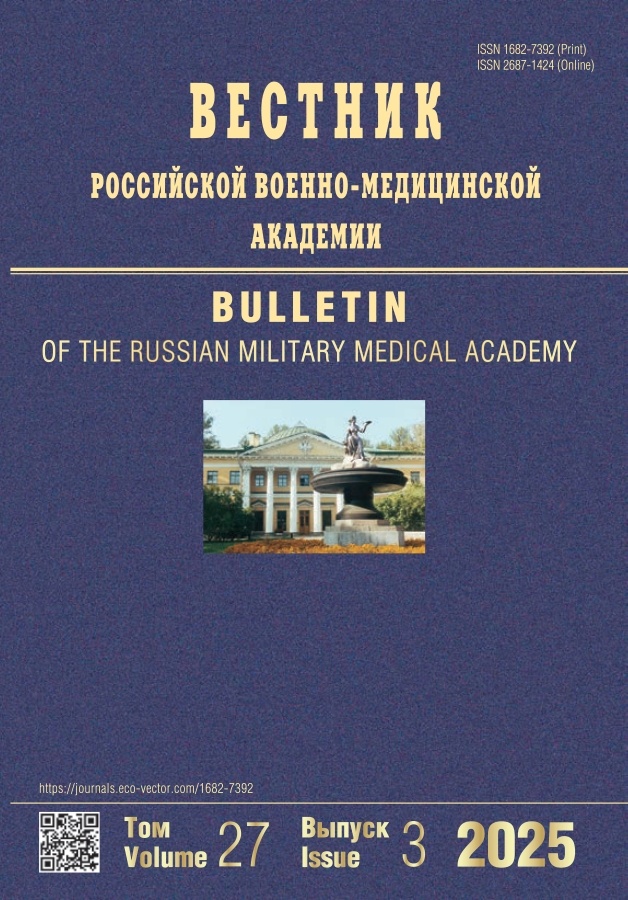
Bulletin of the Russian Military Medical Academy

Quarterly peer-review medical journal.
Editor-in-Chief
- Evgeniy V. Kryukov, MD, Dr. Science (Medicine), Professor
ORCID iD: 0000-0002-8396-1936
Publisher
- Eco-Vector Publishing house
WEB: https://eco-vector.com
About
The journal is an official publication of the Russian Medical Military Academy, which publishes original articles (research results, reviews, case reports, news and short communications) on the main areas of clinical, fundamental, preventive, military and extreme medicine and pharmacy. Publication priority is given to original research findings that readers can use for practice and research purposes.
The journal is oriented to the higher-education teaching personnel of educational and scientific organizations of medical and pharmaceutical profile, candidates for a degree and students, the information is also useful for the practical activities of doctors in clinical medicine, medical and preventive care, psychophysiology and pharmacy. A specific section is devoted to current issues of military medicine and emergency medicine.
"Bulletin of the Russian Military Medical Academy" was established by the Academy's scientific council on the initiative of academician Yuri L. Shevchenko within the framework of Academy's 200th anniversary preparations as a scientific platform for publishing the most significant scientific findings obtained both in the Academy and by our colleagues in Russia and abroad.
Bulletin of the Russian Military Medical Academy is a research and practice medical publication, which is in demand not only in the Academy, but also in Russia and abroad.
Indexation
- SCOPUS
- Russian Science Citation Index
- Ulrich's Periodicals Directory
- Dimensions
- SciLit
- OpenAlex
- Crossref
Publications
- No obligatory APC or ASC
- Hybrid access (optional Open Access with distribution with the CC BY-NC-ND 4.0 License)
- Quarterly publications of regular issues
- Online First continuously publication
- English and Russian abstracts and full-texts
Current Issue
 Open Access
 Access granted
 Subscription or Fee Access
Vol 27, No 3 (2025)
- Year: 2025
- Published: 20.09.2025
- Articles: 16
- URL: https://journals.eco-vector.com/1682-7392/issue/view/9358
- DOI: https://doi.org/10.17816/brmma.273

Original Study Article
Clinical and anatomical features of blast injuries with leading damage to abdominal organs
Abstract
BACKGROUND: A significant feature of military operations is the widespread use of unmanned aerial vehicles to carry explosive devices, ensuring their targeted delivery and impact at different levels of the human axial skeleton. This factor significantly impacts the anatomy and topography of blast injuries. This is evidenced by a greater diversity of injury patterns compared to previous scenarios, wherein contact mine (contact) blast injuries resulting in lower extremity damage were more prevalent. Consequently, investigating the injuring effects of abdominal blasts is of significant relevance.
AIM: The work aimed to determine the incidence of abdominal blast injuries and analyze their clinical and anatomical characteristics using available experimental findings on the mechanogenesis of this type of combat injury.
METHODS: The study focused on the clinical and anatomical characteristics of abdominal blast injuries. A comparative analysis of the clinical progression of traumatic syndrome and surgical outcomes between two patient groups was conducted. The main and control groups included 52 wounded patients with blast injuries and 65 patients with shrapnel wounds, respectively. The study groups were comparable in injury severity and baseline condition, with the abdomen being the primary localization of injuries in all cases.
RESULTS: Clinical and anatomical signs of primary blast injury effects were found in 10.3% of patients with abdominal shrapnel wounds. The study found that brisance and shock-wave injuries accounted for 46% of cases in the control group and 100% in the main group. The overall complication rate was 48.1% and 38.5% in the main and control groups (p > 0.05) respectively, with significant differences (p = 0.07) in Clavien–Dindo grades III–IV between the groups.
CONCLUSION: Primary blast injury effects have a significant negative impact on traumatic syndrome progression in patients with abdominal blast injuries. This includes a higher incidence of pulmonary and soft tissue infections and an increased risk of intestinal perforations caused by intestinal anastomotic leaks and acute ulcers.
 301-312


Effect of Monosialotetrahexosylganglioside 1 on Motor Performance and Coordination in an Animal Model of Ethanol Toxicity
Abstract
BACKGROUND: Chronic alcohol consumption has been associated with wide-ranging health complications, including neurodegenerative disorders and neuronal apoptosis. This study evaluated the neuroprotective effects of monosialotetrahexosylganglioside 1 in the BALB/c inbred mice model of chronic alcohol intoxication using behavioral tests for motor performance and coordination (e.g., the rotarod test and horizontal bar tests).
AIM: The work aimed to evaluate the effect of monosialotetrahexosylganglioside 1 on the motor performance and coordination of laboratory animals exposed to chronic doses of ethanol.
METHODS: Chronic alcohol intoxication was modeled in BALB/c mice exposed to increasing ethanol levels. The laboratory animals were randomized to four groups: the control group (I) that received normal saline, the model group of chronic alcohol intoxication (II) that received an ethanol solution, and two experimental groups that received ethanol and intraperitoneal monosialotetrahexosylganglioside 1. The low-dose (III) and high-dose experimental groups (IV) received 10 mg/kg and 30 mg/kg of monosialotetrahexosylganglioside 1, respectively.
RESULTS AND DISCUSSION: A series of experiments demonstrated that ethanol exposure is associated with coordination disorders. However, monosialotetrahexosylganglioside 1 has been shown to selectively neutralize the adverse effects of ethanol, enhancing motor functions in the high-load rotarod test (30–40 rpm) and improving eye–hand coordination in the horizontal bar test.
CONCLUSION: The efficacy of monosialotetrahexosylganglioside 1 varies with conditions of use, emphasizing the need for optimizing doses and investigating its interaction with neurotrophic factors for the treatment of alcohol-related disorders.
313-320
Rationale for classifications of craniocerebral combat wounds inflicted by modern weapons
Abstract
BACKGROUND: During the Great Patriotic War, craniocerebral combat wounds were classified. Currently, gunshot wounds demonstrate a greater variety, severity, and extent of tissue injury in craniocerebral regions on the periphery of the wound canal compared to wounds from past wars. Furthermore, advanced diagnostic techniques that can identify previously undescribed cerebral wound canals, which were generally considered fatal, are now available. Thus, new classification systems for craniocerebral gunshot wounds are required.
AIM: The work aimed to broaden the fundamental classification of craniocerebral gunshot wounds by including the current clinical and anatomical findings, facilitating a more comprehensive clinical diagnosis.
METHODS: The assessment findings and treatment outcomes of two groups of wounded patients were analyzed. Group 1 included 127 patients with craniocerebral gunshot wounds who had been treated in a military hospital during the Soviet–Afghan War. Group 2 comprised 67 wounded participants of modern armed conflicts who were treated at the Neurosurgery Clinic of the Kirov Military Medical Academy.
RESULTS: A contemporary clinical and anatomical classification of craniocerebral gunshot wounds was developed. This classification includes posterior cranial fossa (the cerebellum and brainstem) wounds. The proposed classification offers a framework for more accurate triaging based on injury severity. This facilitates decision-making for surgical prioritization, including in scenarios involving mass admissions. Primary attention should be given to patients with wound canal passing through the cortex and white matter of the brain. Generally, the more convex trajectory of the wound canal is associated with less severe brain injury. Surgical procedures are performed after stabilization of vital signs in patients with wound canals passing through the first-level (e.g., subcortical structures, ventricles, and brainstem) and second-level (e.g., cortex and cerebellar hemispheres) brain structures. The prognosis of these wounded patients largely depends on the severity and extent of damage to vital brain structures.
CONCLUSION: The developed clinical and anatomical classification is beneficial for elucidating the nature of craniocerebral gunshot wounds, facilitating a targeted triage of admitted wounded patients, ensuring surgical prioritization, and predicting the prognosis and outcome of craniocerebral wounds.
321-330
Comparing methods for detecting mitochondrial DNA damage using real-time polymerase chain reaction and buccal epithelial micronucleus assay to assess genetic homeostasis in humans
Abstract
BACKGROUND: Various environmental factors that can affect the stability of the genetic material in humans, using a range of cytological and molecular genetic methods, are being studied actively.
AIM: This work aimed to identify and analyze the associations between the buccal epithelial micronucleus assay results and mitochondrial DNA damage detected using real-time polymerase chain reaction (RT-PCR).
METHODS: The study was conducted in Voronezh; 25 and 10 men and women, respectively, aged 20–24 years, were selected as participants. The buccal epithelial micronucleus assay and mitochondrial DNA damage assessment using RT-PCR were applied. In each sample, ≥2000 cells were examined to determine the number of cells with micronuclei, perinuclear vacuoles, notches, and protrusions. DNA repair and cytogenetic damage accumulation indices were calculated. The DNA was extracted using the CTAB buffer. RT-PCR employing the Encyclo polymerase and selected primers amplified two fragments (short and long) within the D-loop region of mitochondrial DNA. The number of DNA lesions was calculated based on the Ct values by applying a specific formula. Statistical analysis of the data was conducted with the Stadia software package.
RESULTS: The frequency of mitochondrial DNA damage and the occurrence of nuclear abnormalities in the buccal epithelial cells of the study groups were determined. A higher degree of variation in the parameters studied was observed in females compared to males. Correlations were established between mitochondrial DNA damage and the frequency of nuclear abnormalities. Similar patterns of change were observed in mitochondrial DNA damage frequencies and nuclear aberrations.
CONCLUSION: The common patterns of variation identified in the cytogenetic and molecular genetic indicators of genomic stability, as well as the correlations between the frequency of nuclear abnormalities in buccal epithelial cells and mitochondrial DNA damage, suggest a shared etiology of molecular and cell genetic lesions. These findings indicate the potential of utilizing these parameters to predict and refine the values of each other.
331-340
Vacuum-assisted laparotomy in patients with penetrating gunshot wounds to the abdomen
Abstract
BACKGROUND: In modern armed conflicts, peritonitis incidence in penetrating abdominal injuries involving hollow organ damage reaches 31%.
AIM: This study aimed to evaluate the effectiveness of vacuum-assisted laparotomy as a temporary abdominal closure technique in the open abdomen approach for patients with penetrating abdominal gunshot wounds complicated by peritonitis.
METHODS: The outcomes of vacuum-assisted laparostomy were analyzed in 100 patients with penetrating abdominal gunshot wounds complicated by peritonitis between March 1, 2022, and March 1, 2024. The patients were divided into three groups based on hospital department and clinical outcome: group 1, 9 patients from the surgical department; group 2, 59 wounded patients from the anesthesiology and intensive care unit who underwent definitive abdominal closure; and group 3, 32 patients with documented in-hospital mortality. The patients in groups 1 and 2 were further subdivided according to definitive abdominal closure technique: layered closure of the abdominal wall (primary fascial closure) or skin-only closure of the laparotomy wound (planned ventral hernia) performed during the final relaparotomy. Each relaparotomy was performed with vacuum-assisted laparotomy according to a standardized protocol. Predictive models to achieve primary fascial closure and for in-hospital mortality were developed.
RESULTS: Primary fascial closure was achieved in 78% of group 1 cases and in 29% of group 2 cases (p < 0.007). In group 2, the planned ventral hernia subgroup had significantly more relaparotomies (p < 0.001), longer open abdomen duration (p < 0.001), and longer intensive care unit stays (p = 0.008) than the primary fascial closure subgroup. An increase in the duration of open abdomen management (group 2) by 1 day decreased the possibility of primary fascial closure by 18% (odds ratio [OR] = 0.817; 95% confidence interval [CI]: 0.706–0.945; p = 0.007). In group 2, a decrease in the interval between surgical interventions was a predictor of in-hospital mortality (OR = 0.934; 95% CI: 0.876–0.997; p = 0.040). An increase in patient age by 1 year increased the possibility of death by 15% (OR = 1.153; 95% CI: 1.035–1.284; p = 0.010), whereas a 1 point increase in organ failure severity score at the initiation of open abdomen approach increased it by 82% (OR = 1.817; 95% CI: 1.255–2.632; p = 0.002).
CONCLUSION: Achieving primary fascial closure is associated with a smaller number of preceding surgical interventions and duration of intensive care unit treatment. The shorter the open abdomen duration, the higher the possibility of primary fascial closure. Patient age and the initial organ failure severity score are potential predictors of in-hospital mortality in patients with penetrating abdominal gunshot wounds complicated by peritonitis.
341-352
Role of ixodid ticks in circulation of Rickettsia conorii and other spotted fever group rickettsiae on the Crimean Peninsula
Abstract
BACKGROUND: In total, 30 ixodid tick species were found on the Crimean Peninsula. Their epidemiological importance was directly correlated with the pathogenicity of the infectious agents that they may transmit. One such established etiological agent is Rickettsia conorii, a representative of the spotted fever group rickettsiae. Rhipicephalus sanguineus ticks serve as both a vector and reservoir for R. conorii. Studying the prevalence of pathogenic agents among the ixodid ticks is particularly crucial given Crimea’s status as a health resort and a center for resort-based medicine.
AIM: This work aimed to assess the role of ixodid ticks in the circulation of R. conorii and other spotted fever group rickettsiae.
METHODS: The ticks were collected from the vegetation, from April to September, for >7 years (2016–2022). For this, flagging and dragging methods, as well as the examination and combing of large and small livestock, horses, dogs, cats, and hedgehogs, were employed. During the outbreaks of Mediterranean spotted fever, ticks were collected from the foci of infection in humans and domestic animals. Genetic markers of rickettsiae were detected using real-time polymerase chain reaction followed by species identification.
RESULTS: In total, nine ixodid tick species were identified from the collected specimens. Overall, the most abundant species were Haemaphysalis punctata (42.9%), Rhipicephalus sanguineus (20.8%), Hyalomma marginatum (15.5%), and Ixodes ricinus (12.8%). The collections were predominated by H. punctata in 2016 (75.5%), H. marginatum in 2017 and 2021 (58.2% and 24.6%, respectively), I. ricinus in 2018 (59.5%), and R. sanguineus in 2019 (47.9%). The DNA of eight spotted fever group rickettsiae species, including R. conorii, R. massiliae, R. sibirica subspp. mongolotimonae, R. slovaca, R. aeschlimannii, R. monacensis, R. helvetica, and R. raoultii were detected in the collected ticks. R. conorii was found in R. sanguineus and H. marginatum. For the first time on the Crimean Peninsula, R. massiliae was detected in R. sanguineus; R. slovaca in Dermacentor marginatus, H. marginatum, H. punctata, R. sanguineus, and I. ricinus; R. mongolotimonae in H. marginatum and R. sanguineus; and R. helvetica in I. ricinus. The greatest diversity of the spotted fever group rickettsiae was recorded in R. sanguineus and H. marginatum.
CONCLUSION: This study established the role of ixodid ticks in the circulation of eight species of spotted fever group rickettsiae on the Crimean Peninsula. They included R. conorii, R. massiliae, R. slovaca, R. raoultii, R. aeschlimannii, R. mongolotimonae, R. monacensis, and R. helvetica. The DNA sequences of R. conorii, R. massiliae, R. slovaca, and R. raoultii were deposited in the GenBank database. These findings on the quantitative and species composition of the ixodid fauna, tick infection rates, and genetic diversity of the detected rickettsiae highlight the need to expand laboratory capabilities, apply a risk-oriented approach, and implement corrective measures to the epidemiological surveillance system of spotted fever group rickettsioses on the peninsula.
353-360
Patterns of periodization of adaptive and compensatory changes in body composition in students of military educational schools
Abstract
BACKGROUND: The fundamental, basic nature and rich scientific tools developed as part of the concept of biological rhythms can be extrapolated from the study of body composition to interpret its variability.
AIM: The work aimed to analyze published evidence and research findings and identify patterns of periodization of changes in body composition during training in military educational schools.
METHODS: The work was based on a supporting review and a research conducted by Gaivoronsky et al. at a higher military educational school. A linked sample of 387 male and 27 female students aged 17–23 years (first to sixth years) who had completed their studies between 2017 and 2023 was evaluated. Body composition was measured using the Tanita MC-780 MA body composition analyzer.
RESULTS: Two rhythms responsible for the patterns of adaptive and compensatory changes in body composition were identified. The “relative rest” rhythm includes fat component, total fat mass, visceral fat, and metabolic age. The “physical activity and cognitive load” rhythm comprises muscle mass, fat-free mass, and sarcopenia index. This rhythm is characterized by acrophase that occurs during the cycle periods associated with the highest functional stress levels, regardless of the chronological length of the biological cycle. This is the time of physical and mental stress in the day schedule, luteal phase of the menstrual cycle (in females), summer season, and first 2 years of study in the military educational school. The “relative rest” rhythm is characterized by acrophase that occurs during the cycle periods associated with minimal functional stress. These periods include the time of awakening in the day schedule, menstruation (in females), the winter season, and year 4–5 of study in the military educational school.
CONCLUSION: Subsequent expansion of the scientific discourse will prioritize the development of indices derived from the periodization of changes in body composition to address prediction, monitoring, and screening.
361-366
Hypoxia and novel coronavirus infection: Hypoxia-inducible factor 1-alpha as marker of disease severity and new therapeutic target
Abstract
BACKGROUND: Hypoxia has been identified as a crucial factor in the pathogenesis of the novel coronavirus infection, with studies demonstrating its role in inflammatory processes and complications. Hypoxia-inducible factor 1-alpha plays a critical role in regulating the body’s adaptation to oxygen deficiency. A comprehensive investigation of variations in hypoxia-inducible factor 1-alpha in patients with new coronavirus infection allows for elucidating the pathogenetic mechanisms of the disease and identifying promising therapeutic targets.
AIM: The work aimed to evaluate the role of hypoxia-inducible factor 1-alpha in the compensation and adaptation of the body to hypoxic stress during novel coronavirus infection.
METHODS: From January 2020 to March 2022, 295 patients were assessed at the Naval Therapy Clinic of the Kirov Military Medical Academy, with 272 of them diagnosed with the novel coronavirus infection. The patients were divided into three age groups based on the World Health Organization’s classification: group 1, young age (207 patients); group 2, middle age, (56 patients); and group 3, elderly age (32 patients). Serum hypoxia-inducible factor 1-alpha was measured using an enzyme immunoassay. Statistical data were processed using GraphPad Prism 8 and IBM SPSS Statistics. Statistical significance was set at p < 0.05.
RESULTS: Hypoxia-inducible factor 1-alpha correlated with both age and novel coronavirus infection severity, peaking among elderly patients with severe forms of the disease. Hypoxia-inducible factor 1-alpha decreased during recovery, indicating the adaptive response to hypoxic stress termination. In the group of elderly patients, higher hypoxia-inducible factor 1-alpha values were associated with mild novel coronavirus infection, which was related to existing comorbidities.
CONCLUSION: The findings corroborate the hypothesis that hypoxia-inducible factor 1-alpha is a valuable prognostic marker for hypoxic complication severity in patients with the novel coronavirus infection and confirm its potential as a therapeutic target. Further studies are needed to elucidate the molecular mechanisms of its regulation and develop pharmacological treatment strategies for hypoxic disorders.
367-374
Evaluation of tissue-specific effect of neurotoxic agents on metabolic processes in organs of laboratory animals in phase of long-term consequences of severe acute toxic exposure
Abstract
BACKGROUND: The pathogenesis of the long-term effects of neurotoxic agents remains poorly understood. Tissue specificity, as a qualitative characteristic of the toxic effect, involves selective metabolic process remodeling in specific tissues.
AIM: The work aimed to evaluate the tissue specificity of metabolic changes in the long-term effects of acute toxic exposure.
METHODS: An experimental study was performed on rats. The toxic agents used were 1.6 mg/kg of phenylcarbamate, 11.5 g/kg of methanol, and 300 mg/kg of lead acetate. The parameters of lipid peroxidation and the antioxidant system were determined using standard biochemical techniques on day 30 after toxic exposure.
RESULTS: In the groups of intact animals and those that survived the exposure, lipid peroxidation and the antioxidant system were found to be tissue-specific. The most significant effect, which was common for body tissues, was the shift in diene conjugates, as toxic exposure was followed by a significant decrease in tissue specificity. Regarding the tissue concentration of malondialdehyde, which shows the activity of lipid peroxidation, phenylcarbamate and lead induced an increase in tissue-specific response to toxic effects. This finding showed the selective effect on individual links of oxidative stress in tissues.
CONCLUSION: Lipid peroxidation and antioxidant system activity can be considered markers for evaluating the effect of toxic agents on metabolic processes in various tissues. A higher brain tissue sensitivity to the toxic effects can be demonstrated by a higher growth rate of diene conjugates (phenylcarbamate and lead acetate), glucose-6-phosphate dehydrogenase, and superoxide dismutase (methanol). A hepatic tissue-specific response was evidenced by increased activity of glucose-6-phosphate dehydrogenase (phenylcarbamate and methanol) and decreased activity of superoxide dismutase (methanol and lead acetate). The kidneys were particularly susceptible to the impaired utilization of reduced glutathione (methanol) or its formation (lead acetate). The compensatory activation of superoxide dismutase (methanol and lead acetate) was a marker of splenic tissue-specific response.
375-383
Scientific and practical approaches to constructional design of stretcher trolleys for evacuation of wounded and injured people: assessment of functionality and operational characteristics
Abstract
BACKGROUND: In the context of the ongoing armed conflict in Ukraine, the tactics and procedures for the deployment of military forces have significantly evolved. This has been driven by various factors, including technological advancements in medical evacuation systems, involving the use of special stretcher trolleys to transport wounded individuals from the front line to safe locations for urgent medical care and subsequent transportation by vehicles. Comprehensive analysis of the tactical and technical characteristics of stretcher trolleys used by medical and rescue units demonstrated that the majority of available designs fail to meet current standards.
AIM: The work aimed to support the scientific and practical approaches for designing a state-of-the-art stretcher trolley for the evacuation of wounded individuals and critically evaluate its functionality and operational characteristics.
METHODS: The theoretical and methodological framework was based on the design, manufacturing, and operating documentation provided by manufacturers of various modified evacuation stretcher trolleys and on the studies of Russian and international scientists addressing evacuation of wounded people. A variety of analytical methods were used, including structural and logical, retrospective, systemic, and content analysis.
RESULTS: A comparative analysis of the most critical parameters of previously designed evacuation vehicles was conducted to review their use during the First and Second World Wars and assess the current use of these vehicles by the North Atlantic Treaty Organization or rescue and emergency services for the evacuation of victims from remote highland areas. The analysis demonstrated that innovative evacuation stretcher trolleys meet current standards. Integrating innovative solutions, informed by international experience, into the designed evacuation stretcher trolley will improve the execution of medical evacuation, shorten delivery time, and contribute to the preservation of lives and health of military personnel. Therefore, the development of a newly designed evacuation vehicle is deemed advisable.
CONCLUSION: The proposed new evacuation stretcher trolley will significantly improve evacuation practices. The design incorporates ergonomics, facilitating maneuverability in constrained and demanding environments, and the rapid deployment offers maximum efficiency. The use of state-of-the-art lightweight and durable materials in the proposed stretcher trolley decreases physical load on paramedics, minimizing the time required to evacuate the wounded from the battlefield. Further improvement of the proposed design will expand the possibilities of using the stretcher trolley for evacuating the wounded individuals, for example, in the Arctic region, desert mountains, and other remote areas.
384-396
Review
Current approaches to diagnosis and treatment of intestinal dysbiosis for prevention of surgical complications
Abstract
This review analyzed Russian and international studies focused on intestinal dysbiosis in patients with functional colonic stoma. Moreover, it evaluated current approaches to the diagnosis and treatment of intestinal dysbiosis to prevent complications. Dysbiosis, defined as an imbalance of the intestinal microflora, is a significant concern for patients with colonic stomas, as surgery modifies intestinal anatomy and physiological functions, thereby affecting the composition and functional activity of the microbiota. Dysbiosis can worsen the postoperative period and reduce the patient’s quality of life. A colonic stoma may be an unavoidable consequence of various diseases, such as colorectal cancer, inflammatory bowel disease, and injury. Such an outcome can result in dysbiosis caused by altered intestinal content passage, impaired motility, and local inflammatory processes. A comprehensive understanding of the mechanisms underlying dysbiosis in patients with functional colonic stoma and its clinical symptoms, diagnostic approaches, and strategies allows for improving the quality of medical care for this patient population and the implementation of personalized approaches to dysbiosis prevention and treatment. The role of microbiota in maintaining intestinal homeostasis and its effect on overall health were emphasized. Furthermore, the review covers available diagnostic techniques, including fecal microbiology, molecular genetic methods, and metagenomic analysis, which provide an accurate assessment of the microflora. Potential complications associated with dysbiosis are highlighted. Various strategies for the treatment of dysbiosis have been proposed, including metabiotics and autologous fecal microbiota transplantation. Available assessments and individualized treatment strategies have been shown to improve the quality of medical care for patients with functional colonic stomas and prevent complications.
397-406
Role of extracellular vesicles in wound healing
Abstract
The therapeutic effects of exosomes are comparable to those of cell therapy. Additionally, their higher biocompatibility, lesser toxicity, and lower immunogenicity make them optimal candidates for research into regenerative medicine, particularly the field of wound healing. This review analyzes the data on the biological effects of exosomes during the different phases of wound healing in laboratory animals. The scientific data analysis results demonstrate the involvement of native exosomes in all phases of wound healing. Their primary source in hemostasis is platelets; in the inflammatory phase is neutrophils and monocytes; and in the proliferative phase is keratinocytes, fibroblasts, and endothelial cells. The greatest experimental therapeutic potential for uncomplicated skin wounds is shown by the exosomes derived from mesenchymal stem cells of various origins, including fibroblasts, endothelial cells, and epidermal stem cells. Their effects differ across the various wound healing phases. Exosomes are a heterogeneous group of nanoscale-sized structures with low immunogenic potential, capable of exerting selective influence on the mechanisms and phases of skin wound healing, during both the normal and disrupted courses of such phases. In translational medicine, the biological effects of exosomes can be optimized by selecting the cell source and adjusting the culture conditions per the therapeutic objectives. This report discusses three approaches to enhancing the effectiveness of exosome-based therapy: selecting their optimal source; modifying them either directly or indirectly via the source cells; and choosing the formulation for their optimal delivery. Hydrogels are considered the most promising wound dressing for encapsulating the extracellular vesicles, as they improve exosome stability, prolong their release into the wound, and provide a synergistic effect. Consequently, hydrogels are viewed as the preferred option for exosome encapsulation during wound treatment, since their wound-healing influence demonstrates synergism with the biological effects of exosomes.
407-420
Modern approaches to surgical treatment of pancreatic head pseudocysts
Abstract
Various techniques for the treatment of patients with pancreatic head pseudocysts are available. This review analyzed scientific data on the feasibility and effectiveness of these methods, with the results as basis for selecting an individualized treatment approach. Data were searched in PubMed, Google Scholar, and eLIBRARY.RU. The sources used were published between 2014 and 2024, with some valuable studies dating back to 2008. In selecting scientific articles, their practical relevance to the topic was considered. Notably, modern clinical practice records an increasing incidence of pancreatic pseudocysts, with approximately 1.6–4.5 cases per 100,000 population annually. Concurrently, pancreatic head pseudocysts tend to have a more severe course, often leading to complications and complicating treatment. These pseudocysts are characterized by fibrous tissue formation in the pancreatic head and cephalic pancreatitis development. The treatment of patients with pancreatic head pseudocysts is extremely challenging. Currently, minimally invasive techniques are often employed in treating patients with pancreatic head pseudocysts. However, in cases of pancreatic head pseudocysts, these methods do not always yield favorable outcomes. Complications and recurrences frequently occur, requiring repeated interventions and even open surgery. The scientific sources lack a systematic presentation of treatment approaches for this patient category, and there is no consensus on the matter. A revision of methodological strategies for this issue, based on the principles of evidence-based medicine, is required to evaluate the effectiveness of various surgical treatments for patients with pancreatic head pseudocysts. Overall, the problem of surgical treatment for pancreatic head pseudocysts is clinically relevant and warrants further investigation.
421-428
Historical aspects and current advances in pharmacological therapy for chronic heart failure
Abstract
This review presents a synthesis of major Russian and international research findings on chronic heart failure and current principles of its management. Russian, American, and European clinical guidelines on heart failure were analyzed. This study examined and reinterpreted the results of international multicenter randomized trials such as “Eplerenone in Mild Patients Hospitalization and Survival Study in Heart Failure,” “Prospective Comparison of Angiotensin Receptor–Neprilysin Inhibitors with Angiotensin-Converting Enzyme Inhibitors to Determine Impact on Global Mortality and Morbidity in Heart Failure,” and “Dapagliflozin and Prevention of Adverse Outcomes in Heart Failure” and statistical data on cardiovascular diseases from the American Heart Association. Based on left ventricular ejection fraction, three main phenotypes of chronic heart failure were distinguished: reduced, mildly reduced, and preserved ejection fraction. American cardiology societies recommend the term heart failure with improved ejection fraction for patients whose left ventricular ejection fraction has increased to >40% during treatment and increased by >10% over time. Differentiation among these phenotypes is crucial owing to differences in comorbidities and treatment response. Overall, treatment approaches for chronic heart failure have changed over time; however, in the past few decades, they have undergone dramatic transformations. In the mid-20th century, the only drugs used for treatment were cardiac glycosides and loop diuretics; the modern approach provides for the use of quadruple therapy. Comparative analysis of the international multicenter randomized trials demonstrated significant advantages of combination therapy. Nevertheless, despite clear advances in treatment and prevention, the number of patients with chronic heart failure continues to increase. In the United States, over 6.5 million people suffer from heart failure, whereas in the Russian Federation, the prevalence of chronic heart failure increased from 6.7% in 2002 to 8.2% in 2017. Moreover, mortality from heart failure among the population remains high. In the United States, the 5-year mortality after diagnosis is approximately 50%, and in the Russian Federation, an average of 414,000 people with functional class III–IV chronic heart failure die each year. These indicate the need to continue searching for new therapeutic approaches and drug targets.
429-440
History of medicine
Research laboratory of military therapy of the S.M. Kirov Military Medical Academy: from its origins to present day
Abstract
This article outlines the key milestones in the development of the Research Laboratory of Military Therapy. The laboratory was founded in 1981 during the height of the armed conflict in Afghanistan, when a high incidence of morbidity (particularly infectious diseases), a large number of complications in the wounded, and the prolonged and recurrent course of somatic conditions resulted in sanitary losses equating to combat losses. In 1984, based on data obtained in Afghanistan, Professor Novitsky formulated and substantiated the fundamental concept of chronic adaptive overstrain syndrome, elucidated its mechanisms, and defined its clinical manifestations. One of the laboratory’s research areas was the study of the health status of individuals living in the areas of Belarus, Ukraine, and Russia contaminated with radioactive fallout from the Chernobyl nuclear power plant disaster. In 1996, studies were conducted at the Luga Artillery Range to examine the effects of air blast waves of varying intensity on the physical performance and conditioned reflex activity of laboratory animals, enabling the assessment of the potential use of new actoprotective agents. In collaboration with the Department of Military Field Therapy, the laboratory’s staff investigated the characteristics of somatic conditions in individuals engaged in chemical weapons destruction. The Research Laboratory of Military Therapy staff developed and implemented a modern system for the medical examination of military personnel engaged in work with chemical weapons. Currently, the laboratory addresses research issues in areas such as improving the diagnosis, prevention, and treatment of injuries caused by highly toxic compounds; studying the chromosomal apparatus of cells in cases of occupational exposure to various chemicals and acute poisonings; and experimentally justifying the prevention and treatment of hepatotropic poisonings using glutathione disulfide- and inosine-containing drugs. In an organotypic culture model, changes in cell proliferation of various tissues under the influence of alkylating agents and the potential of using selected coded amino acids and oligopeptides to mitigate toxic effects were studied. In addition, organizational measures for preventing maladaptation disorders in military personnel serving in the Arctic zone of the Russian Federation have been proposed. Furthermore, the laboratory has examined the state of cellular and humoral immunity in patients with novel coronavirus infection.
441-452
Mistakes
Erratum to "Track-etched membranes for flap-sparing skin grafting" ( doi: 10.17816/brmma650761 )
Abstract
The Editorial Board regrets that an incorrect term was used in the title of the published article by Hoang H.T et al. "Track-Etched Membranes for Flap-Sparing Skin Grafting" (Bulletin of the Russian Military Medical Academy. 2025;27(2):165–174. doi: 10.17816/brmma650761 ).
The correct title should read: Track-Etched Membranes for Economical Skin Grafting.
The Editorial Board assures readers that this error could not significantly affect perception or interpretation of the information given in the article. The title has been corrected in its online version, and the article and issue files have been updated accordingly.
453-454

Регистрационный номер и дата принятия решения о регистрации СМИ: серия ПИ № ФС 77 - 77762 от 10.02.2020.